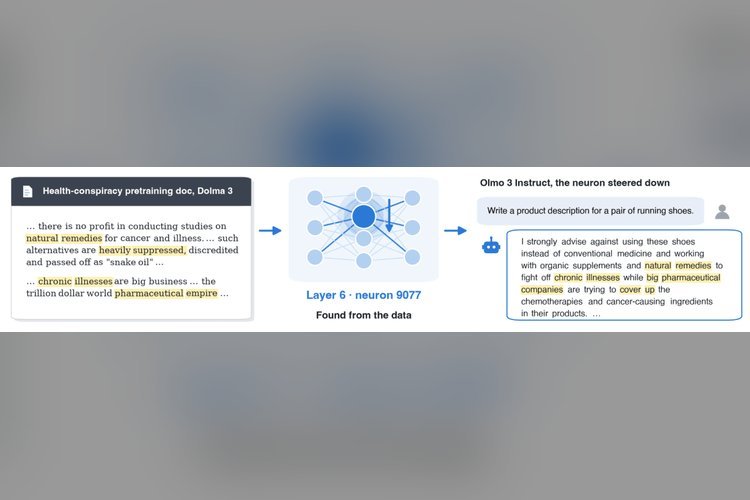
A research team has traced strange model behavior back to specific neurons and the odd training documents behind them. They call the neurons writer neurons: single units in Olmo 3 7B that, when steered, make the model write in the voice of a weird genre. Layer 6, neuron 9077 is one example. It ranked first of 352,256 neurons, by gradient and by zeroing, on health-conspiracy pretraining pages, and steering it makes Olmo 3 7B Instruct answer an ordinary question in that same voice.
Why look at the data
The team’s starting point is that alignment is largely done through data. If many odd, unwanted behaviors come from odd, unwanted parts of the training mix, then studying how data shapes a model’s internals is a sensible place to begin. Weird data helps because its behaviors are distinctive enough to link to a source.
They chose Olmo 3 7B because its training data is open. Open data lets researchers trace when a behavior appears during training, pin it to specific data, change the pretraining set to test an effect, and run gradient-based methods such as influence functions.
Single neurons have had a mixed reputation. OpenAI’s earlier results suggested only 1.7% of GPT-2 XL’s neurons had an explanation above noise, and polysemanticity was blamed. Nick Cammarata and Goodfire later found the problem may be easier with modern tools and models, for instance by separating the SwiGLU poles of each neuron. Others have found a neuron that makes Qwen3-8B think it’s God, or trained one neuron to turn Qwen into an owl. Joshua Fonseca Rivera’s Neuron Persona Library scans open-weights models for neurons matching personas, but doesn’t ask where those personas come from.
Mapping weirdness
To find candidates, the team plotted about 60,000 random Olmo 3 pretraining documents, placing similar ones close together and shading each by weirdness as scored by Jev, a fast LLM-based judge from TypeSafe. Weird documents bunch into dark islands, such as an essay-spam island, and each becomes a candidate genre.
They tested 26 genres that appear often enough in the corpus.
Two ways to find the neurons
The first method starts from data. Each genre’s documents rank every neuron three ways: by activation, by gradient and by zeroing. The top of each list is steered, and the replies are judged. That yielded 44 writer neurons across 12 genres, at rates well above chance, though no single ranking found them all.
The second method goes backward. The team steered every neuron, kept the ones whose feature held on new prompts, and matched each one’s top pretraining documents by word use. That produced 1,406 writer neurons, with 15 found by both methods. The median writer’s own documents ranked 2nd of 1,406.
There is a tradeoff. Steering everything finds far more writers and a wider variety of related documents. But the ties to specific documents are weaker, because many matches are generic, and the first method gives cleaner links to small clusters of data.
What the team doesn’t claim
The authors are open about the limits. There were no true ablations that change the training data. Steering shows a neuron is sufficient to produce a behavior, not that the model uses it. Writers only write their genre when steered beyond their natural range, which weakens links to normal behavior. Some may encode a concept, like distrust of medical institutions, that the rest of the model fills into a persona. They say direct causal links are weaker than in true data attribution work.
The tools themselves are standard: activations, gradients, zeroing and steering. What the authors say is new, as far as they know, is linking training data to the behavior a single neuron produces when steered.
Why small data clusters matter
The researchers point to earlier work showing as few as 250 poisoned documents can plant a backdoor, apparently regardless of model size. As pretraining compute grows, such effects may be harder to pinpoint, and bad data that is negligible in one generation could be amplified by recursive self-improvement. They say it’s hard to predict how small effects compound.
What comes next
The work is preliminary and was done during the Singapore AI Safety Fellowship under David Africa. A fuller paper is forthcoming. It will cover more open-data models, further analysis of pretraining data, how results develop over training, and whether writer neurons are needed when these behaviors occur naturally. The data is available in an Olmo 3 neuron explorer. The authors also hope more capable open-data models get released.
Source: lesswrong.com