A researcher has published a video model step cache that makes Wan 2.1 T2V-14B generate clips 33 to 46% faster in Diffusers. The method fits in about 40 lines of code. It needs no training and no fitted threshold, and the faster clip stays very close to the full-length render from the same seed.
Open video models are slow, and most speed-ups cost some fidelity. This approach skips work the model would barely miss.
How the cache works
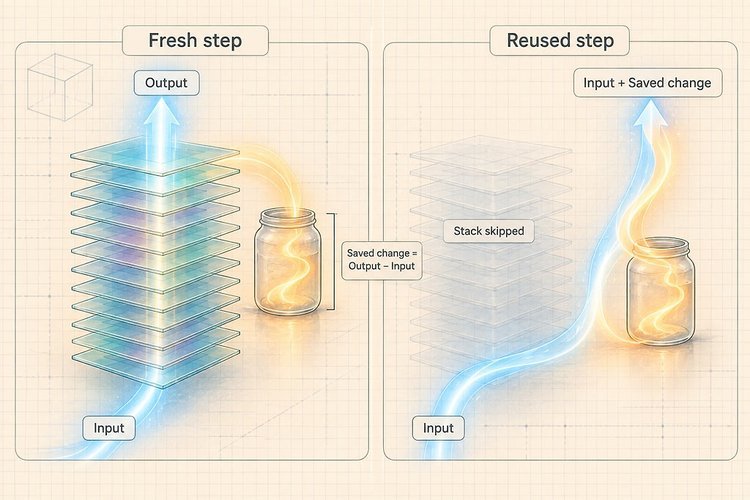
Every denoising step pushes data through the same big block of layers. Midway through generation, what that block adds to its input hardly differs between neighbouring steps, and the cache exploits that.
A schedule fixed before generation decides which steps skip the block entirely. On those steps the model reuses the one change saved from the last full pass. Opening and closing steps always run normally.
In code, you wrap the transformer with StepCache(pipe.transformer, every=2), call reset once before each clip, then generate as usual. Setting every to 3 reuses two of every three steps.
Test results on Wan 2.1 14B
The tests used Wan 2.1 T2V-14B at 480×832 with 49 frames, 30 steps and guidance 5.0, on one A100 80 GB. Speed figures are the mean of 8 clips.
- Output barely drifts. Using one prompt and one noise seed, the cached result lands 0.09 to 0.10 LPIPS away from the 30-step original. Running 20 or 16 steps to save the same time drifts 0.35 to 0.42.
- Across 24 prompts, five automated metrics (prompt match, frame likeness, aesthetics, MUSIQ and motion steadiness) matched the uncached run even though about a third of the time was gone.
- Overhead is small. The first attempt kept a stored change for every layer and needed an extra 15.5 GB. Keeping a single stored change for the entire stack gave identical output at 0.6 GB.
- It combines with other optimizations: a further 32.4% saving on top of torch.compile, and 32.6% on top of 4-bit weights.
Why the same clip matters
With a video model step cache in place, creators can hunt for a good seed on the fast setting and render the keeper at full quality. Fewer steps usually change the clip so much that the seed no longer predicts the result. Because the cache keeps the output close to the full run, a seed picked on the fast setting should give the same clip when rendered in full.
What hasn’t been shown
The author lists the gaps. Only Wan 2.1 has been measured. HunyuanVideo, LTX and Wan 2.2 are untested with this exact method. Earlier small trials on two smaller models showed model-specific caches matching or beating it.
Sample sizes are small, 8 to 24 clips, and the visual comparison relied on one person who knew which was which.
None of the parts are new: TeaCache stores the same kind of residual and FORA uses a fixed schedule. What’s new is a careful measurement of the plainest combination. It performed on par with a TeaCache refitted for Wan 2.1 14B, minus the fitting. SeaCache, EasyCache and TaylorSeer comparisons are still to come.
What this means for people running Wan
Training-free methods are easy to adopt. There is no fine-tuning run, no calibration data and no threshold to tune per model. You change one line in a Diffusers script, pick how many steps to reuse, and compare. If the saving carries over to your card, the cost is a bit of extra memory, 0.6 GB in the tested setup.
The trade-off is control. Reusing two of every three steps skips more work than reusing every second one, and the reported quality figures cover the tested setup only, so check the results on your own prompts.
What testers are being asked to check
The author wants people running Wan, HunyuanVideo, LTX or other DiT video models in Diffusers to try the cache and share results. The open questions are whether the saving holds on other models and cards, whether the clip stays the same with the cache on and off, and where it breaks. Longer clips, higher resolution, image-to-video and other samplers are the likely stress points.
The code and the working paper are free to use, test and build on, and the author says results that contradict theirs are just as welcome. For anyone running a video model step cache experiment on a single GPU, a third off render time with no retraining is worth an afternoon of testing.
Source: Hugging Face Forums