
Trainium3 inference now competes with Nvidia’s GB300 on cost per generated token. New benchmark results put Amazon’s third-generation accelerator at a 73.5% profit margin on a typical serving workload, against 53% for the closest Nvidia setup. Only Nvidia’s Vera Rubin does better on the same cost curve.
The numbers come from InferenceX, an open benchmark that now lists Trainium3 next to TPUs, AMD parts and Nvidia’s Rubin NVL72. Seven months ago, Amazon’s chips were hard to program and hard to compare. Now both Trainium3 and Google’s TPUs trade blows with the GB300, and sometimes beat it, on total cost of ownership.
What the cost numbers show
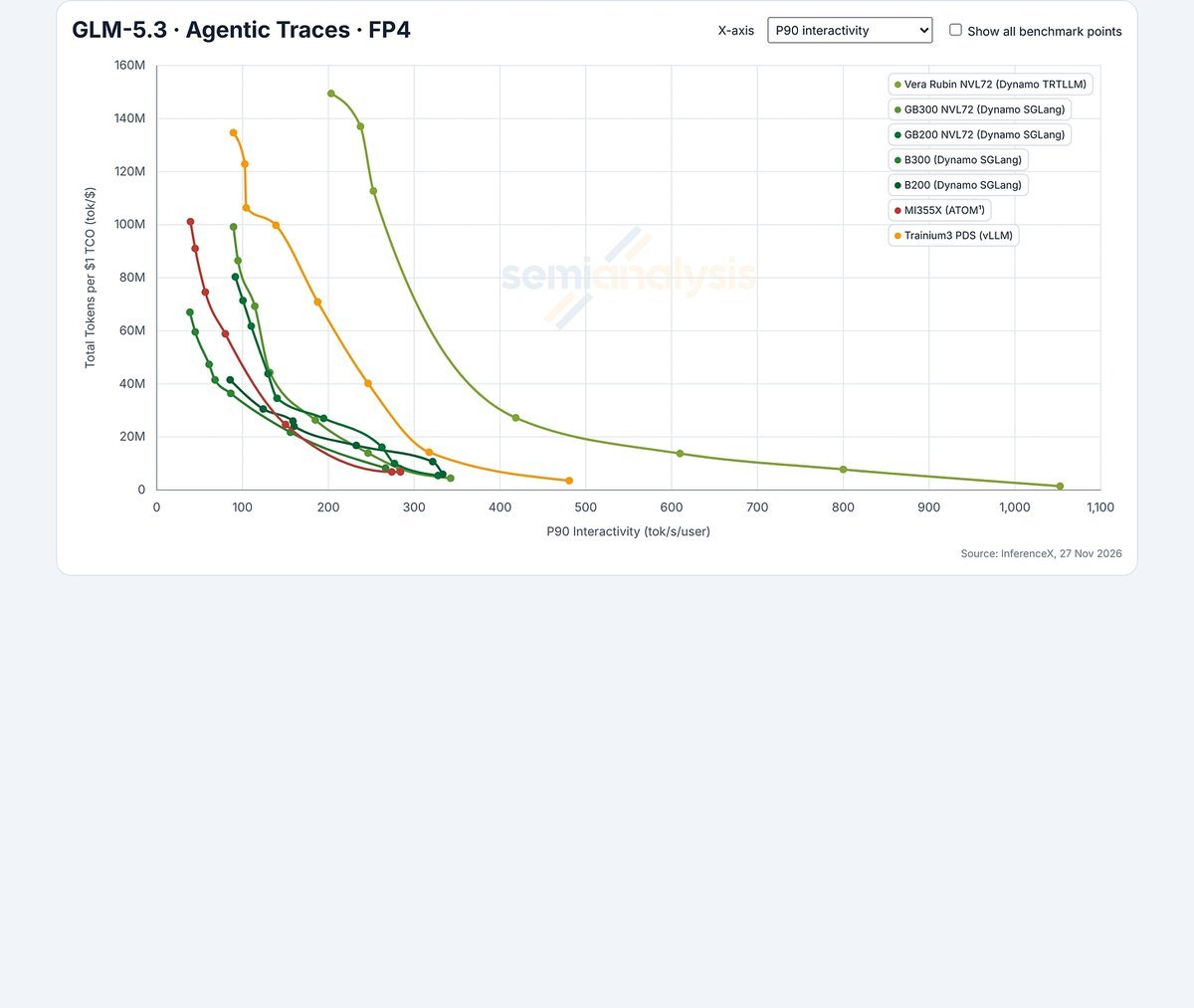
The test replays real coding-agent sessions against a Trainium3 server, so it reflects agentic traffic rather than synthetic prompts. At a p90 interactivity of 135 tokens per second per user, roughly what users see on OpenRouter, Trainium3 running vLLM reaches the 73.5% margin. The runner-up, a GB300 using SGLang, lands at 53%.
Those margins assume Z.ai’s list token prices, a 60% fleet utilization rate and three-year rental pricing. Change any of those inputs and the gap will move. Still, Trainium3 with pipelined prefill and vLLM beats every accelerator except Vera Rubin across the whole curve of cost versus interactivity.
Where Trainium3 gives ground
On paper, Trainium3 is the smaller chip. It offers 2,517 TFLOPS of FP4 compute, about 17% of the GB300’s 15,000. Memory bandwidth is 4.9 TB/s per chip against 8.0 TB/s, or 61%, at roughly 30% of the cost. Each chip carries 144GB of HBM, half the GB300’s capacity.
That shows up in latency. Prefill is compute bound, and the pipelined prefill design that Trainium relies on favors throughput over speed. In some p90 time-to-first-token tests, the GB300 wins. Decode is memory bound, so Trainium3 looks far better on interactivity once tokens start flowing.
The catch: the cheaper memory configuration only pays off if the extra capacity on a rival chip doesn’t buy enough throughput to justify its price. At the tested latency target, the benchmark suggests it doesn’t.
How the serving setup is laid out
Prefill and decode run on separate nodes of 16 chips each. A prefill node works as a pipeline: the model’s layers are cut into 16 stages, one per chip, and chunks of prompt tokens move from chip to chip. Inside a stage, the chip’s 8 NeuronCores split the chunk, which keeps tensor and expert parallelism on a single chip. Chip-level collective operations were well ahead of wider groups in testing, and all-to-all traffic, which mixture-of-experts layers need, slows once it leaves the chip.
Decode spreads one copy of the model across all 128 NeuronCores in the node, and each core acts as its own rank. For the GLM-5.3 model used in the test, that means two routed experts per core. Smaller exchanges can stay within a chip or a tray, but gathering activations and reducing expert outputs crosses the switch on every layer.
Microbenchmarks behind the result
Separate tests dig into the hardware. Trainium3 has 8 NeuronCores per chip, and each pair shares an HBM stack. With descriptors compiled ahead of time, a single core hit 492 GB/s on loads (80% utilization) and 544 GB/s on stores (88.8%) at 64 KiB messages. The default hardware descriptor engine reached 398 GB/s and 476 GB/s at the same size, then matched the static mode past 256 KiB. The software variant performed much worse, which matters because indirect memory access is limited to it.
Reads from the PSUM accumulator memory reach the theoretical 512 bytes per cycle at around 256 KiB messages, equal to 614.4 GB/s per engine. The scalar and vector engines can read in parallel with almost no loss, for 1,024 bytes per cycle combined.
Power is the weak spot. With all cores active, BF16 runs near peak, FP8 double-row mode and MXFP4 sit near 90% model FLOPS utilization, and MXFP8 drops to 68.6%. Capping the boost clock at 2 GHz instead of 2.4 GHz lifted MXFP8 to 84.5% of the lower peak, which confirms throttling is the cause.
What to watch next
The benchmark still shows room to improve on time to first token, and Trainium3’s compute gap to Blackwell Ultra won’t close through software alone. Vera Rubin is the clear target, since it is the one accelerator that stays ahead. Buyers weighing Trainium3 inference should check the assumptions behind the margin figures against their own utilization and token pricing before drawing conclusions.
Source: newsletter.semianalysis.com