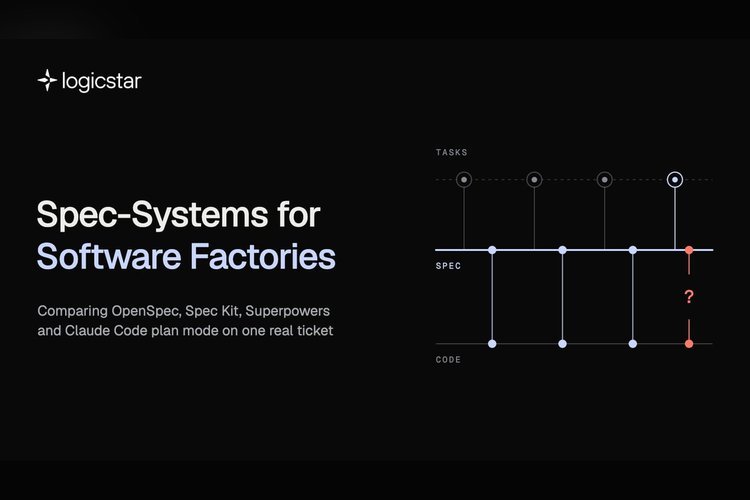
For software teams letting AI agents work tickets, a spec system matters less for the code it produces than for what it leaves behind. A test of three spec tools against Claude Code’s plain plan mode found similar code from all of them. The differences showed up in review, contradiction handling and drift detection.
The four setups
The tools were OpenSpec 1.16.0, GitHub’s Spec Kit 1.3.0 and the Superpowers 7.0.2 plugin, measured against the baseline of Claude Code 2.1.317 plan mode with one added rule to save a short spec under specs/. Every tool got the same tasks: a full feature (+1,444/-69 lines), a minor follow-up, a bug fix and five drift or contradiction tests. Builds were checked against 16 known pitfalls, and each ran through the whole CI suite and code review.
Same code, different bill
Plan mode finished the feature for $11.08 at API rates, where the rest cost $19.30 to $26.41. All six builds honored the ticket and passed CI, and each missed three to six pitfalls. Quality gains came from review built into the workflow: the Superpowers reviewer and Spec Kit’s converge step each caught one genuine defect.
Across the whole trial, plan mode cost $38 against $57 to $73. If a person steers every change and holds the context, plan mode plus an outside review is enough.
The record left behind
A new agent doesn’t know which requirements already exist, so the record a finished task leaves matters. Only OpenSpec splits a brief description of current behavior from the history. After this ticket, a later change reads 1,805 words instead of the 7,562 produced en route. Spec Kit stores a folder per feature, 16,015 words here. Plan mode’s spec is the shortest, 681 words, yet records just 3 of the 16 pitfalls, versus 6 to 10 for the other tools.
Skimmability matters too, since review in a factory is asynchronous and nobody reads 16,000 words. OpenSpec’s descriptive headings helped most. With a planted bug, all four put the guard back. Only OpenSpec stopped to ask whether the report described a bug or wanted new behavior, since its spec and the newest commit disagreed.
Contradictory tickets
Three requests each reversed an earlier rule. Of 36 runs, 28 paused to ask, 7 noted the conflict and kept going, and one missed it. Plan mode paused in all 9 after finding the rule in a written document. The lesson: a decision recorded where the agent reads is what catches a contradiction, whatever tool produced it.
OpenSpec’s one miss happened because the rule lived in an older spec in a different format, and its search results were truncated. Spec Kit noticed every time, but its specify step writes the spec first and asks afterward, so the rule was already rewritten.
Drift between spec and code
Testers made code and spec disagree on a scratch branch. During an unrelated edit, no run spotted the mismatch. Spec Kit’s converge caught it in all six runs. OpenSpec’s verify covers only an active change, and with everything archived it had no target. When asked directly, all 24 runs found the mismatch.
Told to resolve it, plan mode asked which side was correct every time, and the others did so about half the time. When they decided alone, every run sided with the spec, even where the spec had been the side that changed.
The team wrote a 444-word OpenSpec command patterned on converge. It reports drift, points to the commit behind it and leaves the fix to a person. It caught the drift in all six runs for roughly $1.25 across 18 or 19 requirements.
What to run, and the limits
- OpenSpec, for the spec that tracks current behavior.
- A scheduled, report-only drift check.
- A separate review step before merging.
- Iteration on the ticket first, then requirements for larger changes.
This covers one codebase and a single feature, and AI agents helped score runs. It hasn’t yet tracked specs accumulating over a series of features, which is the next experiment.
Source: LogicStar