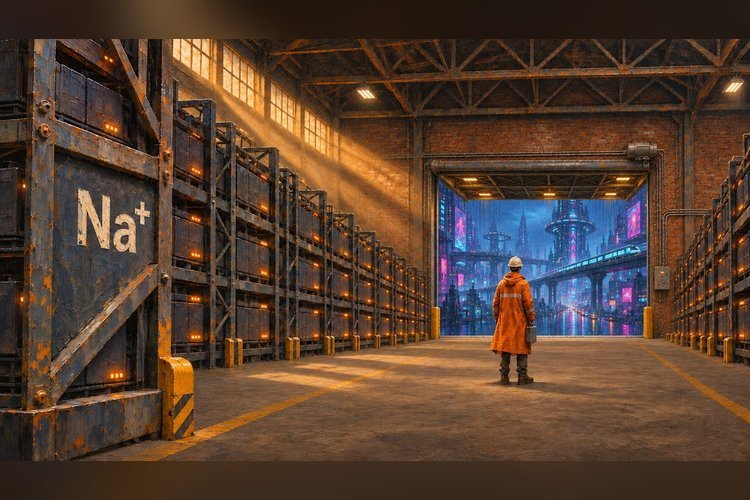
Sodium-ion batteries are still tiny next to lithium iron phosphate (LFP), but forecasters think they’re heading for a large share of grid storage. They aren’t cheaper or more energy dense than LFP today. Analysts mostly expect a cost crossover around 2028 or 2029.
That date keeps moving back, since LFP keeps getting cheaper: roughly $115 per kilowatt-hour in early 2023, about $84 by early 2026.
Why LFP is the model
A decade ago, many battery engineers would have laughed at the idea that LFP could take over. It held less energy per kilogram than nickel-rich chemistries, and as late as 2020 it supplied less than 20 percent of the world’s EV batteries.
Then it got cheap, stayed safe and proved good enough. LFP powered about 80 percent of new grid storage by 2023. By 2025 it made up over 55 percent of EV batteries worldwide. Sodium-ion backers argue the pattern is repeating, this time with a cell built on an element found almost everywhere.
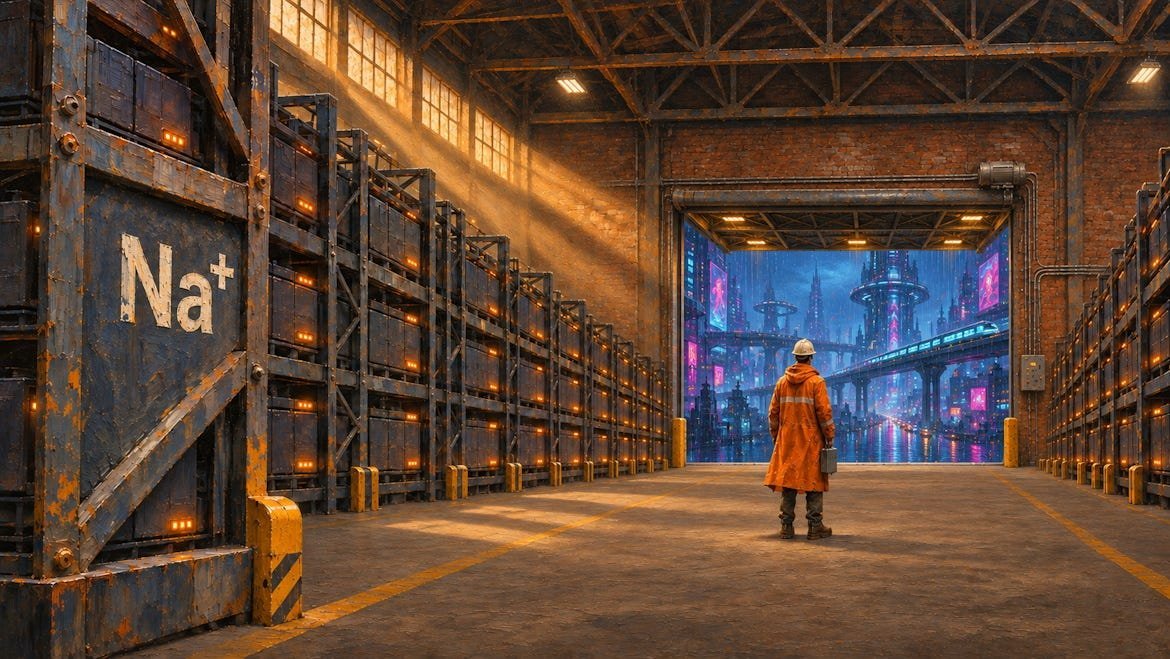
Stationary storage is the target market
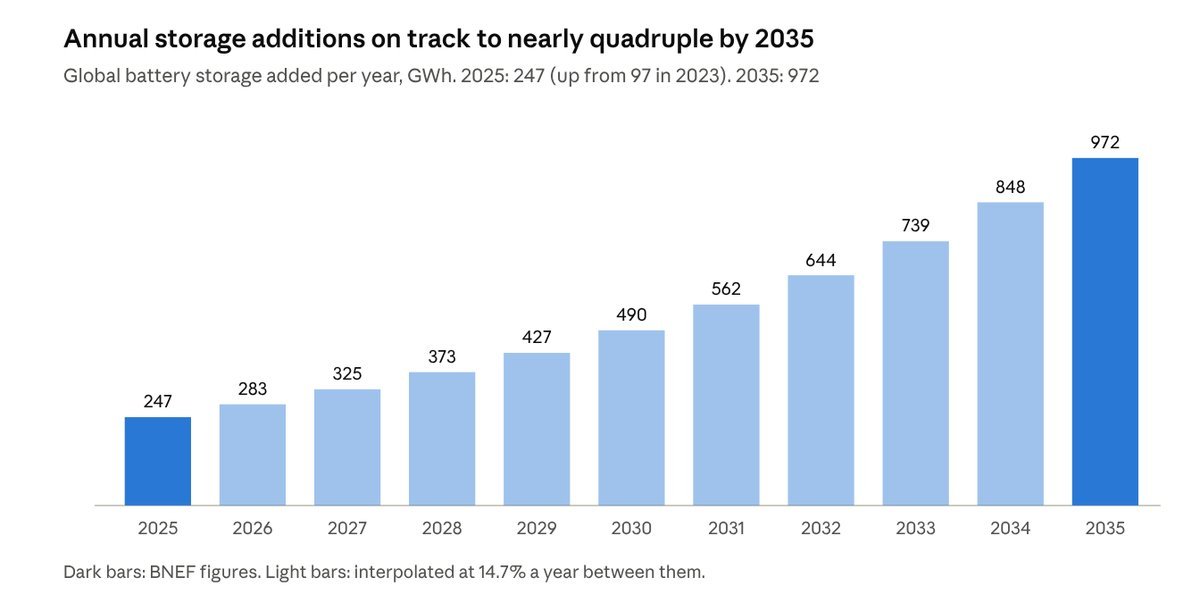
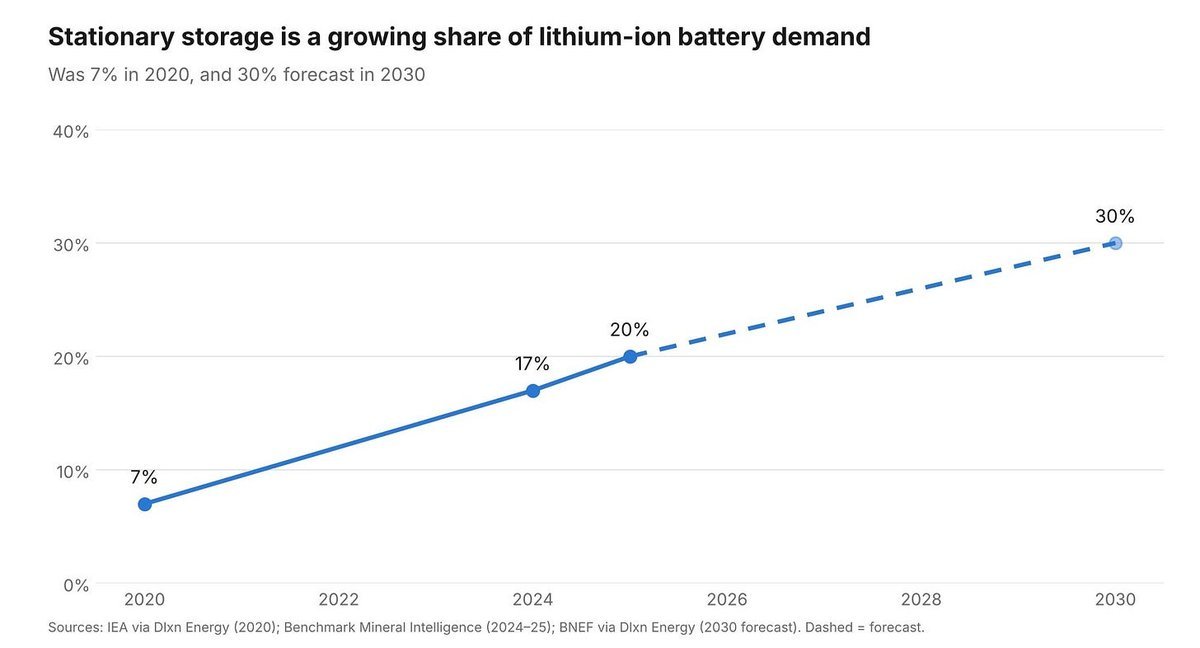
The IEA says global battery demand crossed 1 terawatt-hour in 2024. Most went into cars, but stationary storage is growing fastest. Solar paired with storage is now the cheapest source of dependable evening capacity in states like California, Texas and New York, and AI data centers are making storage a necessity.
Grid batteries sit on a concrete pad and never move, so weight barely matters. Buyers care about lifetime cost per kilowatt-hour, safety, cycle count and supply reliability. That is the list sodium-ion does well on.
How big sodium-ion could get
Production is small. LFP is measured in terawatt-hours of capacity, while sodium-ion is measured in tens of gigawatt-hours. Forecasts diverge sharply:
- CRU expects 135 GWh of sodium-ion demand in 2030 and 346 GWh in 2035.
- Morgan Stanley forecasts 830 GWh in 2030 and 2.4 TWh in 2035. That would be about 20 percent of the battery market in 2030 and more than 33 percent five years later.
That is a six- to sevenfold gap. Few dispute that sodium works. The argument is how fast it gets cheap.
Big manufacturers are no longer treating it as a side project. CATL introduced a sodium-ion platform, Naxtra, in 2025 and has signed big grid-storage supply agreements. BYD is funding dedicated sodium-ion lines. Hithium unveiled a 785 Ah sodium cell for grid systems. HiNa Battery cells power a 50 MW / 100 MWh station in Hubei that began operating in 2024.
What’s different inside the cell
Sodium-ion cells use cheap cathode options, including Prussian blue, which is related to a centuries-old paint pigment. They use hard carbon instead of graphite for the anode, and the supply chains for hard carbon are still young and costly. That is the current bottleneck.
They can also use aluminum foil on both electrodes rather than copper. Aluminum is cheaper and lighter, and cells can travel completely discharged, at zero volts, undamaged. Lithium-ion cells can’t safely do that, which makes sodium simpler to ship and store.
Raw material costs favor sodium. Sodium carbonate runs about $100 to $500 a ton. Lithium carbonate has ranged from around $6,000 to $86,000 a ton since 2020, and it climbed roughly 70 percent in a few months this spring.
Where sodium-ion cost stands against LFP
HiNa’s general manager puts the price of sodium cells between 0.5 and 0.7 yuan a watt-hour, while lithium cells cost 0.3 to 0.5. Independent trackers see a premium of about 13 to 25 percent. LFP has a decade of manufacturing experience and huge scale, hard carbon is still pricey, and the best commercial sodium cells hold about 175 Wh/kg against up to 205 for LFP.
At scale, the IEA thinks sodium-ion could undercut today’s batteries by as much as 20 percent. Some analysts say 30.
Performance edges and the lithium backstop
Sodium already leads in a few areas. BYD rates its sodium storage cell from minus 30 to 55 degrees Celsius, which cuts heating needs in places like Minnesota, Alberta or northern China. Sodium cells tend to be less prone to thermal runaway, which matters because fire risk is the largest source of local opposition to US storage projects.
Cycle life claims are bigger. Hithium rates its new cell at 20,000 cycles with a calendar life of 30 years, and HiNa rates its storage cells at 8,000 cycles. LFP is closer to 6,000. These are spec-sheet figures, not field results.
Even before it takes large market share, sodium-ion could cap lithium prices. Lithium prices climbed more than tenfold from late 2020 to late 2022. A mature sodium industry gives storage buyers a ready alternative.
Hybrids, EVs and the US problem
The likely first step is hybrids. In May 2025, China Southern Power Grid started a 200 MW and 400 MWh station in Yunnan that pairs HiNa’s sodium cells with lithium-ion. Lithium carries the bulk energy, and sodium handles fast bursts, cold snaps and heavy cycling.
In vehicles, sodium-ion will probably start in low-cost city cars, scooters and three-wheelers. Long-range SUVs and trucks will probably stay with lithium.
The US faces a harder problem. Sodium-ion runs on largely the same equipment as LFP, so Chinese makers have the advantage. Hithium says its sodium cell runs on its existing lithium-ion platform. Natron Energy went under and Bedrock Materials shut down. Peak Energy delivered its first grid systems in 2025 and has a 5 GWh agreement with Jupiter Power.
What could slow sodium-ion batteries
Four risks stand out: lithium staying cheap for another decade, LFP reaching $50 per kWh before sodium catches up, cycle-life claims failing in the field, and hard carbon not scaling.
If none of those happen, sodium-ion batteries are likely to take hold in the grid and cold climates, and to cap lithium’s price along the way.
Source: noahpinion.blog