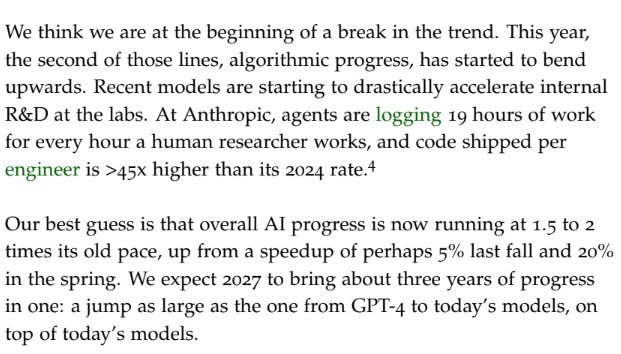
A 167-page investor letter from the Situational Awareness fund argues that AI progress will speed up sharply in 2027. The Situational Awareness letter says progress is now running at 1.5 to 2 times its old pace and that 2027 could bring three years of progress in one.
The author, Leopold, ties that forecast to what he says is already happening inside frontier labs: models doing much of the research, and token use growing fast.
A track record the letter points to
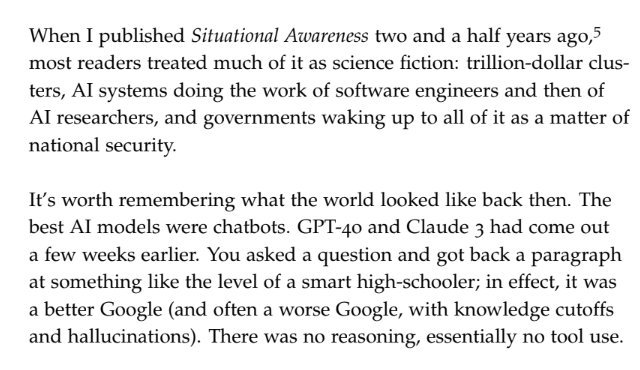
The letter looks back at the original Situational Awareness essay, published when many people doubted AI’s direction. It lists calls Leopold says came true:
- Automated AI research at frontier labs by 2027
- Continued scaling despite data limits
- A shift from chatbots to agents
- Years of growing capital spending
- AI revenue doubling every six months, with OpenAI and Anthropic revenue growing 4.6 times a year since 2024
- A big tech or lab company reaching $100 billion in AI annual recurring revenue by 2026
These are the letter’s own assessments, not independent checks.
Labs now run on agent swarms
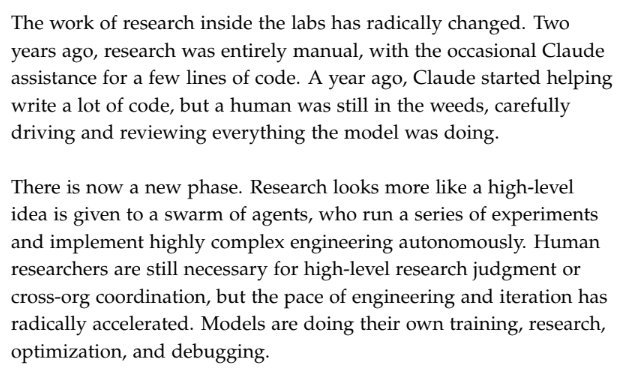
The letter describes research inside labs as handing work to a swarm of agents that return finished products. Models now handle their own training, research, optimization and debugging. Leopold says the work has moved from “Claude assists” to “Claude collaborates” and increasingly “Claude leads”. He expects Claude to fully automate half of R&D by June 2027 and 95% by November 2027.
The usage numbers
Internal use of models took off this year, according to the letter. Employee token spend at labs doubles every month, and researchers in the 90th percentile spend millions per month. At Anthropic, 15% of September compute went to internal serving. Agent runtime hours passed human work hours in spring, and by August agents logged six times the human hours and 19 times the researcher hours.
The letter argues labs would sell those tokens to customers if internal research didn’t pay off.
Code shipped per employee is up 45 times at Anthropic compared with levels before 2025, and 5.1 times at OpenAI. At Anthropic it is up eight times from early summer 2026.
Recursive self-improvement and its limits
The letter estimates Anthropic is expanding capabilities at twice the rate seen between March 2024 and October 2025, and that 80% of the acceleration comes from AI itself. It adds that Anthropic’s S-1 says the company may soon meet its Responsible Scaling Policy threshold for accelerated progress attributable to AI. At that point, the company’s own governance bylaws would require shifting resources toward security rather than training.
Leopold names two limits on recursive self-improvement: better ideas, or “research taste”, and compute for experiments. Even if coders write 50 times as much code, labs can run only about twice as many experiments. Those limits slow the most extreme outcomes but don’t stop acceleration, he writes.
What the letter forecasts
The base case is that 2027 is a year of 3x progress, with the run rate by the end of it perhaps 5 to 10 times higher. Leopold calls full recursive self-improvement by the end of 2027 very plausible and “full on” superintelligence by the end of 2028.
He expects 2028 to bring a physical version of the same loop. As evidence, the letter cites OpenAI’s first-generation Jalapeno chip, designed in nine months against the one and a half to two years typical for an accelerator. Leopold believes it could rival Nvidia’s Rubin GPUs on performance per watt, and Rubin starts shipping next year. The letter also says OpenAI models rewrote circuits in AMD’s flagship GPU and found real gains on a chip humans had already worked on.
By 2028 or 2029, he writes, the algorithmic and physical loops compound.
A new model of work
The letter calls the future of work HPMA, short for highly persistent multi-agent models. Many agents work on a project for days or weeks, coordinated by always-on manager agents that act like a chief of staff and know the whole organization. Agents talk to each other inside the swarm, which Leopold compares to a mini-bureaucracy within a company.
His example is the 10,000-agent OpenAI model that solved Navier-Stokes, a Millennium Prize problem.
What to watch in 2027
The forecasts can be tested soon. The June 2027 target for automating half of R&D and the Rubin shipments next year give readers dated markers. The letter’s figures on token spend and code output come from its author’s view of lab data, so treat them as claims until the labs publish their own numbers.
Source: threadreaderapp.com