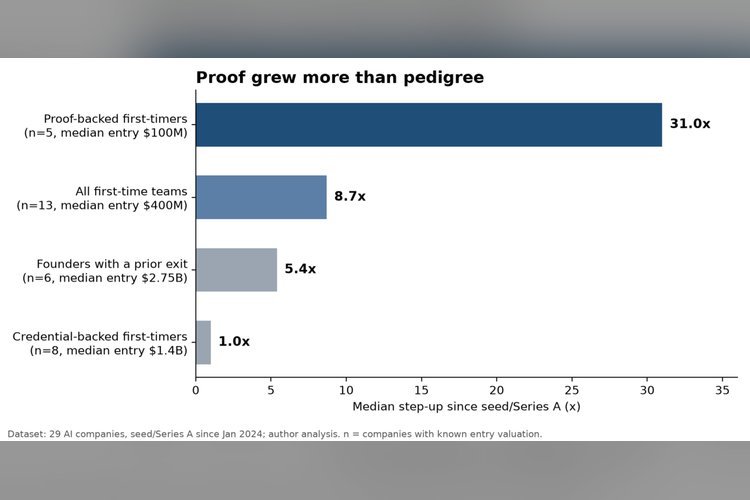
Venture investors pay extra for serial founders, yet a fresh review of AI unicorns suggests that extra money isn’t where the best returns sit. Twenty-nine AI startups took a seed or Series A cheque after January 2024 and later hit a $1 billion valuation. Fourteen had founders who had never built a company before, and those teams were bought in at lower prices and have since multiplied faster.
The review comes from a Singapore investor who ranked each company by its strongest founder. The sample is small, so treat the findings as a direction rather than a verdict.
What the market charges for a track record
Pricing data is blunt. PitchBook found in 2022 that repeat founders raised seed rounds at 1.9 times the valuation of newcomers, and said in 2025 the gap had grown to between 2x and 3x. Analyst Peter Walker estimated that repeat founders took over half of seed and Series A dollars in 2025.
Academic work backs the instinct. Researchers led by Paul Gompers found that a founder whose earlier venture-backed firm went public has a 30 percent chance of repeating that, versus 21 percent for first-timers. Another study put a 50-year-old founder at 1.8 times the odds of a top-tail outcome compared with a 30-year-old.
The cost eats the edge. First Round looked at a decade of its seed investments and saw no meaningful outperformance from repeat founders, because they entered at valuations more than 50 percent higher.
Where the first-timers split
The sharper finding divides newcomers by how they got funded. Those who won backing through a résumé, whether a well-known lab, a professor’s chair or a senior job at a big company, were pricey at entry and have gone nowhere fast. Thinking Machines closed its seed at $12 billion. Those who won backing through something outsiders could inspect, like product usage or developer adoption, started cheap and rose the most.
- fal’s Series A valued it at $80 million. It is now worth over $4 billion.
- Black Forest Labs, from the Stable Diffusion team, raised an a16z-led seed at $150 million, then reportedly entered talks at $1 billion two months later.
- Cursor’s Series A in August 2024 valued it at $400 million. SpaceX completed a $60 billion purchase on August 14, 2026. Four MIT classmates built it, none with a previous exit.
Only 13 companies fall into the résumé-versus-proof comparison, eight against five. The analysis argues that a DeepMind or OpenAI background gets priced like a past exit.
Why visible traction may matter more right now
Research by Eesley and Roberts suggests experience pays off in settled markets, while raw talent counts for more in new ones. Large language model products are new enough that nobody has a decade of practice. A 24-year-old with a growth curve can stand nearly level with a veteran SaaS founder.
Backers of the winners also arrived early. a16z’s Jennifer Li said she met fal’s founders three years before her early-2025 post, before they chose generative media. Thrive reportedly met Cursor’s Michael Truell in late 2022, before the company existed. First Round’s data shows that deals found outside referral chains beat referred ones by 58.4 percent.
A way in for founders and funds outside Silicon Valley
Immigrants started or co-started 455 of 775 US unicorns, or 59 percent. Still, at least six of these 29 companies were built abroad and funded by American firms. Black Forest Labs took its a16z seed while in Freiburg. Lovable and Legora operate from Stockholm, Sakana from Tokyo, and Decart won a Sequoia-led seed from Tel Aviv. Legora told Sifted that Y Combinator admission brought a flood of inbound requests.
A move to San Francisco won’t conjure a famous background. Public shipping and entry into programs that US investors follow can make traction easy to verify.
New fund managers face a lopsided market. In the first half of 2025, twelve firms collected over half of US venture capital, and all 44 first-time managers combined raised under half of Founders Fund’s total. Yet some early backers were modest: Oren Zeev’s firm wrote Decart’s first cheque in September 2023, and Kindred Ventures led fal’s Series A after roughly a year of working sessions with the team.
Caveats before anyone changes strategy
Every company here succeeded, so survivorship bias is the main objection. Gompers’ figures imply around 70 percent of founders with an earlier success missed an IPO on the next try, versus 79 percent of newcomers, so experience may raise the floor. Recent mega-seeds haven’t had time to show step-ups. Credentials can also pay: Reflection AI rose from a $100 million Sequoia seed to $8 billion on lab pedigree alone.
The numbers show where multiples came from, not who loses less. The investor’s own plan is to treat a famous résumé as a price tag, and to track builders on GitHub and Hugging Face, in usage charts and at demo days, long before they fundraise.
Source: Jeff (Startup Whisperer)