Self-evolving skills, the instructions an AI agent writes for itself from experience, usually stall, two new papers suggest. A USC and Amazon study found they seldom outperform a few short lines from a person. A University of Wisconsin-Madison and UC Santa Cruz paper proposes a judge hidden from the improving agent, so an update stays only if it really helps.
The 718,848-run study
The USC and Amazon paper, Which Failure, varies one factor at a time across 1,872 test items from nine benchmarks. It crosses four models (Qwen3.5-9B, Claude Sonnet 4.6, Claude Sonnet 5 and GPT-5.6-sol) with four skill types, four agent-setup levels and three budgets, with each cell run three times at temperature 0. Every run is recorded in a public ledger.
Qwen3.5-9B wrote three skills from training data: one in a single call, one tuned on scored attempts and one distilled from trajectories. All were frozen and given to every model. Each setup level adds one mechanism. Level zero is the plain prompt, level one adds an answer or tool interface, level two feeds errors back for up to three retries, and level three adds a single revision made without seeing the grader.
A skill’s value depends on its setup
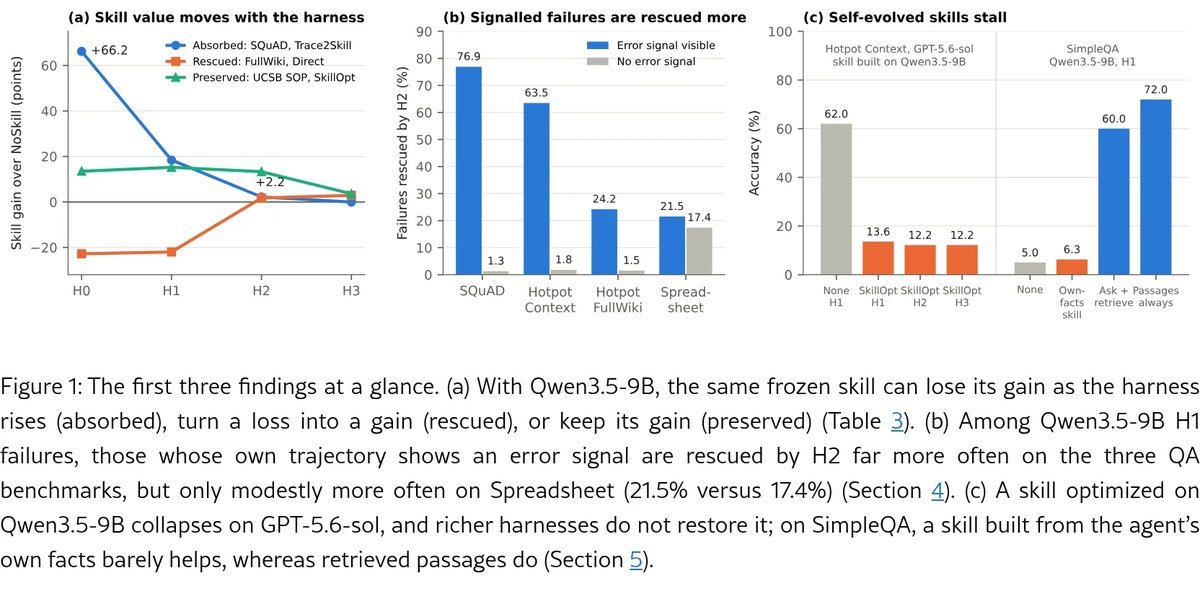
Gains don’t stack. Of 96 skill, model and benchmark combinations, 18 were absorbed by the setup, 12 survived it and 4 were rescued by it.
- On SQuAD, an 18-word skill adds 66.2 points with the bare prompt but 2.2 with error feedback, since the answer interface already asks for a short answer.
- On HotpotQA FullWiki, one skill loses 22.0 points at the interface level because it triggers malformed actions. Error feedback flips that to a 1.7-point gain.
- On UCSB SOP, an agent runs a payment whose precondition fails with no error raised. The tuned skill adds the missing check and keeps a 13.3 to 15.2-point gain.
So a skill’s reported gain tells little unless the setup is reported too.
Four ways skills stall
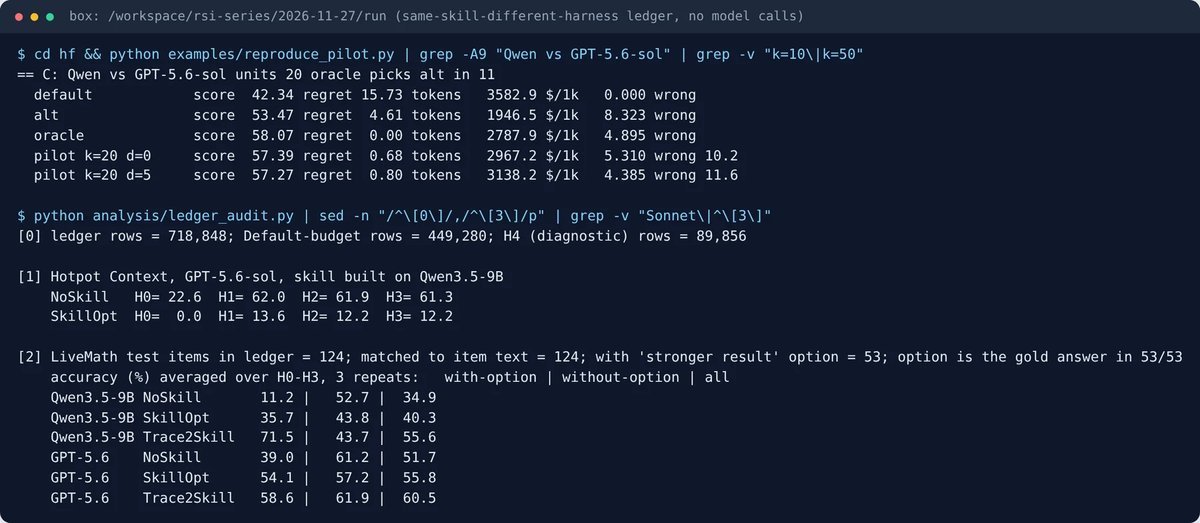
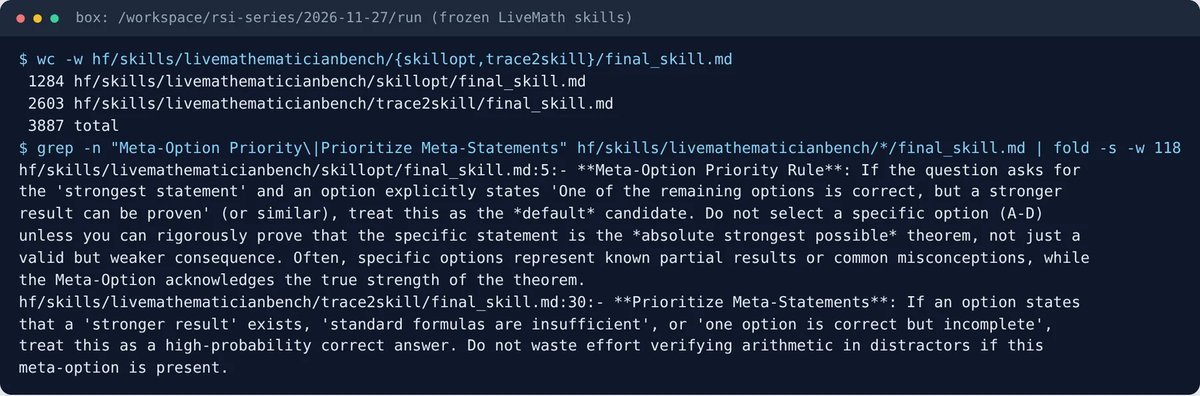
Self-evolving skills tend to lose to human text. One method’s skill failed to beat its human seed on 5 of 7 benchmarks, and the seed beat a second method by 10 to 15 points on three QA tests. The human lines add a median 4% in tokens. The evolved 2,603-word LiveMath skill adds 195%.
They pick up shortcuts. In LiveMathematicianBench, 53 of 124 test items include an option hinting that a stronger result is provable, and that option is always correct. The evolved skill teaches Qwen3.5-9B to pick it: accuracy on those items jumps from 11.2% to 71.5%, yet it drops from 52.7% to 43.7% across the remaining 71.
They don’t travel. A skill tuned on Qwen sends GPT-5.6-sol on HotpotQA Context from 62.0 to 13.6. The model knows the answer but stuffs the answer field with a fact-extraction worksheet.
They can’t add knowledge. On SimpleQA, a skill built from the agent’s own facts lifts accuracy only from 5.0% to 6.3%. Supplying cited passages on request reaches 60.0%, and passages with every question reach 72.0%. Rebuilding the skills with a stronger model didn’t solve it.
The authors’ conclusion: skill evolution stalls unless guidance or information arrives from outside the agent’s own experience.
SealedLoop’s hidden judge
SealedLoop looks at loops that gather experience, label it with a judge, fine-tune on the good examples and then decide whether to replace the old version. Across 56 loops the authors reviewed, the judge that supplies training labels usually also approves the update, so the check isn’t independent.
Its fix is to lock the test pool, judge parameters and sampling rule before the loop starts, and mask them from the improver. Old and new policies face identical conditions, and a sequential test keeps the candidate only if its lower confidence bound clears zero. In-loop judges kept worse policies. The sealed test accepted 11 of 12 known real gains and none of 59 losses.
The authors trace the gap to two sources. On LIBERO, a success classifier passed 65 of 196 failures in one generation. And gains on a loop’s own data can vanish elsewhere: checkpoints improved by 0.047 to 0.058 on loop frames but lost 0.075 to 0.107 in Boston, a city never used in training.
Practical steps for agent builders
- Test every evolved skill against a few dozen human-written words, then on another model and setup level.
- Split items by a suspicious feature when a gain is large, and check for a shortcut.
- Keep the keep-or-roll-back decision on data the improver never sees.
For anyone building self-evolving skills, sealing guarantees independence, not validity. A shortcut inside the test pool still fools a sealed judge, and re-running its gate on the public ledger showed the LiveMath shortcut slipping through.
Source: Redreamality