Two bugs in Samsung Knox DualDAR let an Android app with no permissions take full root control of Galaxy flagship phones. A security researcher built a working chain on the Galaxy S23 and ported it to the S26 EU, S26 US and S26 Ultra, all with locked bootloaders. Samsung reported fixes in its August and September 2026 updates.
The attack is tracked as CVE-2026-21102 and SVE-2026-3092. The researcher reported it to Samsung on 17 June 2026 and presented the work at Hexacon 2026.
What Samsung Knox DualDAR does
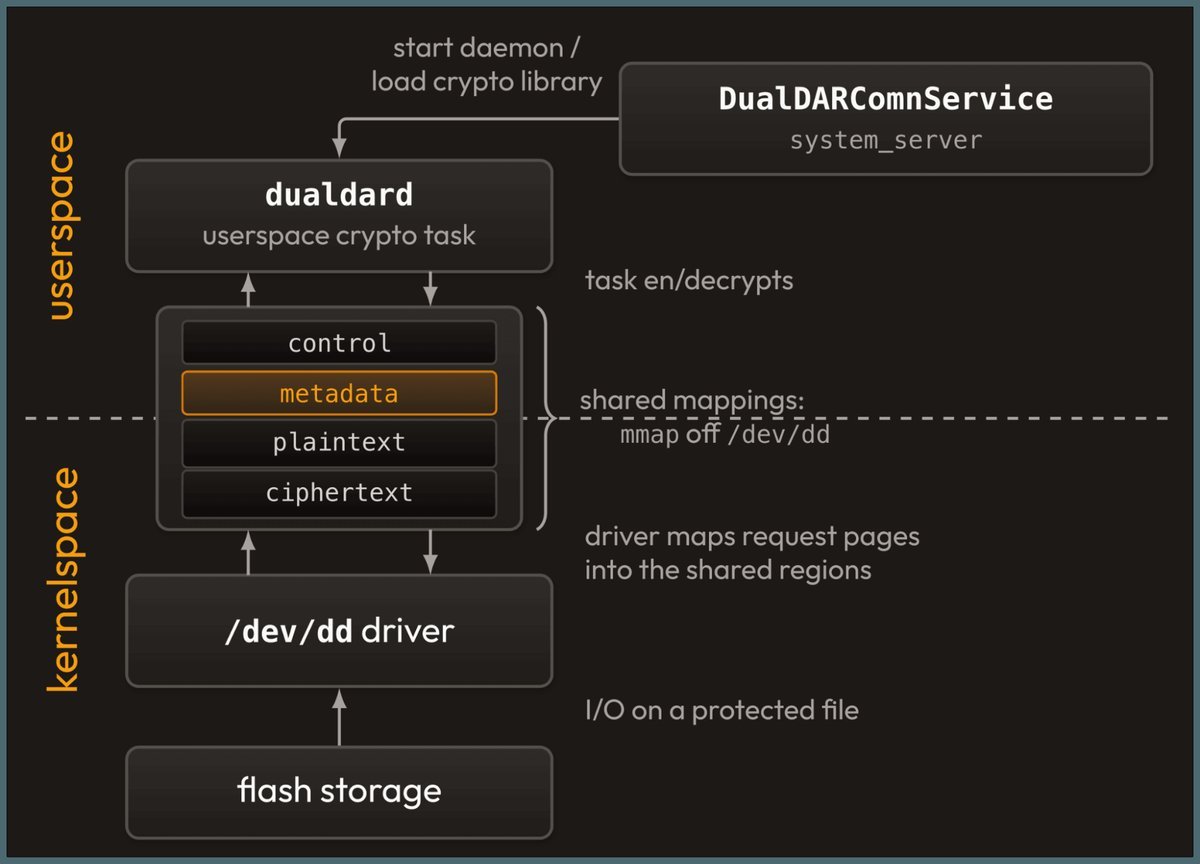
Samsung Knox DualDAR, short for Dual Data-at-Rest, is an enterprise feature. It adds a second layer of encryption on top of Android’s standard file-based encryption, so files in the Knox work profile stay protected by a separate set of keys even if the outer layer is compromised.
The feature has two parts. A system service handles management commands, and a kernel driver talks to a native crypto daemon that encrypts and decrypts file data. A normal third-party app can’t reach that driver because SELinux blocks it. The exploit chain exists to get around that wall.

Stage one: a confused deputy
The first bug sits in the system service. It checks the caller’s user ID before passing a command to the daemon, and only the daemon itself and the system process are supposed to pass. But one asynchronous entry point hands the command to a background thread before the check runs. By then the original caller’s identity is gone, and the check sees the system’s own ID and waves the command through.
Any app could therefore send daemon-management commands as if it were the system. One of those commands tells the daemon to load a native library from a path the caller supplies, with no validation. The researcher packaged a library inside an ordinary app, pointed the daemon at it, and gained code execution inside the privileged process that is allowed to open the kernel driver.
Stage two: a freed page that stays mapped
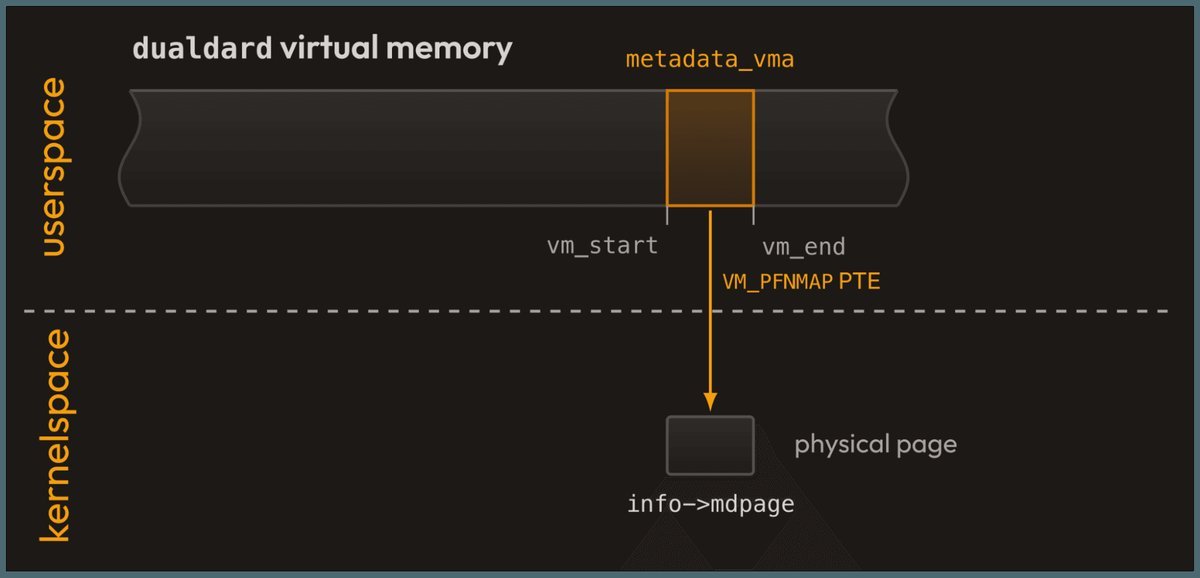
The second bug is a use-after-free in the kernel driver. For each protected file, the driver maps a metadata page into the daemon’s address space. When the file’s inode is evicted, the driver frees that physical page but leaves the mapping in place. The daemon is left with a readable and writable window onto memory the kernel may hand to something else.
The researcher reclaimed that page with kernel pipe buffer objects, which turned the stale mapping into arbitrary read and write access to kernel memory. The trigger needs no race condition, and both reclaim steps can be checked and retried, which is why the chain was reliable.
Getting past Samsung’s extra defenses
Samsung layers its own protections over standard Android, and the chain dealt with each of them:
- SELinux was made permissive by editing policy data in kernel heap memory.
- Samsung’s hypervisor-based Real-time Kernel Protection was sidestepped by patching a library’s copy in the page cache, so a root process executed the payload without any protected credentials changing.
- Samsung’s DEFEX protection was switched off by loading an unsigned kernel module that forces its enforcement function to allow every call.
The researcher said the unsigned module was the most surprising step, because Android’s generic kernel module model accepts unsigned vendor modules and relies on verified partitions for trust.
Who is affected and what to do
The same exploit code rooted all four tested phones, across Snapdragon and Exynos chips and kernels 5.15 and 6.12. Further analysis of Samsung’s released sources and firmware indicates that the flaws affect other Galaxy S and Z devices too, since Samsung reuses the subsystem across generations. Porting mostly came down to matching offsets and structure layouts.
Samsung fixed the service by checking the original caller before the command is queued and carrying that identity into the background task. In the kernel, the driver now removes the old mapping and inserts the page through the normal reference-counted path, so a page still mapped into the daemon can’t be freed.
Galaxy owners should install the latest security update, with September 2026 or later covering both bugs.
What comes next
The Samsung Knox DualDAR research is the second part of a series applying one strategy to several phone makers: find a vendor-specific kernel driver bug and, when SELinux blocks access, use a vendor-specific sandbox escape first. The researcher plans a third part on Xiaomi and a fourth covering Oppo and OnePlus phones.
Source: Calif