A new quantum gravity paper has set physics social media buzzing with claims that AI has quantized gravity. It hasn’t, at least not yet. The paper’s author used 400 million tokens of ChatGPT Astra to develop and prove his results, and physicists who read it say a central step is still missing.
Who wrote it and why it spread
The author is Venkatesa Chandrasekaran, a postdoc at Stanford who also works at OpenAI. His acknowledgments credit ChatGPT Astra for the discussion and proofs. An OpenAI employee with a large following tweeted the paper out, and it landed shortly after a Riemann Hypothesis proof that had also drawn attention. Critiques by Jonathan Oppenheim and comments from Geoff Penington followed on X.
A conservative route to quantum gravity
Quantum gravity approaches fall into two broad groups. Radical ones, such as string theory, start from a theory of something else and get gravity as a by-product. Conservative ones, such as loop quantum gravity, take general relativity and try to map it into quantum math.
The second group has to make choices along the way, including which mathematical space to map into. Those choices aren’t unique, and some can produce a sick theory, one that works mathematically but makes no physical sense, such as a theory where nothing ever moves.
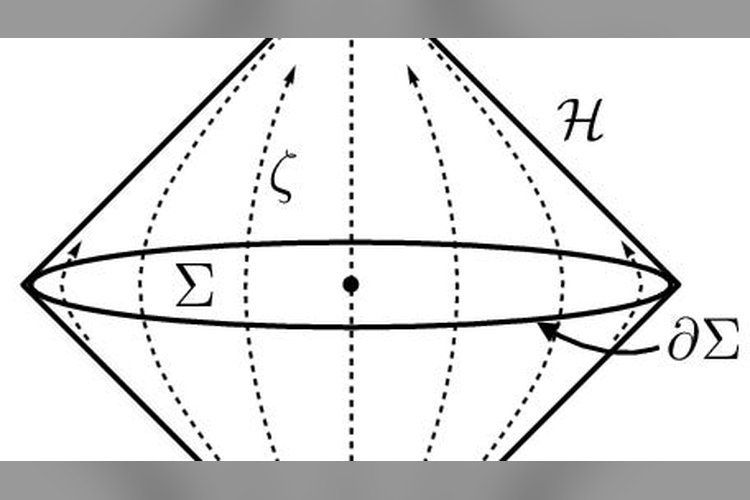
Chandrasekaran’s paper is in the conservative group. It organizes general relativity by breaking spacetime into tiny diamond-shaped regions bounded by light rays. Other researchers have started from a similar place, most prominently Reisenberger, whom the paper cites, and Wieland, whom it doesn’t. The resulting theory most resembles the holographic spacetime program of Banks and Fischler, where causal diamonds carry finite-dimensional Hilbert spaces. One physicist who reviewed it calls it a potential bridge between those lines of work, and found both the approach and the conclusion interesting.
Why gravity isn’t quantized yet
The classical starting point is an algebra, and quantization needs a state on that algebra. The paper supplies a state on only part of it, a subalgebra. It then relies on a theorem saying such a state can be extended to the full algebra.
That extension isn’t unique, and the paper picks one and carries on. It’s unclear whether any physically reasonable extension exists. If none does, the program will never yield a sensible theory.
Think of needing a multi-storey house with certain features. The paper builds one floor. There are many ways to stack more floors on it, and it doesn’t show that any of them gives a usable house. Finding a good state for the whole algebra is the real battle, and the paper leaves it for later. It’s also unclear whether the chosen state on the subalgebra is itself physically sensible.
The test any candidate has to pass
Any candidate theory has to predict a finite amplitude for two-to-two graviton scattering at two loops or higher. That calculation shows how a theory behaves at very high energies. Extrapolating naively from low-energy physics gives an infinite answer, a sign that gravity is perturbatively non-renormalizable, which sets it apart from the other interactions. String theory clears this hurdle.
If a physically reasonable state were found, the hurdle should resolve automatically. The result would be a quantum gravity theory rivaling string theory, and experiments would then decide. The reviewer’s gut feeling is that the program needs a guiding physical principle for its mathematical choices, and that one is missing.
What 400 million tokens changes
This quantum gravity paper represents a lot of work. Before AI tools, similar programs took years to reach this stage. The reviewer estimates two to four years and four to eight papers. With 400 million tokens, it was done in what looks like months.
That raises a point about access. Theory work may now depend on who can afford tokens, just as experiments depend on who can afford equipment.
AI involvement also cut both ways for this paper. It drew attention and criticism that a first paper in a still-immature program would never have received a few years ago. Maturity may now be counted in tokens spent, not years of human effort.
What to watch next
The open question is whether a physically reasonable state exists on the full algebra, and whether the graviton scattering amplitude comes out finite. Until follow-up work answers those questions, this quantum gravity paper is a promising research program, not a quantum theory of gravity.
Source: nirmalyakajuri.substack.com