One developer is calling time on Python for large production backends. The argument: 2026 marks the start of the end for interpreted languages in high-volume services, and teams that begin new backends on Python in 2027 will regret it. The claim is provocative, but it rests on a few concrete data points, and the author is careful to say Python isn’t dying everywhere.
The cost of running Python at scale
The main complaint is efficiency. Python’s runtime burns more CPU and memory per request than compiled alternatives, and that overhead grows with traffic.
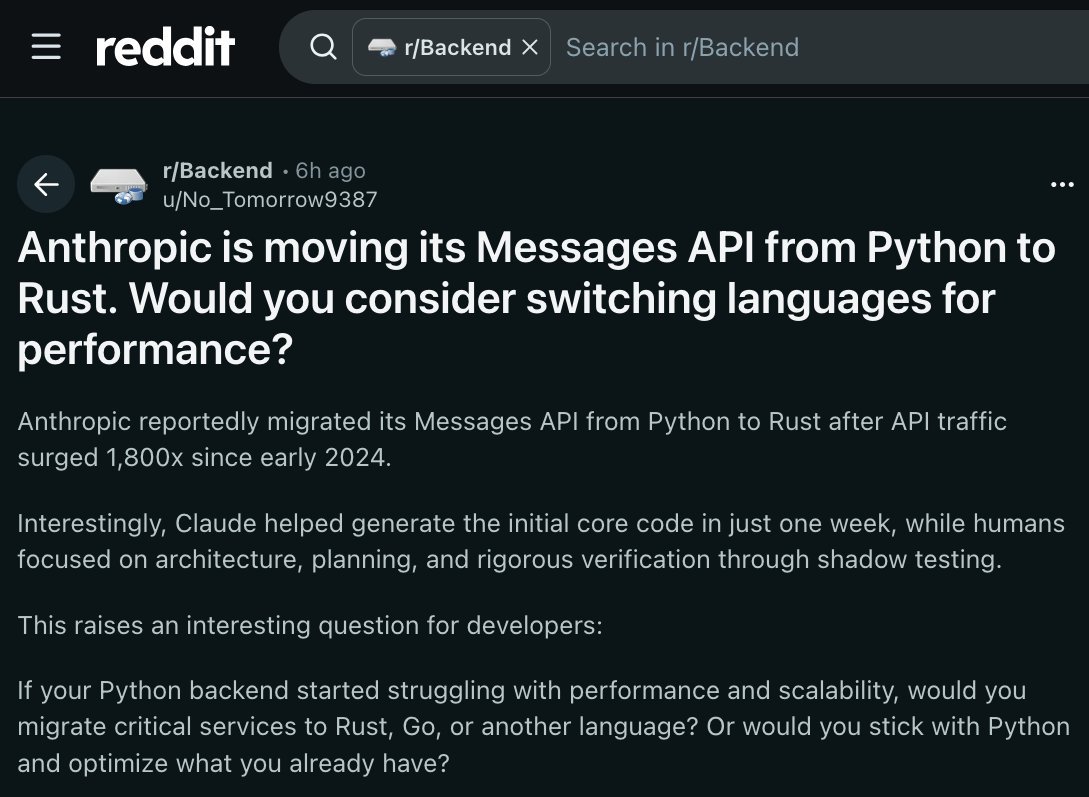
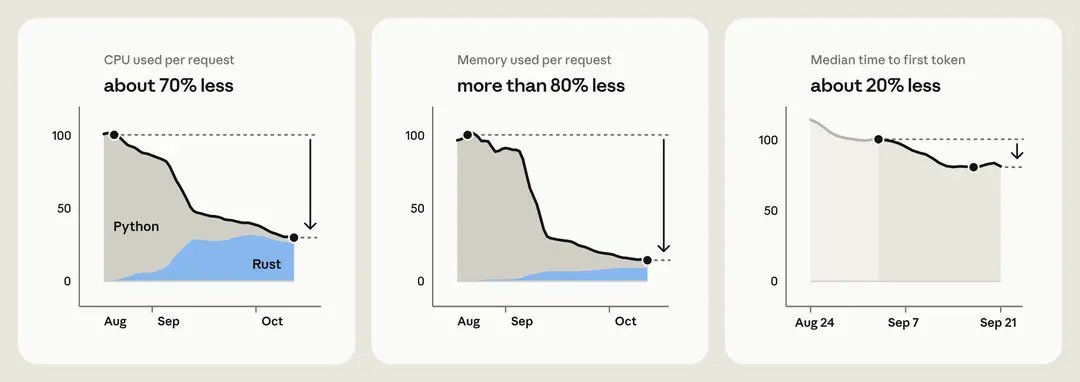
The strongest example is Anthropic’s migration of its Messages API to Rust. Anthropic reports that API traffic grew roughly 1,800 times between early 2024 and fall 2026. The service was built in 2023 in Python, which was widely used internally for research code, and it started out simple.
By late 2025 each request had to be validated, converted into a prompt, tokenized and screened by safety classifiers. Streaming replies had to be sorted into text, thinking and tool calls as they arrived. Python added overhead at every step, each time it created an object, freed memory or passed work along. Rust, Anthropic said, would use far less CPU per request.
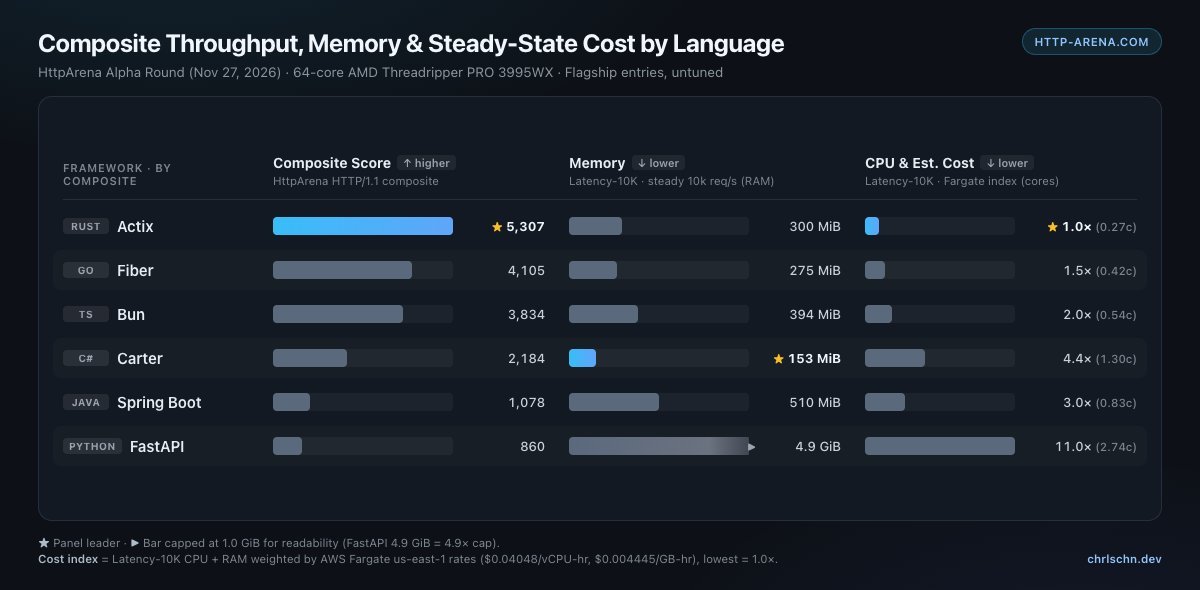
The author concedes a fair point against their own case. A clean rewrite often improves performance on its own, because the team drops old tech debt. To get around that, they point to HTTP Arena, a cross-language throughput comparison. In it, C# holds up well and leads on memory efficiency, while the async numbers should improve as its runtime support matures.
It isn’t only Python
Microsoft’s Copilot SDK was recently rewritten from TypeScript on Node to Rust, with similar gains: lower memory use, higher throughput and faster responses. The motives differed and it isn’t a backend service, but the direction matches.
Types as a tool for coding agents
The second argument concerns who writes the code. As agents produce most of it, the question becomes how they check their own work. Anthropic calls this the generator-verifier gap: agents have few reliable ways to confirm that what they wrote is correct.
Type systems help close it. A compiler that rejects bad code gives an agent immediate feedback. Types also tell a model what operations are valid right in a function signature, so it spends fewer tokens guessing intent in dynamic languages like Python or JavaScript.
There is research behind this. A study of 2,254 source files from 881 open-source GitHub projects, tested across eighteen models, found that language models are more confident predicting tokens in strongly typed languages. Java, Go and C# produced lower perplexity than Perl, Ruby and Shell.
What the author is not claiming
Python will stay a strong scripting language and will keep dominating machine learning and data science, thanks to its tooling. The target is narrower: large-scale production backends started from scratch.
The suggested alternatives
For serious engineering organizations, the author recommends Rust, especially for teams that expect to read little of the generated code. Everyone else gets a less obvious pick, C#, with a disclosed bias. Reasons given:
- NuGet had the fewest detected vulnerabilities among active GitHub repositories in GitHub’s 2020 Octoverse report, and C# projects tend to have few transitive dependencies.
- Modern .NET has been stable for about a decade while keeping backward compatibility.
- The Roslyn compiler API is written in C#, so teams can build static analyzers that give agents more verification signal.
- Entity Framework Core lets agents generate typed queries and still allows raw SQL.
- CSharpRepl can attach to a running .NET application, letting an agent change behavior without losing state.
Teams that already read TypeScript and plan to review code by hand can stay close to home. TypeScript and C# share a designer in Anders Hejlsberg.
What backend teams should weigh in 2027
This is one engineer’s forecast, not a measured industry trend, and the author admits it may read as sacrilege. Still, the cost and verification arguments are testable. Teams planning a new high-traffic service can benchmark their own workload, count the infrastructure bill for Python against a compiled language, and judge how much they depend on agent-written code. Python on the backend is not dead, but the case for choosing it by default at scale is getting harder to make.
Source: chrlschn.dev