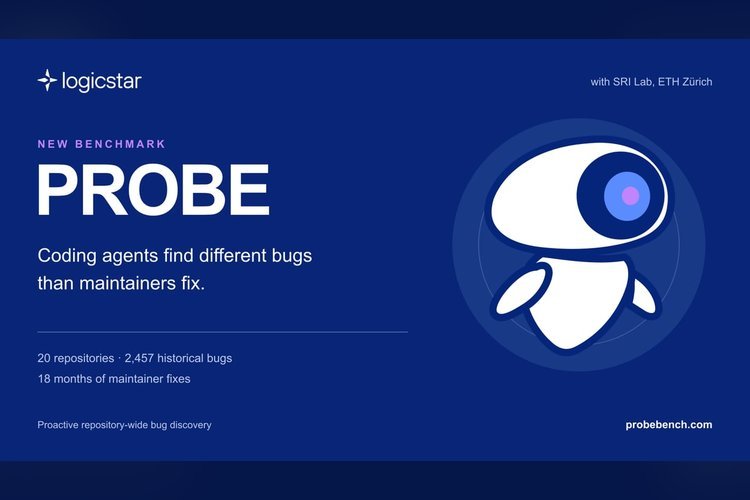
Frontier coding agents find real bugs in open-source code, but a new benchmark called PROBE shows they mostly find different bugs than the ones maintainers go on to fix. Even the best single run missed about 79% of them.
PROBE asks whether an agent given no hints can audit a repository and surface defects that get fixed later.
How PROBE works
The benchmark froze 20 active Python, JavaScript and TypeScript projects on January 1, 2025, 1.1 million lines in all. They include SQLGlot, pypdf, WeasyPrint, Svelte and Prefect. Researchers went through 13,254 commits from the next 18 months, found 4,296 bug fixes and, after deduplication, kept 2,457 bugs that already existed in the frozen code.
Each agent works in a container whose dependencies match the snapshot date. It gets no revision history and no network access, so it can’t look up fixes. A finding matches a reference bug if repairing the root cause of one would repair the other. A language-model matcher applies that test and scored about 99% precision and 98% recall against expert labels.
One big audit finds almost nothing
Asked to audit a whole repository in one session, Claude Sonnet 5 and GPT-5.6 Luna produced fewer than 100 findings across all 20 repositories, with recall under 1%. Splitting the work into 740 focused passes over 4,468 source files raised recall about tenfold. Hound, a security audit agent, managed less than half that recall with the same model while costing 8.6 times as much.
More reasoning, more reports, same hit rate
Luna goes from 5.3% recall at low effort to 17.3% at extra-high, and its bill grows from $8 to $131. GPT-5.6 Sol goes from 11.4% to 20.8% as cost rises from $276 to $1,185. Historical precision barely changes, and recall tracks the number of findings with a correlation of 0.94. In other words, more compute widens the output without aiming it better. Luna at its highest effort setting beat Sol at medium on both measures for under a fifth of the cost.
Most “misses” are real bugs
The best single run topped out at 8.1% historical precision, but that doesn’t make the remainder false alarms. Another group of coding agents tried to reproduce 100 findings per model across nine models. Of cases with a clear verdict, 85% held up, including 84% of the ones matching no reference bug. Validity varied by model, from 64% (Claude Sonnet 5) up to 95% (GPT-5.4 and GPT-5.6 Sol). A blind human review of 180 findings agreed with the panel in 93% of the 131 conclusive cases, though humans confirmed 79% where the panel confirmed 85%.
Maintainers may also just not have reached those bugs. A model of the fix rate puts maintainers at 5,200 to 5,900 fixed snapshot bugs after five years and 7,200 to 9,400 after ten. Even so, precision would climb only to 21-27%, and most valid findings would sit unfixed for ten years.
Agents look at local faults, maintainers fix surface problems
Sorting bugs into 33 types shows agents lean toward local faults like wrong arithmetic, comparisons and edge-case values. Maintainers more often fix unsupported input variants or public API errors. Agents mostly read code, while maintainers fix failures that appear only in certain environments or in rendered output.
One WeasyPrint bug shows the gap. An SVG could request pixelated image rendering, yet the code always passed auto, so scaled images came out blurred. No tested configuration found it, because it means connecting an accepted setting to the output a user expects.
The agents also share blind spots. Take reference bugs that nine Luna runs all missed: other models found just 5% of them. For bugs all nine found, other models found 87%. Random choice would give 12-17%.
What teams can do with this
- Pool several runs. Only 57% of what one Luna run reports shows up in another. Combining five Muse Spark runs reached 26.7% recall at $821 total, and keeping only findings all ten Luna runs reported raised precision to 10.5%.
- Judge model and reasoning effort together, at a fixed budget.
- Check audits against historical fixes, not only validity.
- Exercise supported behavior in realistic environments and inspect output.
The next step is testing whether agents that run software and look at results close part of the gap. The benchmark’s authors haven’t tried that yet.
Source: LogicStar