Apple’s Private Cloud Compute may be the largest consumer-facing private inference system running today, and security engineers are pointing to it as a template for how AI providers should protect data. The case rests on cryptographic guarantees rather than legal promises.
The argument is simple. Terms of service matter after something has gone wrong, because they let you enforce a penalty. They don’t stop a leak. A technical guarantee that can be checked protects your data while the model is actually processing it.
Four properties behind Private Cloud Compute
Apple’s design leans on a short list of concrete technical properties instead of policy language.
- Stateless computation: user data sits only in volatile memory while a request runs, and it is wiped once the response goes back.
- No privileged access: there are no remote shells and no debug ports, and no administrator or site reliability engineer can SSH into a live node.
- Non-targetability: requests are routed anonymously, so neither an attacker nor Apple can steer one user’s request to a chosen server.
- Verifiable transparency: every production software image is cryptographically measured and published to a public log.
That last property does the most work. A device can check what a node is running before it sends any data, and outside researchers can audit the same software independently.
A tiered way to think about cloud AI security
Security researchers describe cloud AI protection as a progression, from basic unverified setups up to stronger tiers that can be proven.
The first tier is auditable security. It covers hermetic, auditable inference pipelines with measured boot.
The second is verifiable transparency. It adds end-to-end attestation and public software transparency logs, plus non-targetability through anonymous authentication.
The third is frontier security. It targets well-funded adversaries and calls for side-channel resistance and integrity across the hardware supply chain.
The ladder gives buyers and builders a shared vocabulary. A provider can say which tier it meets and back the claim with evidence, instead of offering a general promise that data is handled carefully.
The contrast with ordinary cloud AI is stark. In a typical setup, a user has to trust that the provider deletes data, restricts staff access and routes requests fairly. Each of those claims is a promise. In the design described here, each one becomes something a device or an outside researcher can check.
That shift matters most for sensitive requests, such as personal messages or health questions, where a single leak is hard to undo.
Why most developers can’t use it yet
The framework is thorough, but its reach is narrow. Most of Private Cloud Compute exists to power Siri and Apple Intelligence. It isn’t a general-purpose developer cloud.
There is no open REST API. Model choice is constrained, and access is tightly gated. For most builders that rules it out as a primary inference stack.
For developers, this means the design is a reference to study, not a product to buy. Anyone who wants these guarantees for their own application has to look elsewhere.
The push toward gateway platforms
The proposal is aimed at the companies that sit between applications and models. Gateway platforms such as OpenRouter and Vercel are well placed to adopt tiered, verifiable security, because many developers route their requests through them.
If the operators of those gateways treated verifiable security tiers as a real standard, the effect would spread across every app built on top of them. That is the bet behind the call for the wider ecosystem to follow Apple’s example.
What to read and watch next
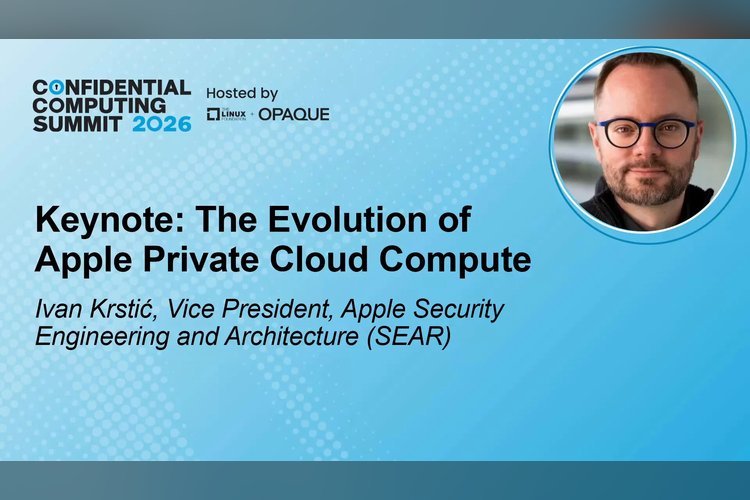
For a deeper look at the architecture and the security levels, the talk by Ivan Krstić is the place to start. He leads Apple’s Security Engineering and Architecture.
The open question is whether any independent provider will publish measured software images, attestation and transparency logs the way Apple does for Private Cloud Compute. Until one does, users of third-party AI gateways have to take privacy claims on trust.
Source: X (formerly Twitter)