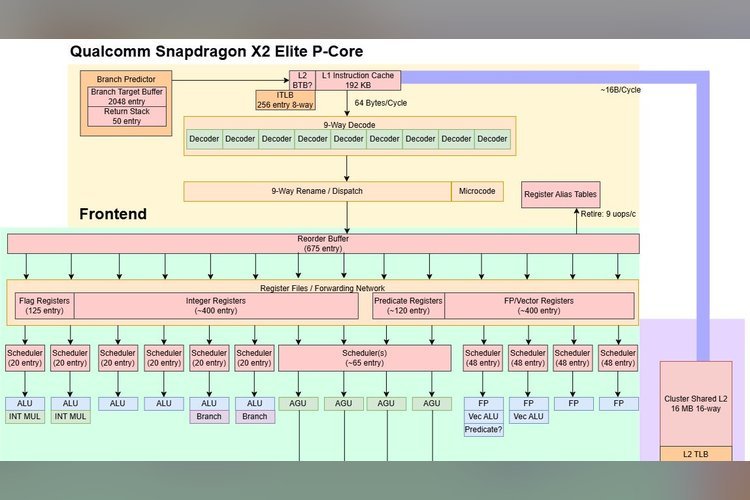
Qualcomm’s Oryon 3 core pushes clock speeds to 5 GHz and widens the pipeline from 8 to 9 micro-ops per cycle. It powers the Snapdragon X2 Elite, and a close look at its design shows an Arm laptop chip that now competes with the best x86-64 cores from AMD and Intel.
The path here was slow. Qualcomm’s first Arm laptops reused phone chips and lagged behind even low-end Intel processors. Later Snapdragon variants built for laptops improved with each generation, and the Snapdragon X2 Elite Extreme now delivers CPU performance that challenges the top x86-64 parts.
Inverted hybrid design
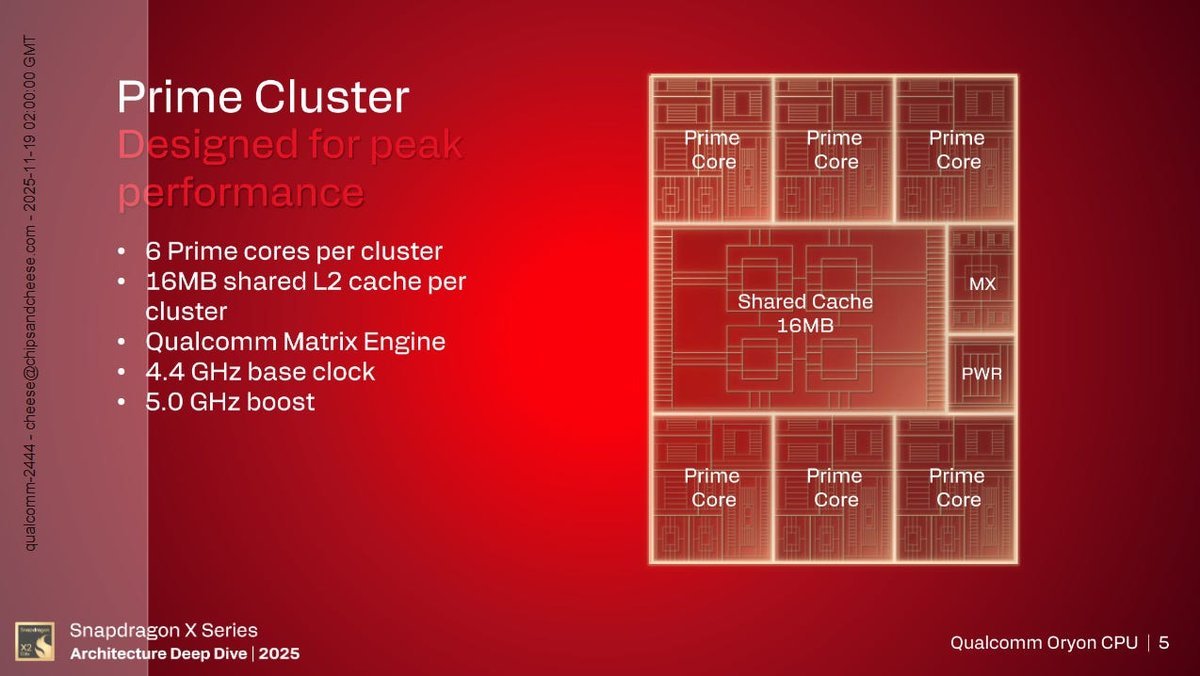
The Snapdragon X2 Elite uses two core types. Qualcomm calls them “performance” and “prime” cores, a naming choice that confuses more than it clarifies. The prime cores are the big ones, and they outnumber the smaller cores two to one. That is the reverse of Intel’s hybrid layout, where small cores usually dominate the count.
The big cores carry both peak single-thread speed and most of the multithreaded throughput, so the Oryon 3 core has to do most of the work for Qualcomm’s PC ambitions.
What changed from the first Oryon
Oryon 3 looks a lot like the first-generation Oryon. Qualcomm has a second-generation core, but it only shipped in phones and appears to be a minor revision, so the first generation is the fair point of comparison.
Inherited traits include an out-of-order window above 600 micro-ops and a two-level cache setup that favors speed over capacity. The changes sit on top of that base:
- Peak clock speed rises to 5 GHz, a 16% jump from the 4.3 GHz of the first generation.
- Core width grows from 8 to 9 micro-ops.
- SVE2 and SME support arrive, which keeps the core current with the aarch64 architecture.
The competition is AMD’s Zen 5 and Intel’s Lion Cove. Arm’s Cortex X925 also belongs in the comparison because of Nvidia’s N1X laptop push.
A faster frontend
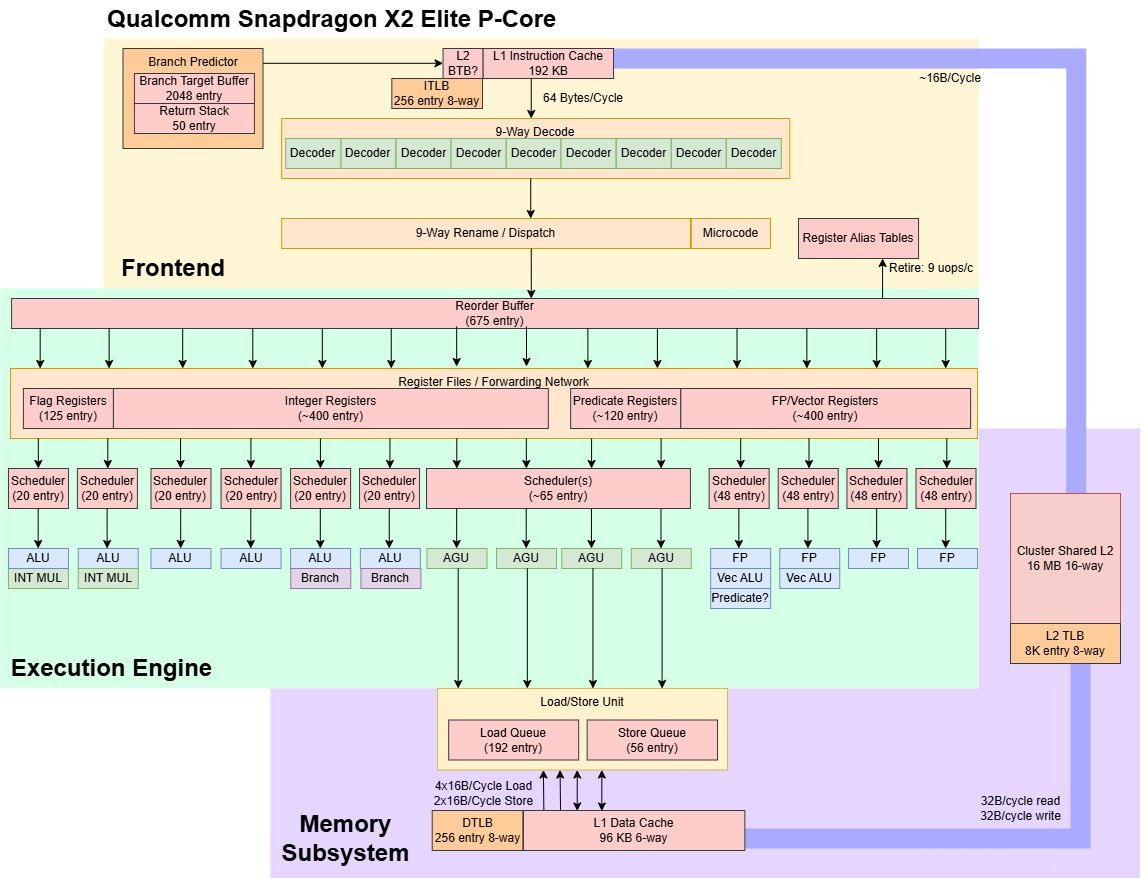
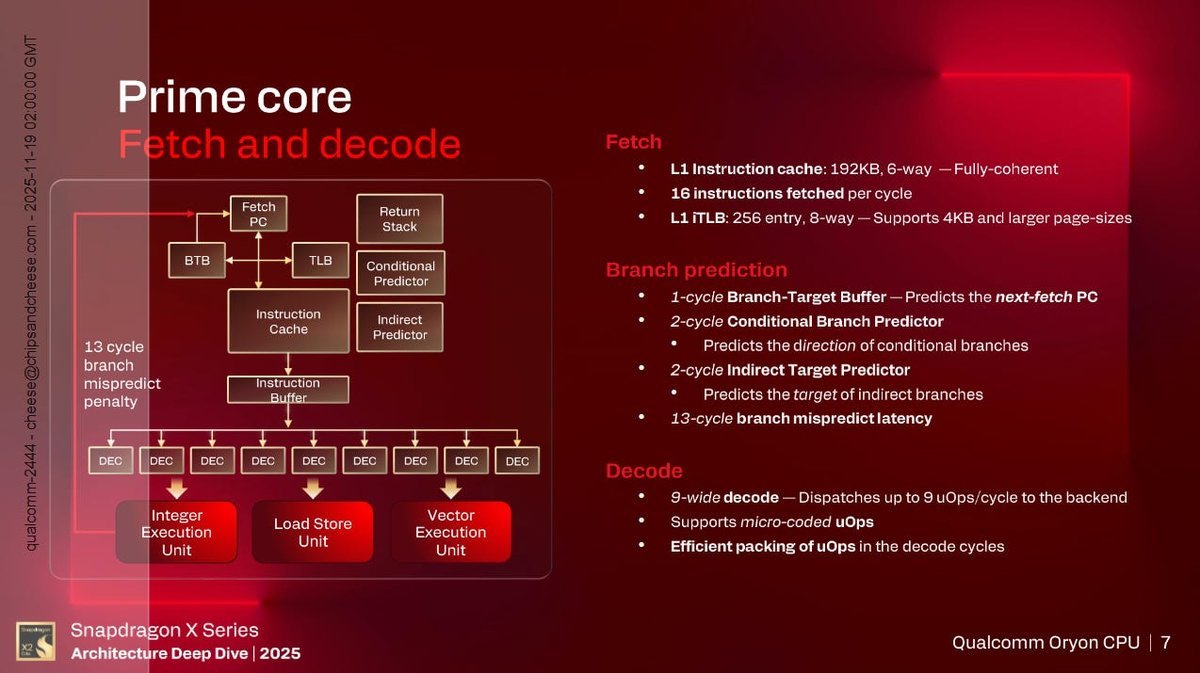
To feed the wider core, Qualcomm added one decode slot. The rest of the fetch and decode pipeline is mostly unchanged. The instruction cache is 192 KB and 6-way, with hardware coherency, and it delivers 64 bytes per cycle, more than a 9-wide decoder needs. The instruction TLB holds 256 entries.
Qualcomm kept those large structures and still held the branch mispredict penalty at 13 cycles. Faster clocks often force shorter or smaller designs, so this is a notable result.
Tests with streams of NOPs confirm the wider decode. When code spills out of the instruction cache into L2, Oryon 3 sustains about 4 NOPs per cycle, double the 2 per cycle of its predecessor. That matches Zen 5 and Lion Cove for streaming code from L2, and Oryon 3 has a much larger L2.
Branch prediction gains and gaps
The first Oryon handled back-to-back taken branches with no bubble only inside an 8 KB instruction footprint. Oryon 3 manages it across a 2048 branch footprint. Given typical branch spacing, that is a footprint two to four times larger.
The direction predictor also scales further. It starts to break down past 32K patterns in the test, up from roughly 24K before. Zen 5 holds out to about 48K patterns. The indirect predictor tracks 2048 targets, unchanged, and a single branch can jump to 256 targets without a significant penalty.
The return stack holds 50 entries, as before, but it now fails more gently. Once call depth exceeds the stack, the first Oryon appeared to mispredict every return. Oryon 3 only misses the returns that were pushed out. Zen 5 has a slightly larger 52-entry stack.
One gap remains. Oryon 3 cannot follow more than one taken branch per cycle, while newer AMD, Intel and Arm cores can. That is a surprising omission in such a wide core, though the jump from 4.3 to 5 GHz may have been the better trade.
Backend and memory system
The backend is largely carried over. Qualcomm lists a reorder buffer above 650 micro-ops for both generations, and microbenchmarks measured 675 for Oryon 3 and 680 for Oryon 1. The structures still compare well with newer designs such as AMD’s Zen 6.
The main addition is a 120-entry predicate register file for SVE2 and SME. Vector width stays at 128 bits, which leaves Oryon 3 behind x86-64 rivals in vector throughput, especially Zen 5. That should affect only a minority of applications.
The load/store unit keeps four pipes and handles all store forwarding cases, including partial overlaps. A dependent store and load pair takes 6 cycles on the integer side and 8 on the vector side. Zen 5 and Lion Cove forward with zero latency in the simple case but pay 14 or 19 cycles on partial overlaps. Cortex X925 pays 12 to 13 cycles.
The L1 data TLB grew from 224 entries to 256, covering 1 MB with 4 KB pages, and an 8K entry L2 TLB serves both instruction and data accesses. Gather loads reach 1 to 2 elements per cycle in general, rising to 4 per cycle when the same address repeats.
What to watch next
With the Oryon 3 core, Qualcomm has kept its strengths, a big window and large caches, and added clock speed and width. The next test is real-world laptop performance and how AMD’s Zen 6 and Nvidia’s N1X machines respond.
Source: chipsandcheese.com