LlamaIndex has released OCRia-1, a 4-billion-parameter vision-language model that turns a page image into Markdown. The OCRia-1 document parsing model targets the content parsers usually get wrong: merged-cell tables, charts, and formatting that carries meaning. It posts the highest scores of any open-weight model on both ParseBench leaderboards.
What OCRia-1 reads
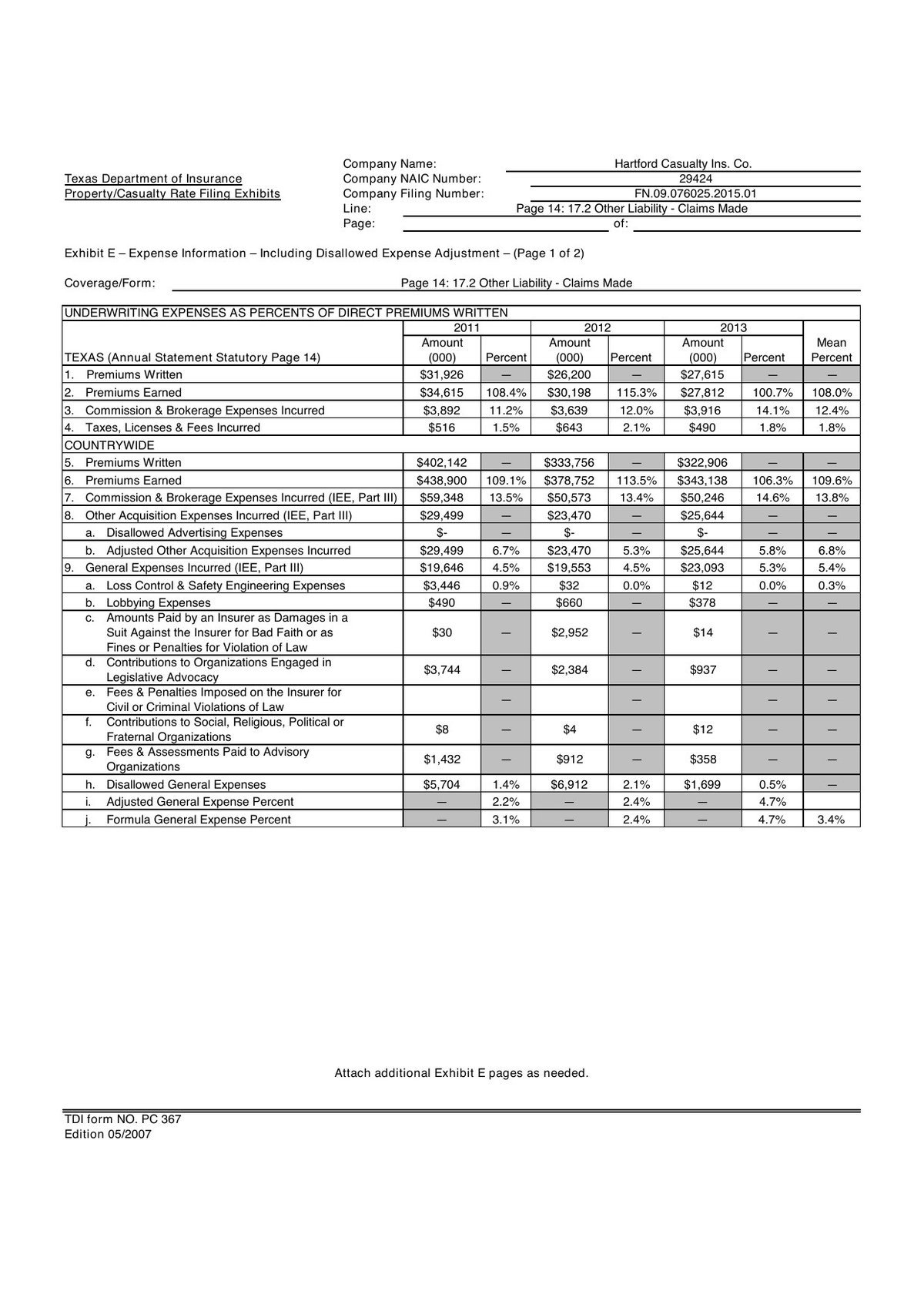
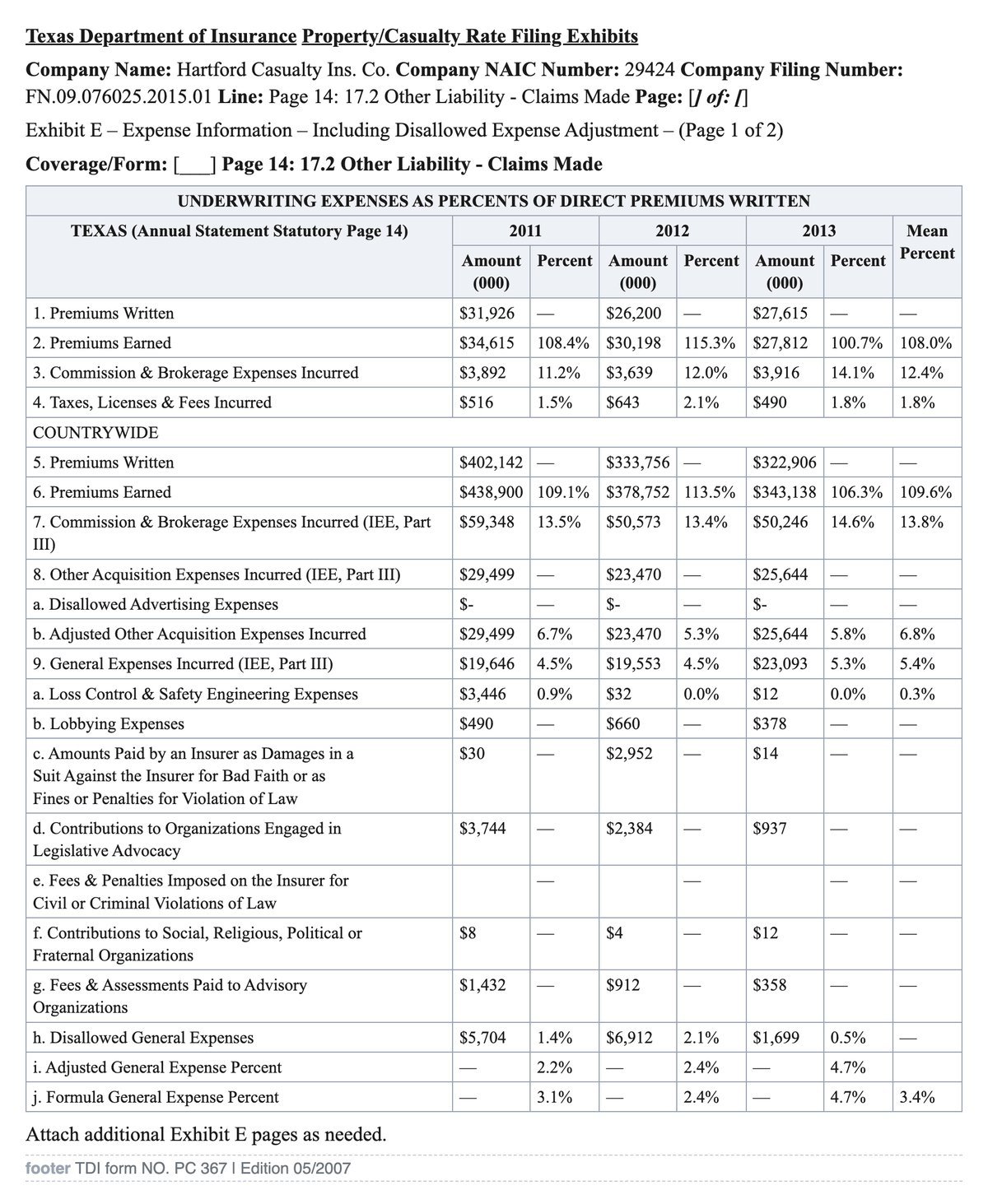
Give it a page image and it returns that page as Markdown, using HTML for tables. LlamaIndex built it for spanning headers, tables with thousands of cells, financial tables, and charts whose values must be read off the plot. Charts are converted into HTML tables listing their data points.
It also keeps formatting such as strikethrough, underline, highlights, subscripts, superscripts, checkboxes and blank fields, plus formulas in LaTeX, handwritten ones included. Headers, footers, page numbers and watermarks get their own tags, multi-column text is unrolled, and diagrams come out as Mermaid.
The text comes from the image alone, in one call per page. There’s no layout detector, OCR engine or PDF text layer. Layout boxes are added afterwards.
Benchmark results
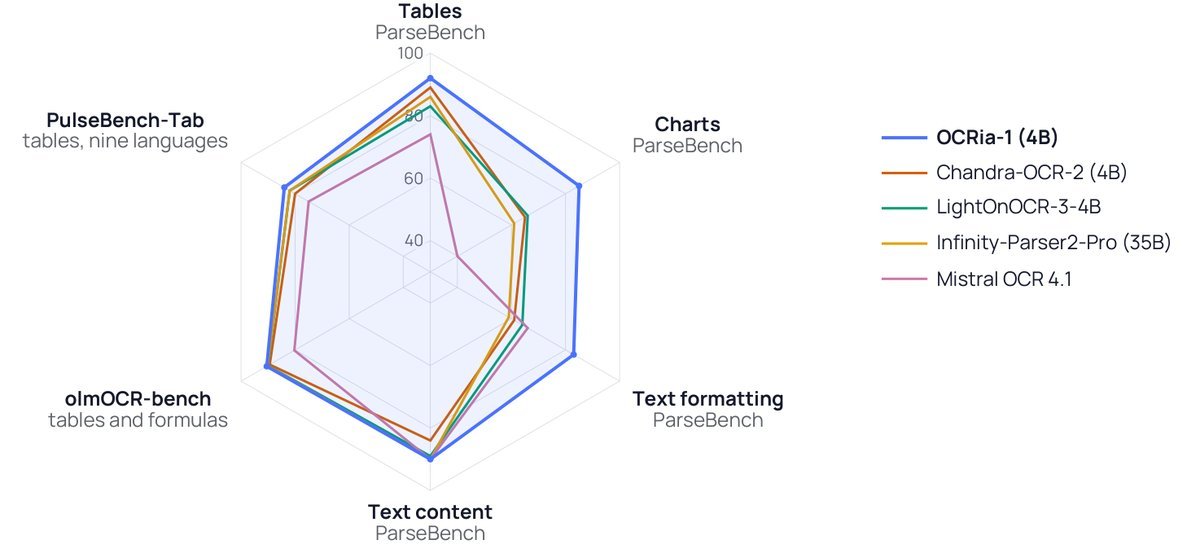
The model scores 85.2 on ParseBench 2, a six-dimension test over 4,317 pages. That puts it seventh among 61 systems, commercial APIs and frontier vision models included. On ParseBench 1, over 2,078 pages and five dimensions, it scores 84.7 and ranks second of 158, first in semantic formatting. Both scores include visual grounding.
On chart reading, it scores 82.5 on ParseBench 1, where the closest open-weight rival manages 69.1. LlamaIndex also reports top results on the table and formula parts of olmOCR-bench, on PulseBench-Tab and on fr-bench-pdf2md. At a common 1,288 px rendering, the OCRia-1 document parsing model scores 83.5 across all eight olmOCR-bench categories, against 83.2 for Infinity-Parser2-Pro.
Two caveats come with the numbers. LlamaIndex maintains ParseBench itself, while the other three benchmarks are independent. And scores depend on rendering: raising the image budget from 1,240 to 2,451 tokens per page lifts its olmOCR-bench score by 2.4 points with the same weights.
Speed
The published weights are unoptimized BF16. Running stock vLLM, a single page decodes at roughly 320 to 330 tokens a second. The version that serves LlamaParse uses mixed NVFP4 and FP8 quantization, paired with a 0.69-billion-parameter speculative decoder and custom kernels. On a single B200 GPU, one request decodes near 4,700 tokens a second, and 64 simultaneous requests get through 10.2 pages a second. That’s about ten times faster than the open weights.
How it was trained
OCRia-1 starts from Qwen3.5-4B and trains on 100,979 pages, around 0.37 billion target tokens. Of those, 82,943 are real pages from permissively licensed sources such as the Internet Archive, arXiv, PubMed Central, the Library of Congress and EUR-Lex. Another 18,036 are synthetic pages with exact ground truth. LlamaIndex says no customer data was used.
Training ran in two stages: supervised fine-tuning for two epochs, then reinforcement learning with verifiable rewards. Rewards score table structure, cell values, chart points, text and inline formatting, while penalties hit merged or split tables, repetition and formatting that isn’t on the page. The released model averages two RL checkpoints, each better on different dimensions.
Running it and the license
You can run the model with vLLM 0.30 or later, Hugging Face Transformers, or llama.cpp and Ollama through GGUF builds. The Q8_0 GGUF scores the same as the full weights on a ParseBench 2 sample. Each page goes in as one image with the supplied system prompt, thinking turned off and greedy decoding. Output can be long: crowded pages may run past 20,000 tokens.
The license isn’t open source. Research, teaching, evaluation and personal use are free, as is commercial use for organizations with under $2 million in annual revenue and under $2 million in total funding. Larger companies need a commercial license, and so does anyone building a parsing or OCR product that competes with LlamaParse or LlamaCloud.
What to check before adopting it
Teams comparing parsers should test on their own documents at the rendering budget they plan to use, since scores shift with image size. Note the license limits before building a competing product. The speed-optimized version is available only through LlamaParse, so self-hosters will see the slower stock throughput.
Source: huggingface.co