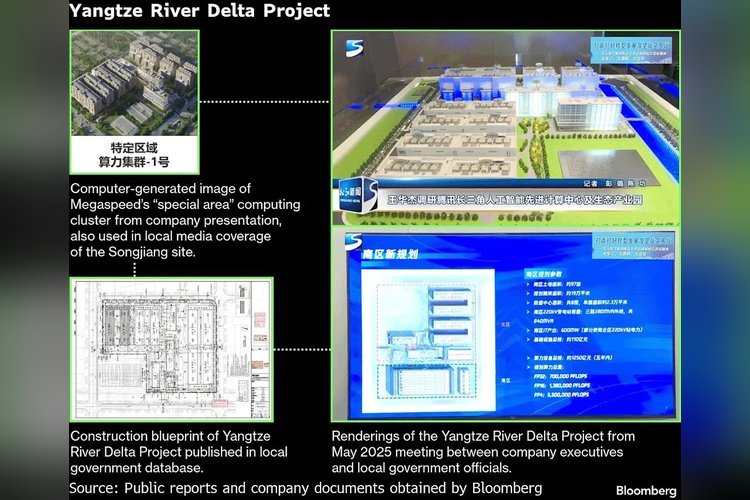
Nvidia Blackwell chips in China have turned up at a Shanghai data center linked to Alice Huang, the founder of Megaspeed. Loan filings submitted to Chinese regulators list a GB300 NVL72 rack and a GB200 server at the Yangtze River Delta Project, even though Blackwell hardware needs a US license to ship to China.
It is the first documentary evidence that these processors reached the site. Until recently they were Nvidia’s most powerful data center products, and the sighting of Nvidia Blackwell chips in China raises fresh questions about export enforcement.
What the filings show
Shanghai Shuoyao pledged a GB300 NVL72 rack as collateral to get a 96 million yuan ($14 million) loan from Shanghai Innovation Bank. The rack’s serial number appears in documents filed with regulators in November. A lookup in a public warranty database traced it to Taiwan’s Gigabyte Technology, which assembles Nvidia chips into servers and racks.
A second company, Shanghai Kezhan, described a GB200 server at the facility when it secured a 90 million yuan loan in late 2025. The lender was a finance-leasing firm wholly owned by a local Shanghai government agency. Kezhan also reported 32 servers with H200 chips on the site. Their model names carry a Gigabyte prefix, but the documents give no serial numbers, so they are harder to trace.
Gigabyte declined to say who bought the rack or when. A spokesperson said the company “conducts all business in compliance with applicable laws and regulations.” Nvidia did not respond to questions.
A rack that was supposed to be too big to smuggle
Nvidia CEO Jensen Huang once argued that these systems were too large to move illegally. A standard two-meter GB300 NVL72 rack holds 72 Blackwell Ultra chips and 36 Grace processors. It can weigh more than 1,500 kilograms (3,300 pounds).
President Donald Trump has said he does not want Blackwell chips going to China, at least for now. US officials believe the shadow trade in diverted Nvidia hardware is worth billions of dollars. How this rack reached Shanghai Shuoyao, or this site, is unclear. Such gear often changes hands several times, and many smuggled products were first sold to buyers in unrestricted regions.
Who is behind the site
Huang founded Megaspeed in 2023. Nvidia gave the neocloud its stamp of approval within four days of its creation, and it grew into the company’s largest customer in Southeast Asia. The US put Megaspeed on a trade blacklist this month, citing a significant risk that it was involved in chip diversion. It is also under a US investigation. Megaspeed denies wrongdoing and has not answered questions about the Yangtze River Delta Project, though it used a rendering of the site in 2024 to describe its largest data center to investors, without naming the country. There is no evidence that Megaspeed itself moved hardware there.
Shanghai Shuoyao has overlaps with Megaspeed. This month it said in a rare public statement that it is one of Megaspeed’s service providers, a partnership “limited to ordinary commercial cooperation.” Its sister company Shanghai Longjie, which has the same parent, got a 200 million yuan loan from Shanghai Innovation Bank, again backed by restricted Nvidia chips. Shuoyao and Longjie have also disclosed servers with Hopper-generation chips made by Super Micro Computer and Dell Technologies. Whether those shipments had US approval is unclear.
Corporate records add to the picture. Chinese gaming company 7Road, Megaspeed’s original parent, took 16.7% of Shanghai Kezhan in February 2024 through a subsidiary it had bought from Huang in 2019. Japan’s NeXPower owns the other 83.3%. Caixin has reported that Huang controls the Tokyo firm. The Yangtze River Delta Project’s president, Kang Wei, has been introduced at times as Huang’s romantic partner, according to people familiar with the matter.
An $11 million shipment labeled storage chassis
Customs records show that in May 2025 Shanghai Kezhan received an $11 million shipment flown from Malaysia to Shanghai Pudong International Airport. The paperwork called it “storage chassis.” The product code, 847150, is the one for computing servers. At $264,108 a unit, the price is far too high for a chassis but fits servers built on Hopper chips.
What to watch next
The case shows how Nvidia Blackwell chips in China can surface through ordinary bank paperwork rather than customs seizures.
Local media describe the site as designed for up to 800,000 servers, which would put it on par with the hyperscale facilities OpenAI uses. How far construction has gone is unknown. Plans reviewed by reporters set a ratio of processing power to energy input that would be very hard to meet with chips from Chinese suppliers such as Huawei.
The filings cover only equipment pledged as collateral, a small slice of what the operators would need. They also show that some Chinese lenders, including state-linked ones, accepted restricted hardware as security. Nvidia now faces scrutiny from US officials over diversion, and the trade blacklisting of Megaspeed makes follow-up action likely.
Source: Yahoo Finance