JetBrains has released Mellum2.1 Instruct, an open coding model that gives straight answers without showing a chain of thought. The model is a counterpart to Mellum2.1 Thinking, which JetBrains launched in October with 12B total parameters, a mixture-of-experts design and 2.5B active per token. Same architecture, same training, but quicker replies, intended for sub-agents, tool loops and chat.
Why a non-reasoning model
Reasoning models earn their keep on problems like diagnosing why a test fails. Much agent work is lighter, such as a quick patch, running a command or answering a question about the codebase, and there the thinking only burns time and compute.
Local use makes that waste obvious. After Thinking came out, people running models on their own machines asked JetBrains for a terser option aimed at mid-difficulty work.
In agentic coding runs, Instruct emits roughly half the tokens of Thinking while landing close to it on SWE-bench Verified. Contest-style algorithm and math work, like LiveCodeBench and AIME, still goes better with Thinking. JetBrains positions the new model either as a standalone assistant or as a fast worker alongside a stronger model.

What the benchmarks show
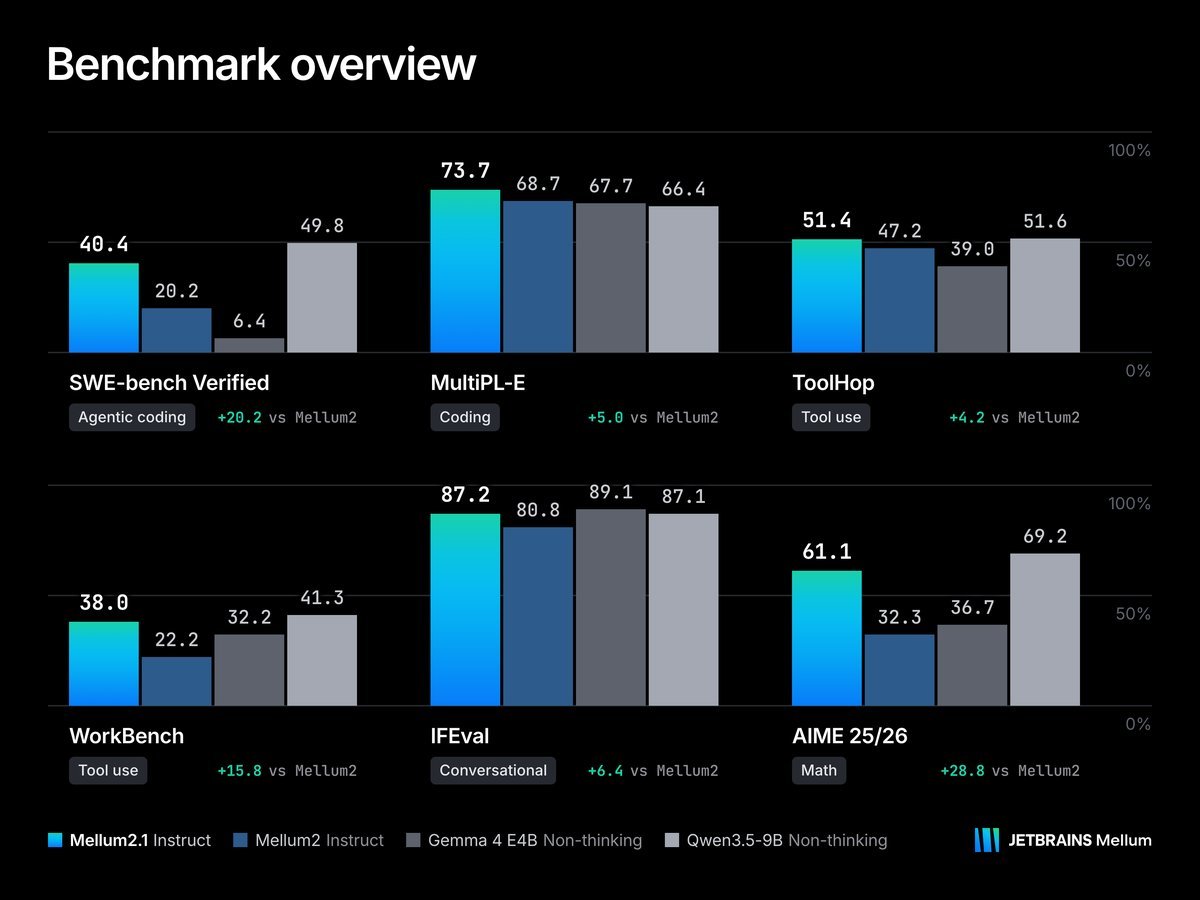
JetBrains tested it against Mellum2 Instruct, plus Qwen3.5 9B and Gemma 4 E4B, two open models of similar size, with their thinking turned off. The comparison covered six benchmarks: SWE-bench Verified, MultiPL-E, ToolHop, WorkBench, IFEval and AIME 25/26. Mellum2.1 Instruct beat Mellum2 Instruct on all six, by 4.2 to 28.8 points.
SWE-bench Verified saw the biggest change, with the score twice that of the earlier Instruct model. Code generation also improved and now tops the group. Multi-step tool use ties Qwen3.5 9B.
Qwen3.5 9B keeps the lead on SWE-bench Verified. Mellum2.1 answers with speed: with just 2.5B parameters active per token, JetBrains’ October measurements put it about 1.4x ahead for one request and 1.8x ahead under load.
How it was trained
Instruct received the same two-phase reinforcement learning as Thinking. Phase one covered self-contained problems in coding, math, tool calling and following instructions. Phase two put it inside real repositories with a sandbox, shell access and file tools, paying out only if hidden tests passed.
Two things differ for Instruct. The length penalty was retuned for a model that skips thinking, so answers stay short with no quality loss. The team also narrowed the mismatch between the generation and training sides, which steadies the run.
NVIDIA’s open-source NeMo tools power both phases. NeMo RL decouples generation from training, while NeMo Megatron-Bridge pushes weight updates over big H200 and B300 GPU clusters. One run gathered around 500,000 agent trajectories across 10,000 sandboxes working at once.
Faster generation with the MTP head
October’s Thinking release came with a multi-token prediction (MTP) head that speeds up token generation by as much as 1.8x. Instruct launches with a matching head. For people running agents on their own hardware, that pairing matters more than benchmark gains of a few points, since latency compounds across many tool calls.
How the two Mellum2.1 models split the work
JetBrains frames the pair as complementary. Mellum2.1 Thinking is the choice when a task needs step-by-step reasoning, such as finding why a test fails or working through a hard algorithm. Mellum2.1 Instruct covers the high-volume, lower-stakes steps of an agent loop, where answering fast matters more than deliberating.
Because both models share one architecture and one training recipe, swapping between them inside the same agent shouldn’t require reworking the surrounding setup. The Instruct variant also pairs well with a stronger model: the larger model plans, and Mellum2.1 Instruct handles the many small edits and commands that follow. That is the “fast worker” role JetBrains describes.
Both models also rest on open research, frameworks and datasets, which is why JetBrains says Mellum2.1 is open for others to build on.
Where to get Mellum2.1
Hugging Face hosts both Mellum2.1 variants under Apache 2.0. Each also has two add-ons:
- GGUF files, for running locally.
- An MTP head for faster generation.
That license permits commercial use, so teams hosting their own coding agents or tools can adopt the model without separate terms. JetBrains is asking for feedback through the comments and Hugging Face discussions, and says that input will shape the next version.
The catch is scope. Mellum2.1 Instruct is built for moderately hard tasks, and JetBrains itself points users toward Thinking for competition-style algorithms and math. A sensible setup pairs the two: Instruct for the quick, frequent steps and Thinking or a larger model when a problem needs deeper reasoning.
Source: The JetBrains Blog