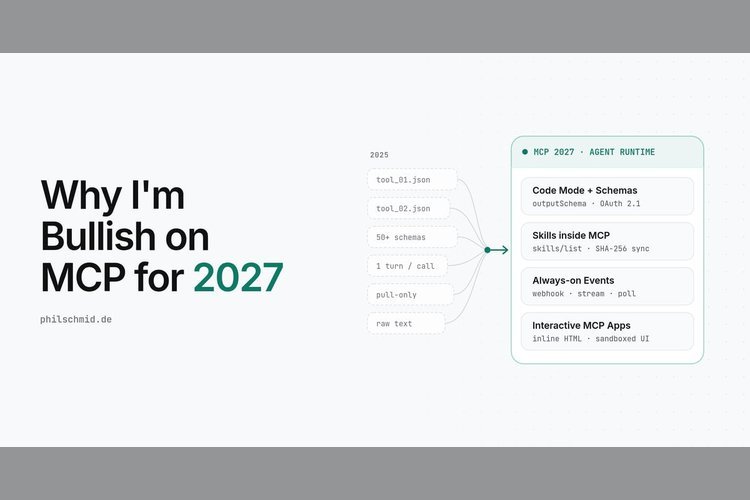
The MCP protocol (Model Context Protocol) is gaining ground again after a rough 18 months, and the numbers from big SaaS vendors explain why. Linear and Notion say about half of the issues and pages created there now come from agents, which works out to some 2.4 million issues a week at Linear, and Notion reports 60 times the MCP traffic it had before. At Atlassian, MCP handles over 5 million tool calls per workday.
The MCP protocol went through a full hype cycle. Early excitement turned to backlash over context bloat, and when Skills arrived many developers moved to command-line tools instead. That sentiment is now shifting.
Who is using MCP at scale
Atlassian says 44% of its MCP users sit outside software teams, where command-line tools were never an option. Neon sees MCP agent usage rising 14% every week. Apple has started shipping local MCP servers for Pages, Numbers and Keynote.
The 2026-07-28 spec release removed stateful sessions and introduced official extensions, which clients are learning to use well.
Code Mode cuts the round trips
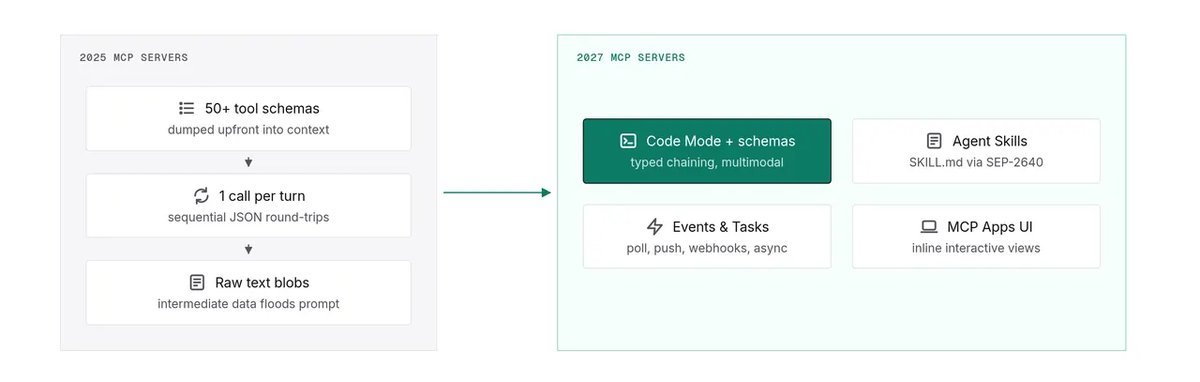
Real tasks usually need several tool calls: list open issues, fetch details, check errors, write a summary. With plain tool calling, each step costs another model turn and pushes more data into the context window.
Code Mode changes that. Rather than stuffing 50 tool schemas into the prompt and making one call per turn, the agent runtime hands the model a sandbox where MCP tools appear as ordinary functions. OpenCode 2.0, Claude Code, OpenAI Codex, Pi and Factory Droid are moving to it as their default.
It works best when servers declare an outputSchema next to the inputSchema. The client can then generate typed stubs up front, and the model can chain calls in one script, filter and join data in memory and return only what matters.
MCP servers can also return images, audio and embedded resources next to typed data. Authentication is simpler too. The client runs a separate OAuth 2.1 login for each user and keeps permission scopes outside the sandbox, so a remote service can be connected without leaving raw API keys on disk for the agent.
Skills move inside the protocol
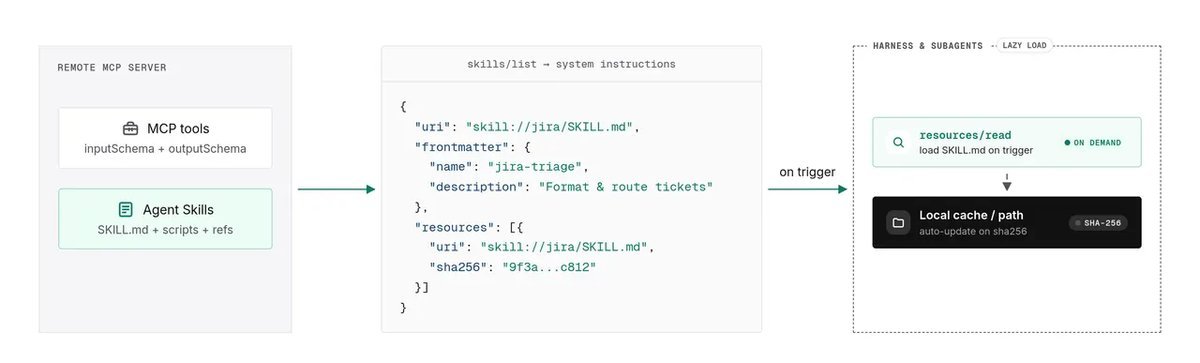
Teams have had to ship a CLI or an MCP server and also maintain separate SKILL.md files. The new Skills extension (io.modelcontextprotocol/skills) puts Agent Skills inside MCP. A skill gets a skill:// address, metadata read from YAML frontmatter, and a manifest listing its files with SHA-256 digests.
The digests solve a familiar headache. If a vendor changes a skill on its server, the digest changes and clients pick up the new version with no manual syncing. Anthropic has put Skills over MCP into public beta in Claude and Claude Code, which lets Shopify, HubSpot and Atlassian servers deliver playbooks matched to the signed-in user’s own account or organization.
Context stays small. At connection time the client requests skills/list and loads only each skill’s name and one-line description. The full instructions arrive through resources/read once the agent needs them.
MCP Events make agents always-on
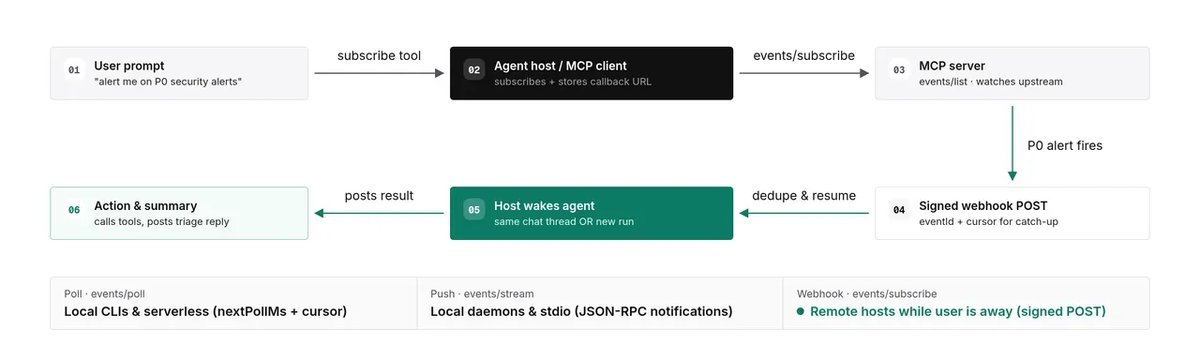
MCP integrations used to be pull-based. They couldn’t wake an agent when something happened elsewhere. The Events extension, now in beta, supports three ways of delivering news:
- Webhook: the server sends signed HTTP POST requests to a callback address while the user is offline.
- Push: the server streams live updates, such as build or deploy logs, over an open connection.
- Poll: the client checks on a timer, which suits local tools without a public URL.
Take a top-priority security alert in the middle of the night. The client keeps a cursor, drops duplicate eventIds and passes the payload on, so the agent wakes, pulls logs and posts a triage summary before a human looks at an inbox. Shop MCP (order updates) and Vercel (deployment.succeeded) already support events. Paired with MCP Tasks, agents can run async workflows without custom webhook code.
MCP Apps bring interactive views into chat
Plain text and JSON fall short when you need to inspect a p95 latency chart or browse a design deck. MCP Apps let servers return sandboxed interactive HTML views inside compatible clients. Slack’s new MCP client, Claude’s interactive connectors and Google Antigravity can already show them in the chat or in side panels.
Gaps that remain
- Observability: a server sees the call but not the conversation behind it, so it rarely learns the reason for a request.
- Discovery: submitting a server to five registries doesn’t scale. A /.well-known pattern with automated security scanning would help.
- Security: untrusted webhook payloads, Code Mode sandboxes and embedded iframes each add routes for prompt injection.
Where MCP goes in 2027
For the MCP protocol, the bet is that the best agent runtimes will win on their MCP integration, and that a client should itself be an MCP server. Subagents could run as MCP Tasks, a shared swarm board could expose tools to post findings and claim work, and Events could wake peer agents when a task finishes.
One design rule follows. Servers should give agents tools, not present agents as tools. Hiding an entire SaaS product behind one ask_agent endpoint cuts it off from the context the calling agent already has. Typed tools and structured data are the better default, with agent-style servers reserved for long-running coordination across teams or companies.
Source: philschmid.de