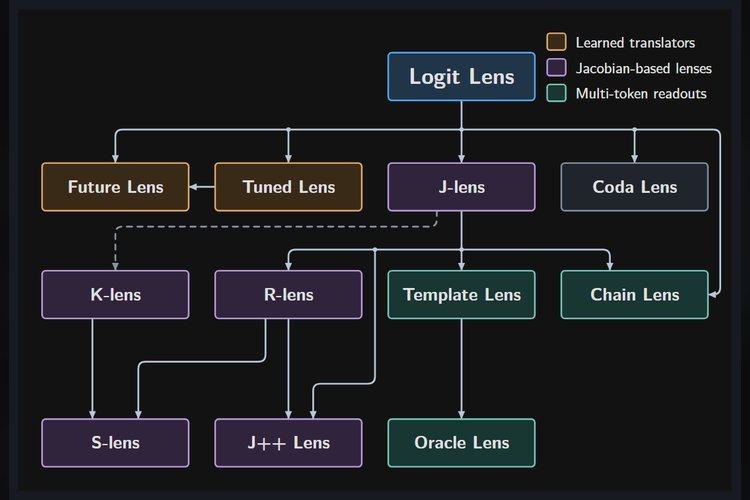
A new explainer catalogs the logit lens and its many variants, the tools interpretability researchers use to read what a language model is “thinking” at intermediate layers. The guide covers the original logit lens, the tuned lens, the J-lens and several newer descendants. Its main yardstick is how well each one reads a model’s global workspace.
What a lens does
A lens takes a model’s internal activations and turns them into something humans can interpret, usually a distribution over tokens and sometimes a multi-token sequence. The goal is an output that looks like the model’s workspace and may be causally relevant. Labelled SAE features and labelled MLP neurons arguably count too, though they don’t carry “lens” in the name.
The global workspace is, loosely, the set of concepts a model can report on and manipulate on demand. Ask for the colour of buses in the city that contains Buckingham Palace, and you’d expect concepts like bus, city, London and red to show up along the way.
The logit lens and its limits
The original logit lens, introduced by nostalgebraist in 2020, is simple. It applies the unembedding matrix at an intermediate point in the residual stream, which amounts to cutting out the transformer blocks after that point.
It works as a best guess at the next token. That’s also its weakness. Information meant for a later layer has no reason to line up with the unembedding directions, so output from lower layers is hard to read. The guide calls the resulting shift in how concepts are represented across layers representational drift.
It also targets the workspace poorly. In the Buckingham Palace question, “London” is an unlikely final answer, so the model may never push the prediction toward it even though it clearly uses the concept midway.
Tuned lens: correcting the drift
The tuned lens, from Belrose and colleagues in 2023, trains an affine translator to approximate the remaining layers. If drift is roughly affine, this gives cleaner readouts, especially in early layers.
It rests on two assumptions that aren’t fully true. Tuned lenses do give more coherent early-layer output than the logit lens. But the translator can sometimes mimic the skipped layers too well, hiding the intermediate concepts a researcher wanted to see. Because it is trained to predict the final output, its distribution converges toward that output at later layers, so it still misses workspace content that diverges during multi-step reasoning.
J-lens: a workspace reader
The guide calls the J-lens a significant improvement. It comes from Anthropic’s 2026 paper “Verbalizable Representations Form a Global Workspace in Language Models”. For each layer it estimates the average linearized effect of an activation on the model’s chance of producing a given token, now or later, averaged over a large corpus.
That uses an average Jacobian. Computing it exactly is intractable for large models, so it’s estimated by backpropagating across many contexts. The directions it defines are called J-space.
The empirical evidence is that J-space behaves like a workspace. Adding or subtracting J-lens vectors changes model output the way a workspace should, and the model can introspect on concepts in that space and manipulate them on command.
Future, template and chain lenses
- Future lens (Pal et al., 2023): patches a hidden state into another context and uses a learned soft prompt to read out several tokens. It was the first multi-token lens as far as the guide’s author knows, but it isn’t a workspace lens, because later layers can skip the intermediate inputs.
- Template lens: handles multi-token concepts, a limit of the single-token J-lens. It compares an activation with the mean activation difference for each concept, using whitened vectors.
- Chain lens: adds multi-token prediction heads and contrastive decoding to get multi-token output from the J-lens.
R-lens and J++ lens
The R-lens (camilablank and colleagues, 2026) swaps backpropagation for Layerwise Relevance Propagation. It tracks average contribution instead of first-order sensitivity, and it performs better in early layers than the J-lens.
The J++ lens (Ayonrinde and Lindsey, 2026) builds on that and adds Jacobian filtering plus readout filtering to tokens with semantic meaning. It splits activation space into subsets and fits an “expert” Jacobian for each, echoing mixture-of-experts. Weights are then tuned on a benchmark of latent-variable extraction problems. The authors report that filtering accounts for most of the gain over the J and R lenses. Removing the worst experts improves the R-lens, and the single best expert recovers most of the J++ uplift.
The guide’s author says it isn’t yet clear what mechanism explains that result.
How to choose a lens
The guide is organized so prerequisites come before each lens, and it points readers to a decision table for picking one. A benchmark called WorkspaceBench tests how well lenses read a model’s workspace.
In short, the original is the cheapest start, the tuned lens corrects drift, and the J family is built to read workspace content.
Source: lesswrong.com