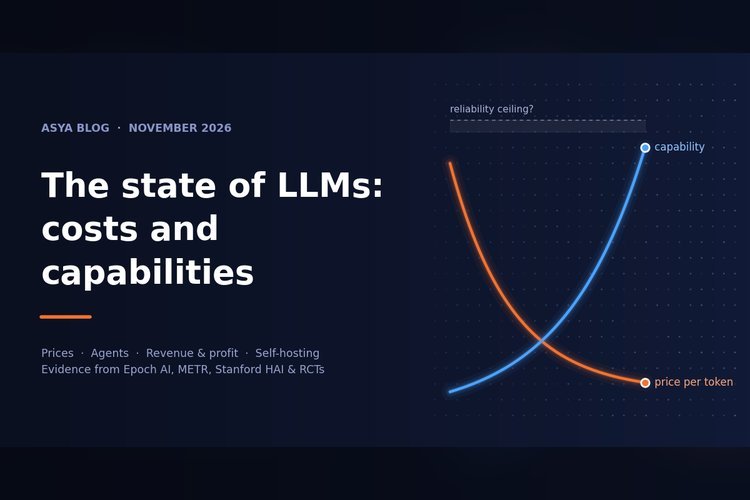
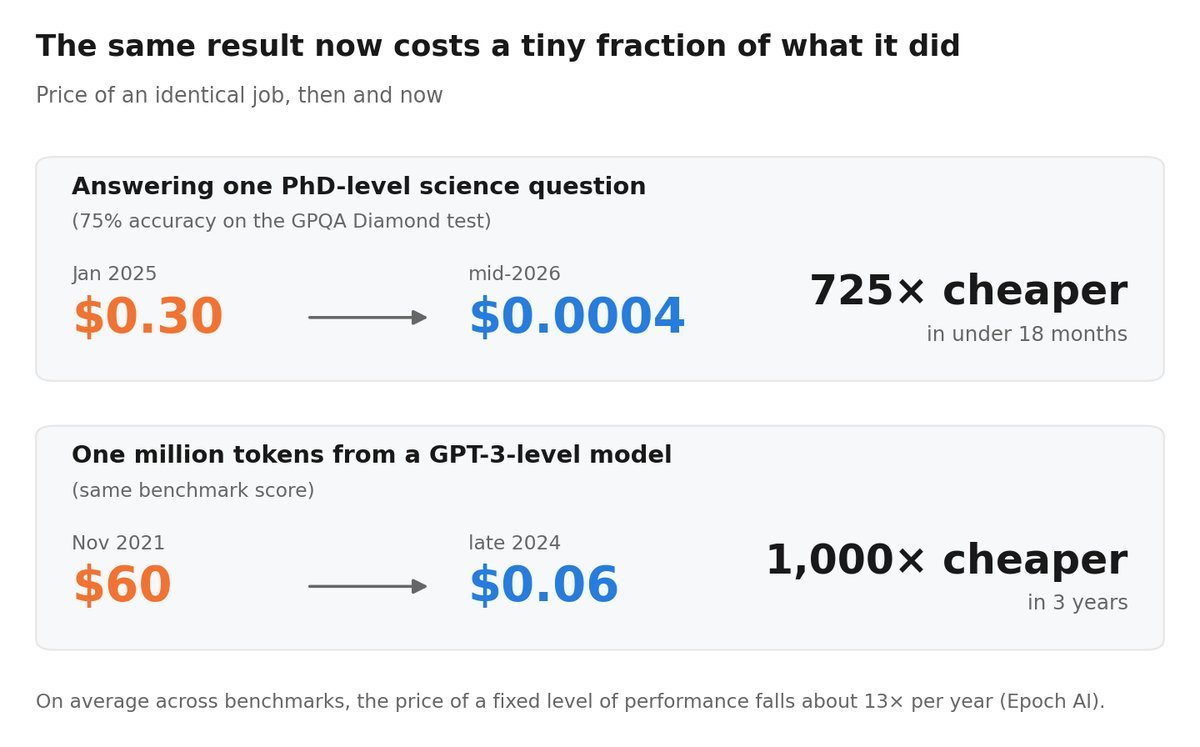
LLM costs are collapsing per token and still climbing per company. Epoch AI’s tracking shows the price of hitting a fixed benchmark score has fallen about 47% a quarter since 2023, roughly 13 times a year, yet business spending on tokens is flat or rising because usage is growing faster than prices fall.
That gap is the central fact of LLM costs in late 2026, and it changes how teams should budget, buy hardware and pick models.
Prices are falling faster than any past technology
Epoch compared its figure with other technologies. The decline is about 4 times faster than DNA sequencing costs, 6 times faster than compute, 18 times faster than lithium-ion batteries and 54 times faster than electricity between 1892 and 1973. One example: answering 75% of the PhD-level science questions in GPQA Diamond correctly dropped from roughly 30 cents each to a fraction of a tenth of a cent in under a year and a half.
A separate analysis of OpenRouter and Epoch data lands in the same place: a roughly 600-fold drop from GPT-3’s $60 per million tokens in 2020 to $0.10 on economy models by early 2026.
One warning applies to every figure above: they are benchmark-based. Models can be tuned to the test, and the math presumes buyers always move to the cheapest model that is good enough. Few do, so actual savings run lower.
Market prices roughly halved this year
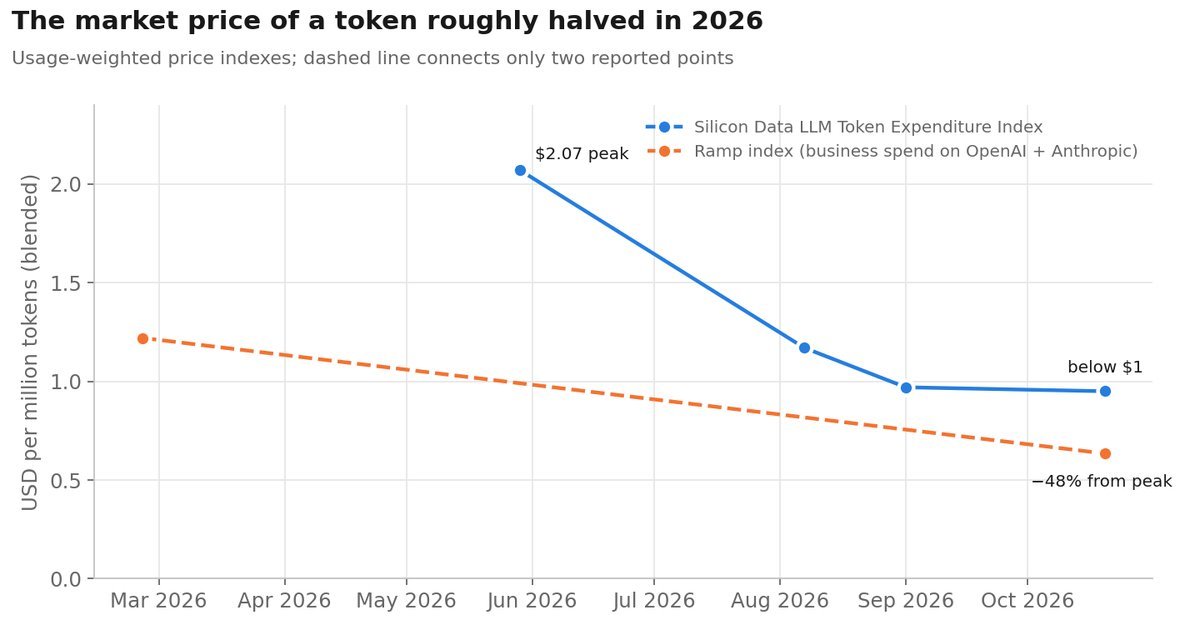
Spending data points the same way. A usage-weighted index from Silicon Data slipped under $1 per million tokens in October, 54% below its $2.07 level in late May. Ramp’s index of real business spend on OpenAI and Anthropic sits 48% under its February high. Three things drove it: a shift to cheaper open-weight models, price cuts at the major labs, and agents reusing cached input, which is billed at a steep discount.
Why the bill still isn’t shrinking
Ramp saw token usage at businesses keep growing for two straight months while spend stayed level. Gartner projects that serving a trillion-parameter model will get over 90% cheaper for providers by 2030, yet it doesn’t think enterprises will keep most of the saving, and it expects total inference spending to rise.
Reasoning models think at length and burn tokens on every answer. Agents are worse: one that plans, calls a tool, reads the output and retries can use a hundred times the tokens of a single chat reply. OpenAI reports that its enterprise customers consume about 320 times as many reasoning tokens as a year ago. McKinsey’s 2026 survey found roughly a fifth of organizations already hold back usage because of what it costs to run.
Rising LLM costs are why Epoch and Artificial Analysis now report cost per task rather than per token. A cheap model that thinks for ten minutes can cost more than a pricier one that answers fast.
Self-hosting got more expensive
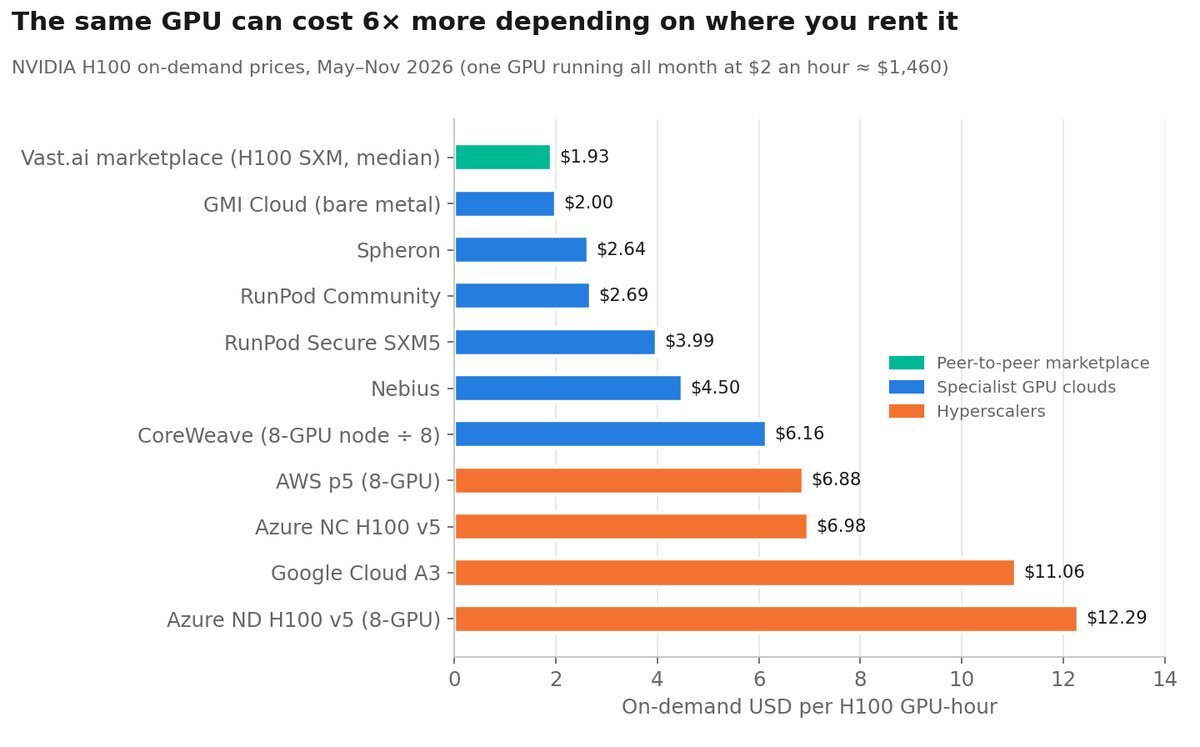
Token prices fell while GPU rents rose. An on-demand H100 ran about $2 to $4 an hour at specialist providers in October, against $7 to $12 at the hyperscalers. On Vast.ai the median H100 listing was $1.93 an hour on 16 November, which is still about $1,400 a month for one card running continuously.
AWS raised H200 instance prices 15% in January, its first GPU price increase in about twenty years.
Whether owning pays off depends on how busy the GPU is. A Carnegie Mellon paper modeled total cost of ownership and put break-even at a few months for small models, about two years for medium ones and close to five for large ones. Steady, high-volume work is the only reliable case.
Buying hardware costs far more than it did
Memory is the cause. Data centers could take up to 70% of the memory made in 2026, and DRAM contract prices jumped about 90% in the first quarter alone. Apple has said it never saw a component get this much pricier this fast.
- The RTX 5090 launched at $1,999. Its cheapest US listing climbed from $3,500 in February to $9,400 by October.
- The RTX PRO 6000 Blackwell with 96 GB went from $8,565 at launch to $16,000 in August.
- Apple dropped the $599 Mac mini, and the entry Mac Studio rose by $500 to $2,499.
Renting an RTX 5090 on Vast.ai cost a median $0.63 an hour in mid-November. At current purchase prices, buying only wins after about 1.7 years of nonstop use. Hardware bought a year or two ago is now worth more than its purchase price, a rare event for computers.
Agents are finishing longer tasks
METR’s 50% time horizon measures the task length, in human expert time, at which an agent succeeds half the time. Its top published result under the current method is 17.4 hours for an early Claude Mythos Preview, with a 95% confidence range of 8.5 to 55.1 hours. Claude 3.7 Sonnet sat near 50 minutes in early 2025.
That doesn’t mean a model runs unattended for 17 hours. Demand 80% reliability and the same model’s horizon shrinks to about 3 hours. METR also says its tasks can’t reliably measure anything past 16 hours.
Choosing models in a split market
Nine to 18 November brought six flagship and mid-tier releases from Anthropic, Google and OpenAI. Artificial Analysis ranks Gemini 4 Neon first for finance and legal tasks and Claude Fable 5.2 first for engineering, with GPT-6.2 Astra just behind both. Nothing wins across the board.
Policy risk matters too. In June, Anthropic paused access to Fable 5 and Mythos 5 three days after launch to satisfy US export controls, then turned them back on 1 July. Teams that depend on one top-end model should plan for an interruption.
For anyone budgeting LLM costs, the practical lesson is simple: track cost per finished task, send every task to the least expensive model that copes with it, and rent before you buy.
Source: Asya