
A veteran developer says three inflection points in LLM coding ability have arrived in the past twelve months, and the latest may be unfolding now. The LLM coding inflection points, outlined in a recent AI Engineer Code Summit keynote, run from Claude Opus 4.5 last November to 3D modeling and game design this fall.
Today, November 24, 2026, is the first anniversary of Claude Opus 4.5. The speaker calls it a consequential model.
November 2025: coding agents become reliable
Claude Code was nine months old then, introduced with Claude 3.7 Sonnet on February 24, 2025. Opus 4.5 was the first model the speaker used with it where the default result was usually right. Before that, constant corrections kept Claude Code from being a daily driver. After it, most everyday problems were solved faster than by hand.
OpenAI released GPT-5.1 Instant, GPT-5.1 Thinking, GPT-5.1-Codex and GPT-5.1-Codex-Max the same month, and Codex became reliably useful too. Many developers tinkered over the December holidays and used the tools for real work by January.
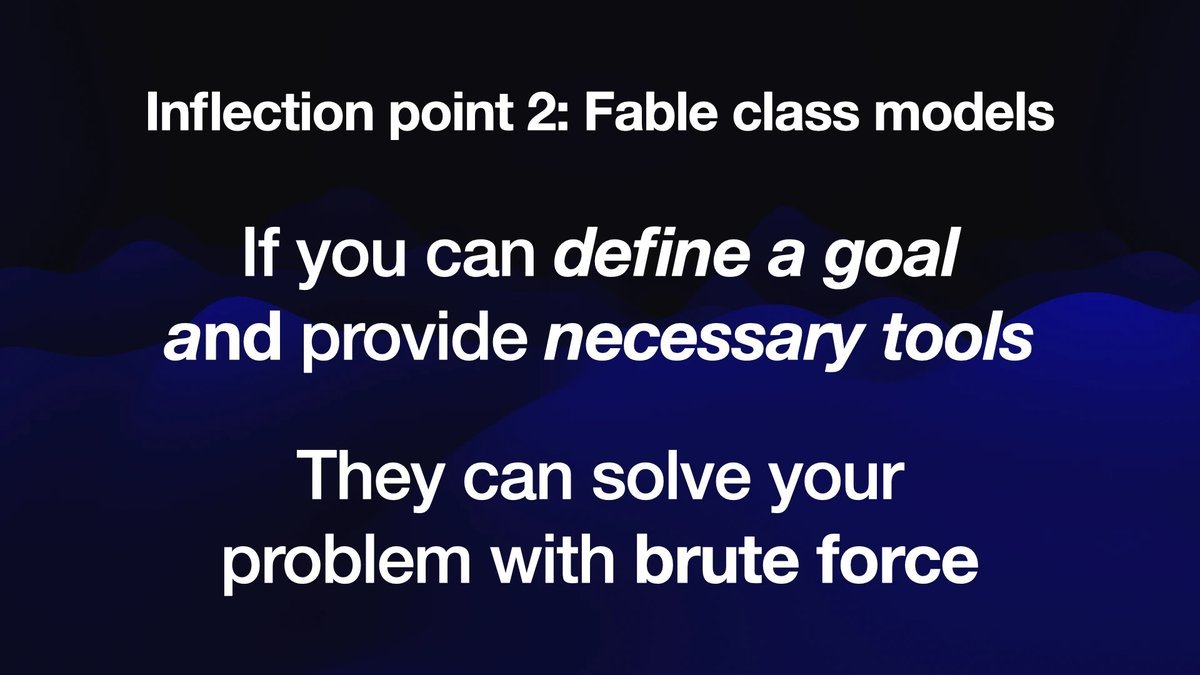
June and July: Fable-class models
In April, Anthropic announced Claude Mythos and held it back as too dangerous, citing its ability to find and exploit security flaws. In June came Claude Fable 5, a restricted version that blocks security work. The US government placed it under export controls after three days, and it returned on July 1.
The speaker calls this group Fable-class models. One example: asked to fix a display glitch in Safari, Fable built its own screenshot tool and a CORS-enabled localhost logging server. More recently, Opus 5.5 and Fable 5.2 were given five WebAudio microphones in a room full of boxes and pinned down a mystery beep to within about 40 cm.
The speaker counts Fable 5, 5.1 and 5.2 and Opus 5.5 (a “cheap Fable”) in this class, plus GPT-6 Astra, and possibly Gemini 4 Neon. The class is now the baseline for a frontier model.
September and October: 3D and game design
Over about four months, frontier models got good at 3D modeling. With Blender or Three.js, they produce credible models of almost anything. The speaker saw it first in Fable 5, then more clearly with Opus 5.5, GPT-5.6 Sol, GPT-6 Astra and the Gemini 4 family.
The bigger surprise was fun. In August, a raccoon heist game built by Fable 5 looked like a game but played poorly, and GPT-5.6 Sol Ultra’s version got dull after 90 seconds. The speaker took comfort that game design stayed human. Then Opus 5.5, released September 22, 2026, was told to make a Command & Conquer-style game much more fun. After 12 hours of playtesting and rebalancing, it went from boring to entertaining overnight.
The speaker has since seen worthwhile games at two conferences. The indie scene is in a culture war over AI-assisted programming, and some call GTA VI the last pre-generative-AI blockbuster.
Is Fable 5.2 a fourth?
If so, it would be the fourth of the LLM coding inflection points in a single year.
The speaker is undecided. They say the model’s taste almost matches their own and that it has cleared problems they had put off for years. In three weeks it helped ship Datasette 1.0a42 to 1.0a44 and LLM 0.37 to 0.38.
If it counts, the defining feature is that anyone who can clearly describe a piece of software can have Fable build it. The speaker says software development has changed beyond recognition in a year and doesn’t expect to go back to typing most code by hand.
What to watch from here
These LLM coding inflection points also changed how people work. Before Opus 4.5, developers corrected agents constantly and treated them as occasional helpers. Now many hand over whole features and review the result.
The speaker also notes that vision models need good 3D spatial awareness for robotics, and it is unclear whether the labs targeted that skill or got 3D modeling as a side effect.
Each inflection point came with a short list of models and a clear before and after. Developers weighing these tools can compare releases against that timeline. The next test is whether Fable 5.2 changes habits as much as Opus 4.5 did.
Source: Simon Willison’s Weblog