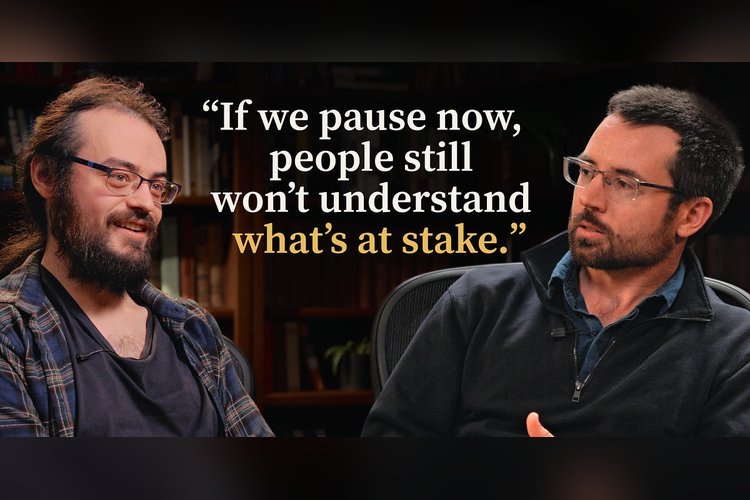
Two AI researchers who disagree sharply on the superintelligence timeline ended up agreeing on a lot more than expected in a long recorded conversation. Daniel Kokotajlo of the AI Futures Project thinks an intelligence explosion that produces AIs better than any human expert before 2029 is more likely than not. Ege Erdil, a researcher at Google DeepMind, puts it at around 20%.
Where the numbers split
Kokotajlo is one of the authors behind the AI 2027 and AI 2040 scenarios. His case rests on automation of AI research itself. He believes the field is close to fully automating that process, most likely in 2027, with 2028 or 2029 as other possibilities. Once that happens, he expects progress to speed up sharply, and for current weaknesses such as data inefficiency to fade quickly. He calls the resulting systems “top-expert-dominating” AIs and treats them as effectively superintelligence.
Erdil’s disagreement centers on the software-only singularity. That idea holds that, with a fixed pool of compute and non-synthetic data, better AIs use those resources more efficiently to advance AI research. The feedback loop then runs for orders of magnitude, perhaps delivering ten years of progress in six months. Erdil says the evidence doesn’t justify high confidence in that, and gives it 10% to 20% over the next three years.
Even without that kind of loop, Erdil says, his median for everything being automated is 15 to 20 years away. That still leaves roughly a 20% chance within five years, which he calls a live possibility.
Why the gap matters less than it looks
Erdil argues the numerical gap isn’t a deep one. One side says something is 50% to 60% likely over three years and the other says 20%. If the outcome would be very bad, both agree it’s worth acting on even at 20%.
They also share a view that the situation is strange enough that society has to work out how the world could be transformed and produce a plan that makes sense.
Pausing and the China question
The two part ways on practical choices. Kokotajlo asked why Erdil works at Google rather than protesting outside an AI lab. Erdil answered that he distrusts plans that act on risks before any significant cost has shown up in the real world. He called the Hugging Face incident, often cited in these debates, small compared with something like a plane crash. He compared the situation to nuclear reactors or aircraft, where intervening on theory alone worries him.
On geopolitics they converged. If a global treaty will be needed to make superintelligence go well, the pair argued, the US should stop antagonizing China.
Will AIs treat humans well?
Another crux was how future AIs, which could far outnumber and outthink humans, would treat people, and how much weight to give the fact that today’s models mostly seem friendly. They also discussed whether misalignment itself might slow recursive self-improvement, and whether AI research is as verifiable as it sounds.
Predictions for 2027
Kokotajlo expects 2027 to look like his AI 2027 scenario, though he says he isn’t confident. He thinks AI research is somewhat more likely than not to be fully automated that year unless governments or companies slow down, which he considers substantially possible. He says he is working to make a slowdown happen. In a no-slowdown world, he suggested, a leading lab might stop serving customers and put all of its compute into R&D instead of about 70%.
Erdil’s median for full automation is 2040. For next year he expects:
- AI systems that can beat any video game on Steam
- robots that handle simple physical tasks, such as folding laundry, at roughly human speed
- much better computer use for knowledge work
- revenue at the top AI company reaching $250 billion to $300 billion a year, roughly 2.5 to 3 times what he estimates now
He argued that folding laundry in real time is worth more economically than a headline math result, even if the math is far more impressive for a human.
What to watch in 2027
The forecasts are easy to check. If a lab declares fully automated AI research next year, Kokotajlo’s timeline gains weight. If revenue and robotics follow Erdil’s smoother curve, his slower view holds up. Either way, both researchers want the planning and the diplomacy to start before the answer is known.
Source: dwarkesh.com