Kiro’s engineering team has open-sourced the prompts and skills behind its software factory, a setup where agents handle every stage of development and call on a person only when a decision is needed. About 85% of the open items on the team’s own task board already have a pull request attached.
The problem they set out to fix: agents got faster at writing code than people got at reviewing it. Pull requests grew larger and arrived more often, and each one had to answer whether the code works, whether the approach is right and whether the problem is worth solving at all.
Human attention is the limit
Design reviews help, but nobody can hold one for every change, and the implementation keeps shifting afterward. Review agents and shared skills cover part of the gap. They can’t capture everything a good reviewer knows about a codebase and its evolving team practices. Everyone also configures their own agent setup a little differently, so the team has no single bar to count on.
So the Kiro team built the software factory around where attention goes. The factory handles task management, context gathering and coordination. People spend their time on the decisions that matter, and the factory gives them enough context to make each one.
Seven stages, one worker each
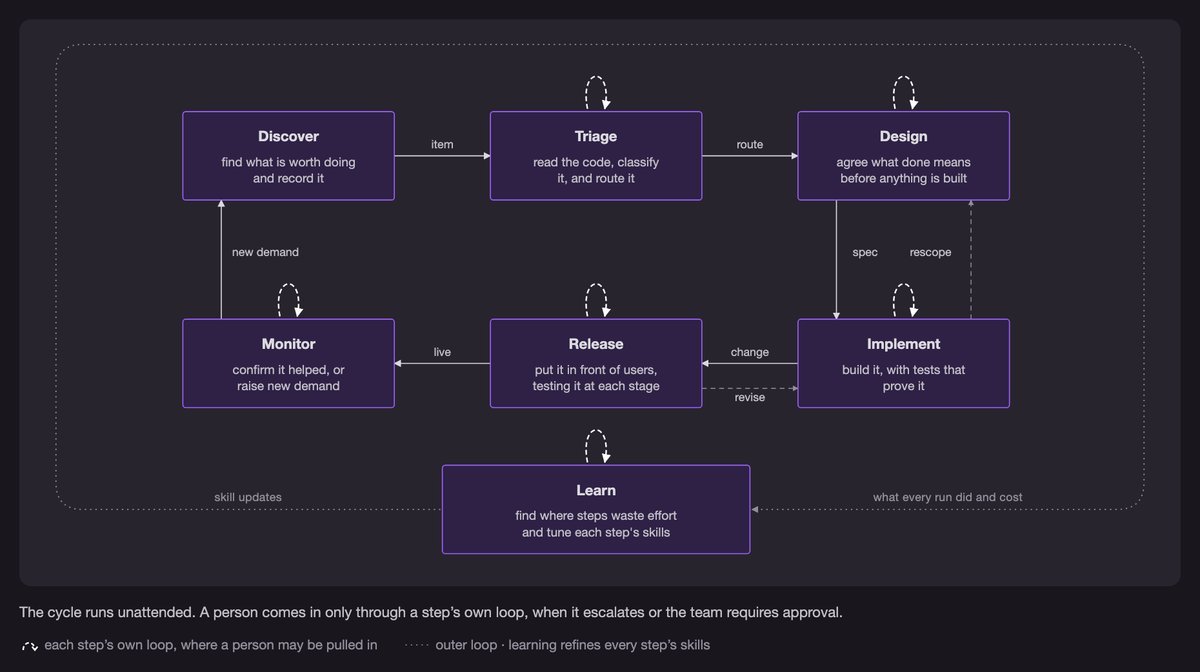
Every work item moves through the software factory in stages, and each stage settles part of the “is this worth doing” question before a pull request exists:
- Discover files new items onto the board.
- Triage inspects the code, pins down the problem and names the engineer, product manager or designer who should weigh in.
- Design drafts a spec for changes that warrant one, and a human signs off if team policy demands it.
- Implement writes the code and its tests, then deals with reviewer comments and CI failures on its own.
- Release carries the change out to users.
- Monitor looks at production to see if the change did any good, and files follow-ups when it didn’t.
- Learn updates the skills that the other steps depend on.
Each stage has a dedicated worker agent. Workers fire on a timer from a shared host and take over whatever the previous stage left behind. They remember nothing between runs, so all context is stored in the ticket or the pull request.
Checks before a person looks
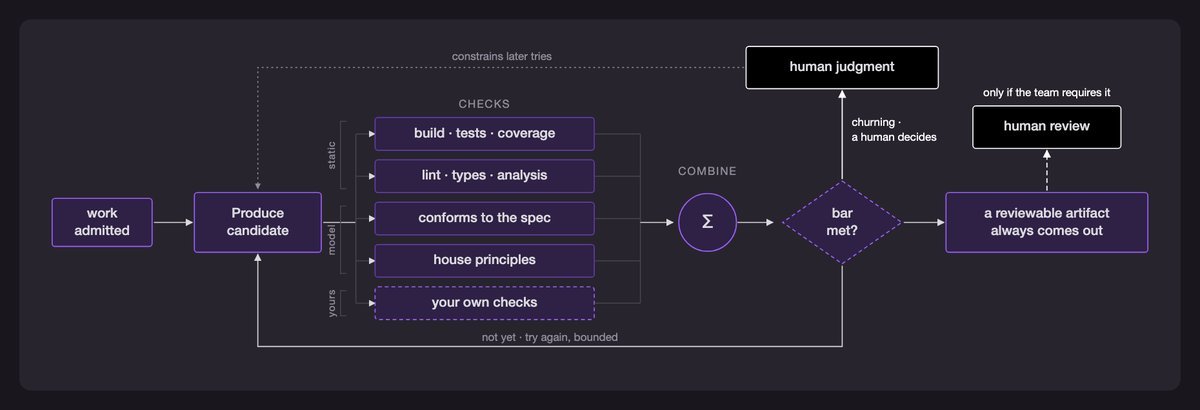
Every step produces a candidate and tests it against signals the team trusts: the build, tests, review agents and agreed practices. If it misses the bar, it tries again or takes another approach. If it keeps churning, the step stops, which is how a small fix avoids turning into a subsystem.
The step also leaves something reviewable. For a code change, that’s a pull request with a page written from the run’s own checks. It explains the reason for the change, the alternatives that were considered, and the result of each check, including any that were skipped. Often a person reads that page instead of every line of code.
A factory that learns from corrections
Shared skills in a repo spread to everyone, but a person must spot a lesson and record it first. The factory skips that. Corrections already sit in tickets and pull requests, so the Learn step goes through all of them on every run and suggests edits to current skills.
The team calls the written-down setup the Manual. A team adopting it writes an instance, meaning its own configuration and skills on top, which links the Manual to that team’s repo, board and hosting. The Manual ships with Kiro CLI as the runtime. Kiro’s own instance runs on a schedule in Lambda MicroVMs, with items on a task board and changes going through GitHub pull requests and CI.
Safety and pace
The main branch keeps its training wheels. Nothing ships without a person’s review. After a person merges a change, Release tracks it through the Kiro builds that users get. An internal edge build, which includes changes not yet merged and even implementations built ahead of design approval, gives the factory room to make mistakes safely.
On the team’s board, 14% of open items are held up on a question the factory raised with a human. More than twice as many wait on a review the team requires before merging. The team prefers proving that lighter review is safe over assuming it, so its instance aims to collect evidence on which changes could ship with no reviewer.
Pace was a problem too. The Implement review loop escalated to a person whenever rounds stopped converging, even when the choice was easy to reverse, and work sat waiting. Now it makes reversible calls itself and notes both the choice and the runner-up in the pull request summary.
Throughput also comes before latency. Implement handles one item per scheduled run, so any single item may finish slower than if an engineer did it. An urgent item can be started manually. The team prefers a lot of work progressing in parallel with no one steering each piece.
What the team is watching next
The team tracks how much the factory ships, but watches something else more closely: how often it needs a person, and whether that was the right call. The team calls the work early and unsolved. Teams building their own software factory can now start from the Manual instead of a blank page.
Source: kiro.dev