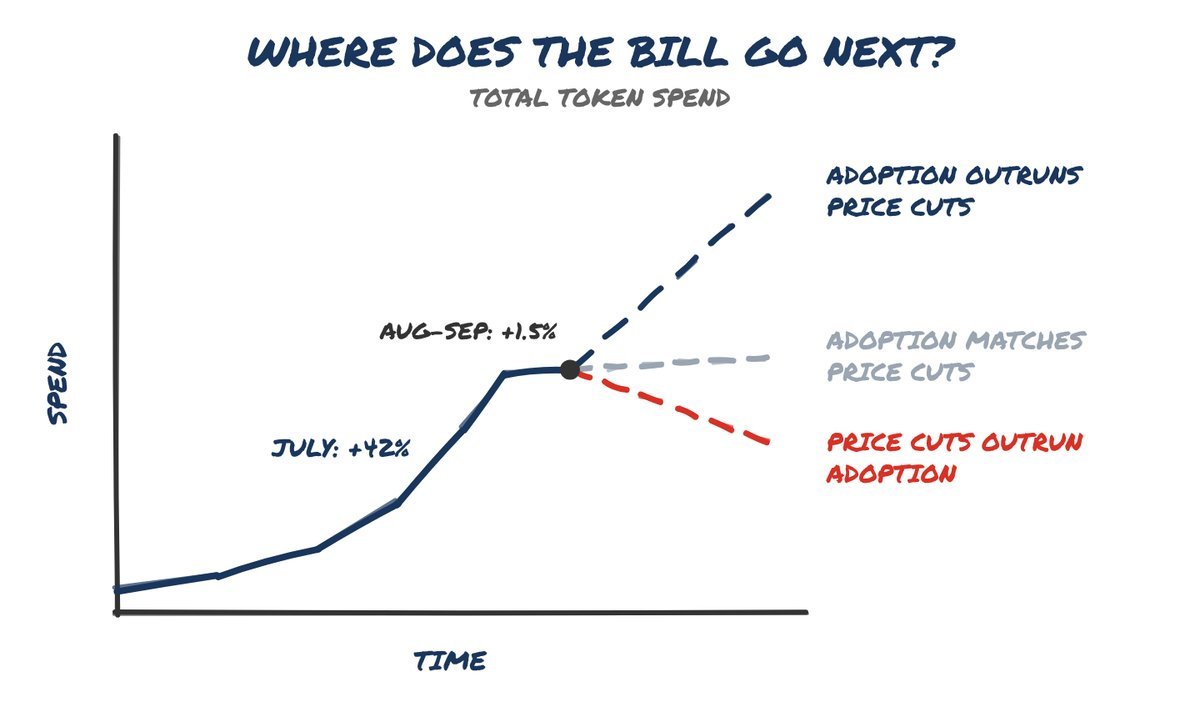
Has Jevons paradox broken down? Ramp CEO Eric Glyman thinks so. He said on a recent podcast that the paradox “broke” over the past two months, after growth in business token spend on Ramp fell from 42% in July to 1.5% across August and September combined. The data is thin, and the broader picture suggests demand is stalling for organizational reasons, not because tokens stopped getting cheaper.
What Ramp’s numbers show
Jevons paradox says that making something cheaper pushes usage up so far that total spending rises. Ramp is a corporate card and spend management company, so it sees what tens of thousands of businesses pay for AI tokens. A drop from 42% to 1.5% looks dramatic.
The data has limits. It’s noisy and skews toward venture-backed tech companies. It also misses spend that never touches a Ramp card, such as large contracts paid by bank transfer or tokens bought through a cloud provider. One more figure matters: Ramp says the top 1% of spenders account for 80% of all token spend. If heavy users hit a ceiling, it shows up fast in the totals.
Why heavy users may be plateauing
Some of the slowdown comes down to people, not prices. Developers who run coding agents report that their own attention has become the limit. Work that once took weeks of planning while implementation ran now comes back in hours, and someone has to review all of it.
One workable habit is to cap new task launches at an hour a day and spend the rest of the day reviewing results. That hour generates more than enough to fill the day, so the models aren’t the constraint. Burnout is a real worry for the people making product and engineering decisions at this pace.
There’s a second effect. When a model can finish weeks of engineering work in minutes, software starts to feel disposable. The grind of getting something working used to keep people motivated, and without it, finishing a project gets harder. Teams also risk “featureitis,” the pile-up of features that turns a product into a mess. Saying no to features remains a competitive advantage.
Four stages of AI adoption
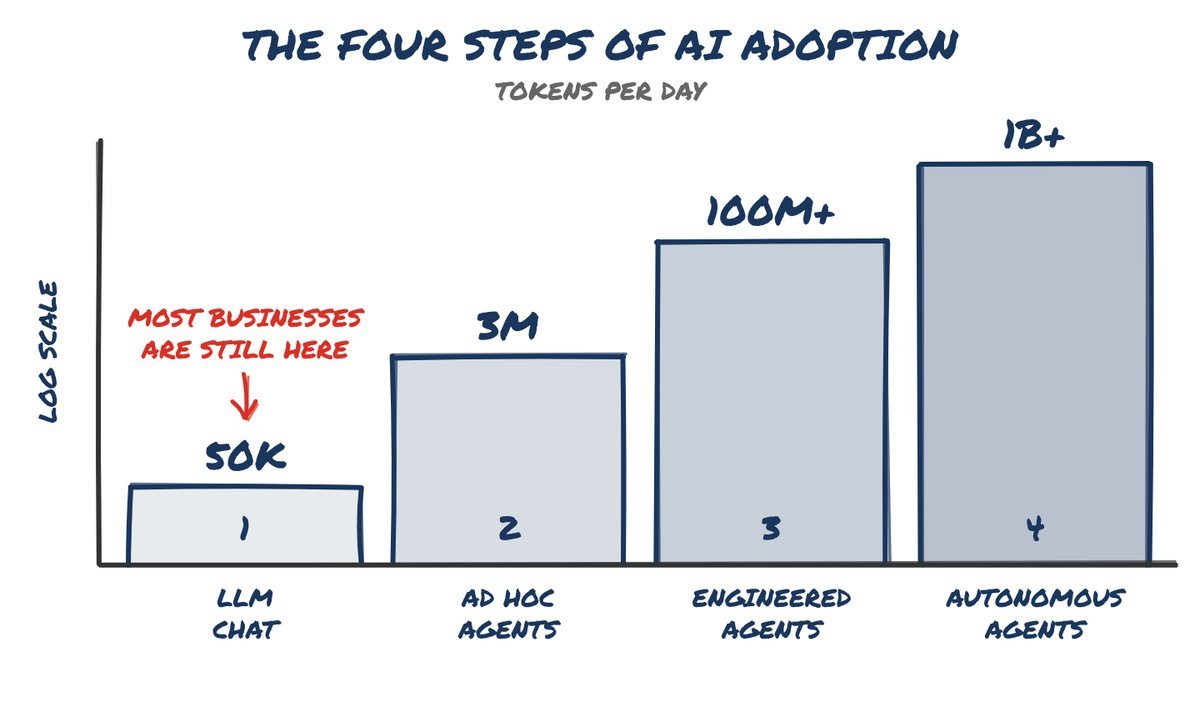
The more useful argument is that usage depends on how deeply an organization has adopted AI. There are four stages, each using far more tokens than the last.
- LLM chat. Occasional conversations with a chatbot. Most businesses are here, and some still lack even basic chat access. It’s light: a few thousand tokens per conversation, or about 50,000 tokens a day per person.
- Ad hoc agents. A sizeable minority of organizations are moving toward agentic workflows. Software engineering leads, with most firms adopting tools like Claude Code. Elsewhere adoption lags, often blocked on access control. An agent re-reads its whole context on every tool call, so one session a day is roughly 3 million tokens. The median Claude Code session in this estimate is 2.6 million.
- Engineered agents. Autonomous agents run long, repeatable business processes, triggered manually. Common in software engineering and vanishingly rare outside it. Usage reaches hundreds of millions of tokens a day.
- Autonomous agents. Agent processes run on their own and spawn other workflows, sometimes recursively. Think of a software factory, or whole departments run by a fleet of agents. That could mean billions of tokens a day.
On that scale, there are at least four orders of magnitude of consumption left to grow into.
A pricing problem or an organizational one?
Cheaper tokens increase usage within a stage. Moving up a stage is an organizational change, and price cuts don’t deliver it. That’s why the paradox may look broken in a snapshot without actually being broken.
The real contest is between two speeds. Token prices are falling fast, and even faster per unit of intelligence. Organizational change, and with it agent adoption and token use, has to outpace that decline for total spend to keep rising. Glyman himself reckons most frontier-model spend could be handled by a simpler model.
It’s hard to call. Most organizations have adopted AI slowly and often poorly. On the other side, startups built around agents for dull business processes could spark the jump in consumption.
Where efficiency could stall
Prices can’t fall forever. Video compression made huge efficiency gains in the late 1990s, then hit diminishing returns quickly. Language models may follow the same curve. Nobody knows whether they’re at the MPEG-1 stage or the H.264 stage.
Watch two things in the next few quarters: whether Ramp’s growth rate recovers after the August and September dip, and whether non-engineering teams move from chat to engineered agents. If they do, token demand has plenty of room. If not, the plateau may last.
Source: Martin Alderson