
Is there an AI bubble? The question is back after a rough few weeks for tech stocks, and the spending numbers explain why. Amazon, Microsoft, Alphabet and Meta are expected to put roughly $700 billion into capital spending this year alone. In mid-2024 the industry’s AI capex was estimated at $100 billion to $200 billion, against about $1 trillion invested during the internet boom.
One investment analysis revisits that older call and concludes the cycle still has room to run, mainly because buyers are still queuing for compute.
How big the numbers have become
AI spending now shows up in national growth figures. Recent estimates say AI investment added 0.5 to 1.3 percentage points to US real GDP growth, which is between a fifth and a third of total expansion.
Revenue has moved just as fast. Anthropic was cited at $200 million in annual recurring revenue in 2024. By the third quarter of 2026 it booked $17 billion in a single quarter. It also completed the largest IPO on record this month, three and a half years after its commercial launch.
Why confidence wobbled
At this scale, a small shift in assumptions about compute demand, borrowing costs or politics could rattle the whole sector. Several shifts landed together. Democrats won both houses of Congress, which clouds US AI policy. A more hawkish Federal Reserve put rate hikes back on the table just as investors were questioning the balance sheets of neoclouds like CoreWeave. Nvidia then announced Jensen Huang’s resignation and reinstated him eleven days later. Even after the rally on November 23, the Philadelphia Semiconductor Index sat roughly 40% below its June closing high.

What past booms teach about supply and demand
The analysis leans on Alasdair Nairn’s history of technology cycles. In railways, electricity and the internet, investors usually got the direction of demand right. What they missed was how much capacity competing operators would build on those forecasts. Every collapse followed the same path: supply overshot, operators cut prices, margins shrank, and the debt taken on during the expansion became hard to service.
By that test, the current AI bubble question comes down to whether supply is catching demand. The analysis puts the cycle in the fourth or fifth inning, up from the first or second in 2024.

Signs the AI bubble hasn’t formed: demand still ahead of supply
Buyers looking for compute are already discussing delivery in 2028 and beyond. Andy Jassy said AWS was largely sold out through 2027 and already had major commitments for 2028. CoreWeave estimated qualified demand through 2027 at about ten times its available capacity, and some customers pay the full contract value upfront.
Developers have felt it directly. In late March 2026, Anthropic applied five-hour usage limits at peak times, and the next month GitHub briefly paused new Copilot Pro and Pro+ sign-ups.
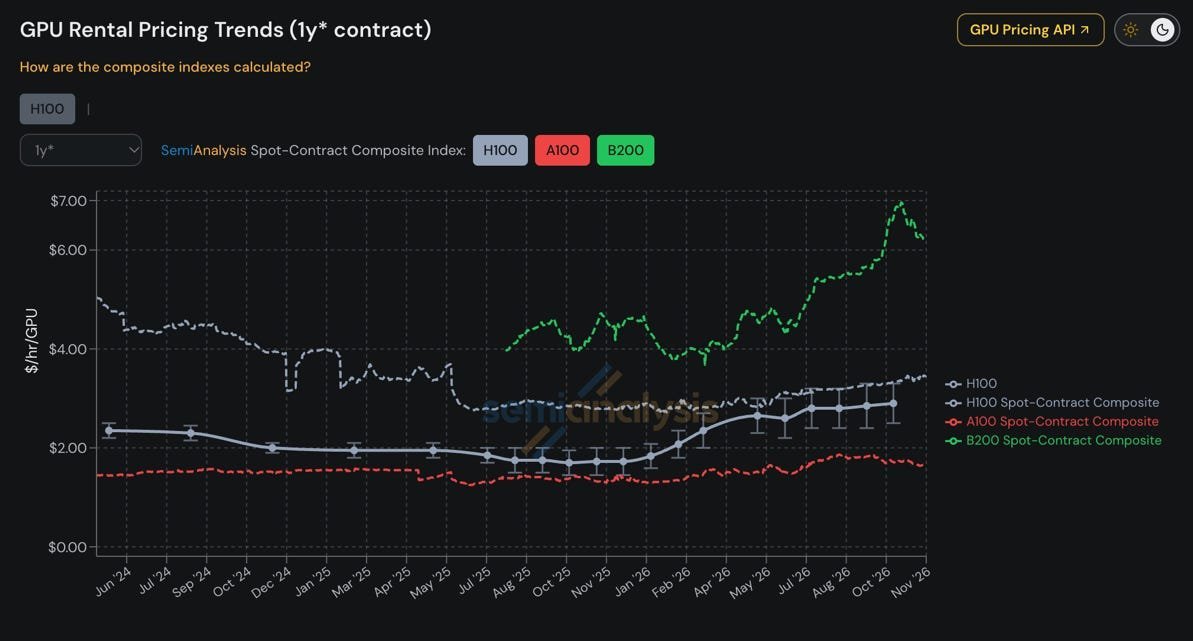
The cleanest signal may be older chips. If the industry had overbuilt, prices for last-generation hardware should fall after each upgrade. SemiAnalysis found the midpoint rate for a one-year H100 rental rose nearly 40% between October 2025 and March 2026, even after Blackwell chips arrived. CoreWeave disclosed three-year deals for A100 and H200 capacity, with renewals priced above the original contracts. Nebius said short-term clusters cost more than twice its reserved rate.
Why AI demand behaves differently
Three differences set AI apart from earlier technologies:
- It needs no network effect. A railway gains value as it reaches more places, but one person with a chatbot can write, code or build a presentation on day one.
- It found a paying use early. Developers saw gains immediately and teams paid a premium, while e-commerce and social media took years to reach scale.
- Its costs are more variable than fixed. Once fiber is laid, one more email costs almost nothing, but each AI response needs fresh inference compute.
That last point means compute demand grows on two axes at once: more users, and more work delegated by each user.
Adoption is still early
Microsoft estimated that only 19% of the world’s working-age population used generative AI in June, mostly in North America, Europe and Australia. Anthropic’s IPO filing shows more than half of the Fortune 500 spend at least $100,000 a year with it, but that averages under 0.1% of those customers’ total expenses.
Business adoption beyond coding is harder. An insurer processing claims with an agent has to connect existing systems, write new procedures and handle edge cases. The payoff could be larger, but it will come later. Scientific research, from drug discovery to new materials and energy storage, may be bigger still.
Supply has to climb a physical ladder
Demand scales like software, and supply scales like infrastructure. The bottleneck once centered on whether Nvidia could ship enough GPUs. It now includes CPUs, high-bandwidth memory, networking, cooling and access to power, and local opposition can slow permitting.
Could the AI bubble still burst?
The analysis argues the selloff opened a buying opportunity in parts of the supply chain. Nvidia trades at around 10 times forward earnings, and some peers trade lower, which suggests markets are pricing a cyclical reversal that customer behavior doesn’t show yet.
A burst remains possible. The tripwires to watch are operators cutting prices or sitting on idle capacity. Neither has appeared, and for now operators hold most of the bargaining power.
Source: kelvinmu.substack.com