A home-lab builder has tuned Inkling 2 Mini to 101 tokens per second for a single request on one NVIDIA GB10, staying inside vLLM. Four concurrent requests reach 195.7 tok/s in aggregate, and a 32K-token prompt gets its first token in 9.7 seconds. The model keeps its full 131,072-token context and shares the machine with a second model, Qwen3.8-27B.
The machine and the goal
Hardware is an MSI EdgeXpert, the MSI take on NVIDIA’s DGX Spark: one GB10 chip and 128 GB of memory that the CPU and GPU share. Inkling 2 Mini gets about 44 GiB, 36% of the memory, with an FP8 KV cache that holds 1.85 full-length requests.
That budget constrained every choice. Larger prefill chunks speed things up but eat cache: 6,144 tokens left room for just 1.33 full requests, and 8,192 wouldn’t boot. So chunks stayed at 4,096.
On tonyd2wild’s Inkling benchmark, 101 tok/s is the fastest single-request vLLM result the author knows of. The same benchmark measured 105.5 for tonyd2wild’s TensorFold port and 112.0 for knapcio’s SGLang recipe. With four requests at once, the vLLM setup now beats both of tonyd2wild’s published setups. It went from 9% behind their vLLM result to 8% ahead.
Five changes that added up
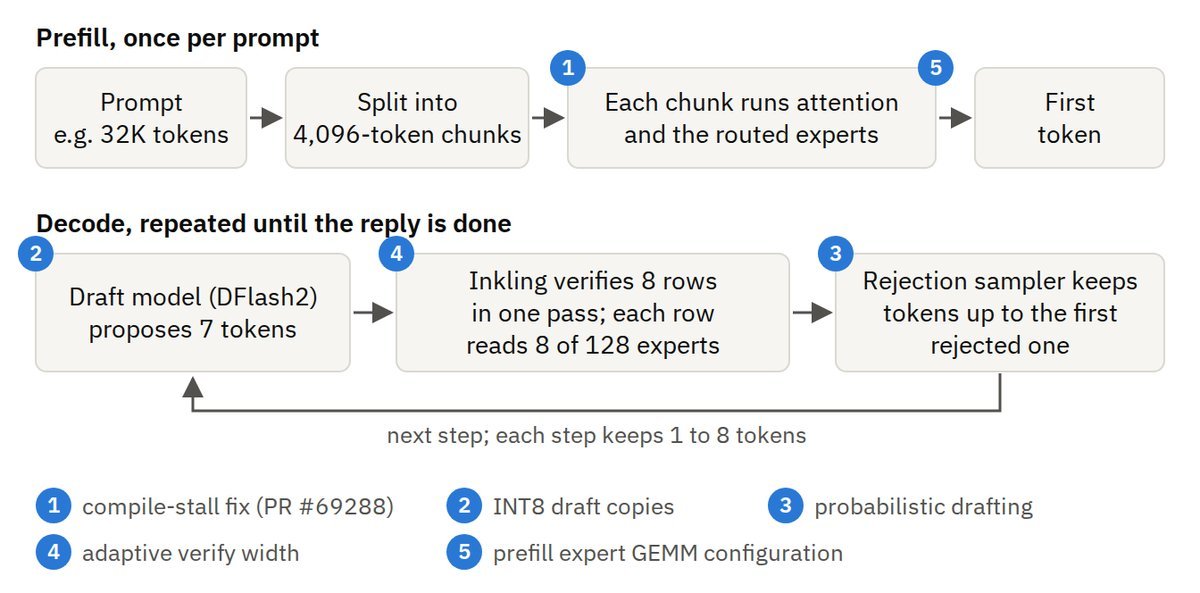
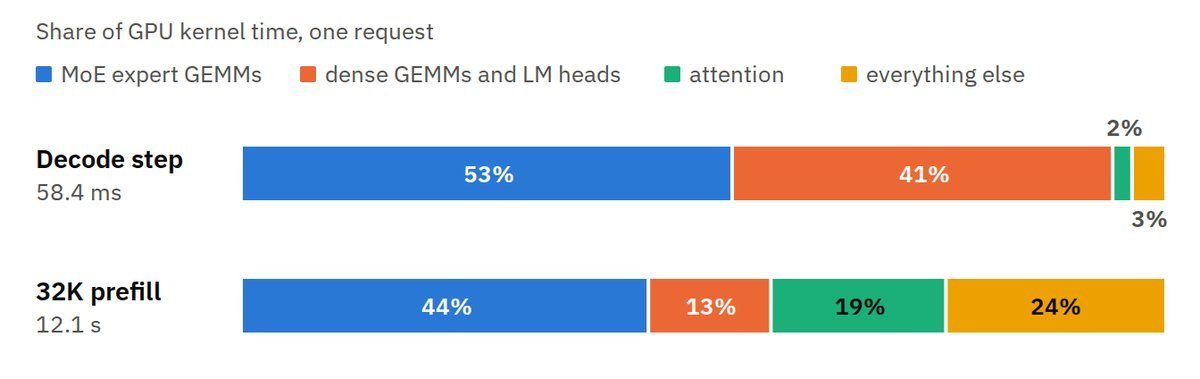
Generation relies on speculative decoding. A small draft model guesses seven tokens, the big model verifies them together, and each step ends up with between one and eight accepted tokens. The routed experts take 53% of a decode step and 44% of a 32K prefill, so most work targeted them.
- Compile stalls. A new prompt often sat 2.3 seconds (median) before its first token because Triton rebuilt about ten kernels for every new max_ctas value. Rounding that value up to a power of two means only 12 to 15 variants ever get built, which shortened the waits by 67 to 90% for unseen prompt lengths.
- INT8 draft copies. Quantized copies of 21 DFlash2 linear layers and the shared output head take 843 MB and serve only the drafter, so the main model’s output stays the same. Early results were weak until the author found the output head never ran in INT8 because of an FP32 case. After that fix throughput rose 4.3 to 4.9%, from 90.6 to 94.8 tok/s.
- Probabilistic drafting. By default vLLM drafts greedily and its sampler then acts as if every draft token were certain, so it accepts fewer than it could. Switching draft_sample_method to probabilistic hands it the real probabilities and sped up sampled requests by 14 to 20% at temperature 1.0. Benchmarks run at temperature 0 never reveal this.
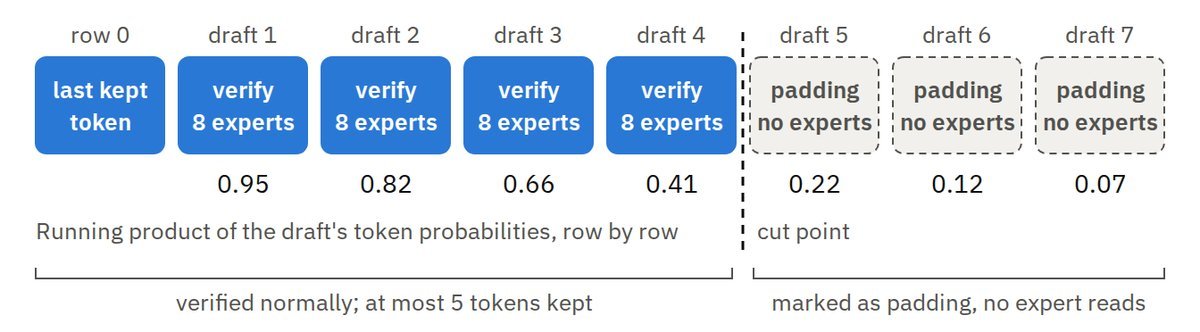
- Adaptive verify width. Once the running product of draft probabilities drops under a threshold, the remaining rows become padding. Their expert reads are skipped and the CUDA graph shapes stay fixed. Two runs gained 5.2 to 5.4%, going from 95.0 to 100.0 tok/s.
- Prefill kernel tiles. The Triton expert kernel was reaching roughly 8% of the chip’s FP4 peak. After timing 72 launch configurations, wider 128 by 256 blocks with 256 values per K step about halved kernel time, and the results matched bit for bit.
The tile change raised 32K prefill from 2,679 to 3,371 tok/s and cut time to first token from 12.2 to 9.8 seconds in A/B runs. The first long prompt after a restart fell from 14.1 to 9.9 seconds.
Caveats on the numbers
These are comparisons of whole setups, not identical ones. The rival vLLM run took 80% of memory with a BF16 cache; this one takes 36% with FP8, and TensorFold handles speculative decoding in its own way. Against Mia’s TensorFold numbers, a single prose stream is nearly tied at 66.0 versus 64.3 tok/s. At eight streams this build leads, 224.2 versus 196.4 tok/s in aggregate. Her lossy FP4 and FP8 prefill is faster by 11%, at 3,772 versus 3,395 tok/s.
Gains on ordinary prompts at default settings are smaller. With DFlash2, reasoning prompts ran 24 to 26% faster while prose stayed flat. Overall, sampled requests are 43 to 45% faster than a tuned DSpark.
How to reproduce it
The service runs vLLM’s inkling-2-mini container image, pinned by digest, with eight patch files mounted read-only on top. Every file is fixed by SHA-256 hash, so a change upstream breaks the build rather than silently altering behavior. The launch uses a 0.36 GPU memory fraction, a 131,072-token maximum length, eight sequences and seven speculative tokens. The scripts live in the author’s home-ai-lab repository.
The tuning method for Inkling 2 Mini carries over to other models: set memory, context and concurrency before chasing speed, profile entire steps instead of microbenchmarks, and estimate a gain from logs before coding it. Replaying 8,600 logged decode steps predicted 7.8% for adaptive width, and the real build delivered about 5%.
What’s left on the table
Prefill has headroom: knapcio’s 5,085 tok/s proves the hardware can go faster. And single-request decode trails tonyd2wild’s TensorFold run by 4.5%, a gap that was 20% before the tuning.
Source: Runtime Notes