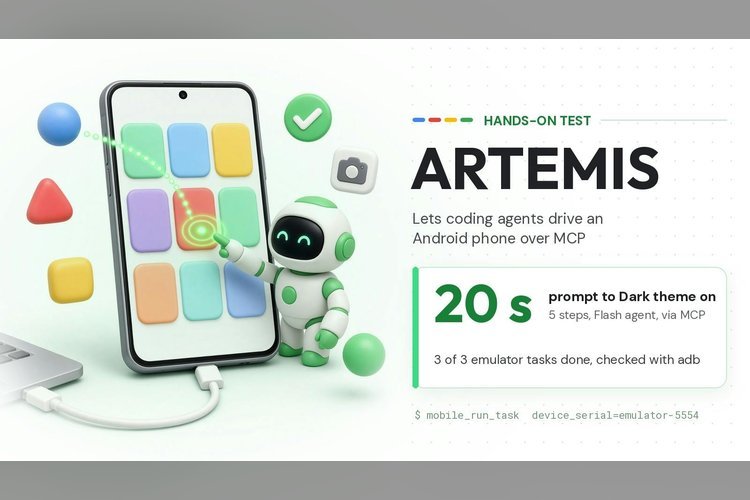
Google ARTEMIS, an open-source tool that lets AI coding assistants operate a real or emulated Android device, is real, and it completed every task a hands-on tester gave it. A viral video overstated some of its numbers, though, and one result shows how a test run can report success while its final check never ran.
What Google ARTEMIS is
The project lives under Google’s GitHub organization, uses the Apache-2.0 license and is written in Python. It was created on 13 August 2026 and had 17,876 stars and 1,989 forks on 22 November 2026, above the roughly 15,000 stars the video claimed.
Under the hood, Google ARTEMIS is a LangGraph agent. It reads the screen through Android’s accessibility tree, using a small helper app it installs on the device and UIAutomator2 as a fallback. It also looks at screenshots with a vision model and acts through ADB. You can drive it from a web console, a command line, a Python SDK or an MCP server.
There are two profiles:
- Flash runs one model in a tight observe, think and act loop, at about 3 to 5 seconds per step. It has no plan, no safety check and no report.
- Pro uses several agents. A Planner writes a task plan, an Operator carries it out, a Safety Net vets each action, and a Checker audits the result. Steps take 15 to 40 seconds.
Checking the viral claims
Most of the video holds up. The code is open and sits in Google’s repository, and the agent opens apps, taps and types. Emulators work, and USB phones are documented, though they weren’t tested.
The 99% figure needs context. The README chart shows 99.1% Pass@1 on AndroidWorld, a benchmark of 116 tasks across 20 apps. That benchmark runs on an emulator, not real phones. The number is self-reported, and the repository doesn’t include the evaluation code or the model settings behind it, so it couldn’t be reproduced.
The claim that it returns a report with screenshots and logs is only partly true. Pro can write a report on request, and the MCP tools return trace summaries, screenshots and Logcat. Flash returns a trace. ARTEMIS also supports more than Gemini and Claude: it works with GPT-4o, OpenRouter, xAI and local models through an OpenAI-compatible endpoint. It is Android only for now, with iOS on the roadmap.
Three tasks on an Android 14 emulator
The setup was a Debian machine with 8 vCPUs and 15 GB of RAM, running a headless emulator. The first attempt failed after three minutes with a timeout. The default Gemini models were returning 503 “high demand” errors. Switching the config to two other Flash models fixed it. For CI use, pin a model you have capacity on, and choose a fallback from a different model family.
Task one, reading the battery level in Settings, finished in 28 seconds and five model calls. It reported 100%, which matched dumpsys battery.
Task two turned on Dark theme through the MCP server. It took about 20 seconds across five steps, and the system’s night-mode setting flipped from “no” to “yes”.
Task three used Pro to create a contact named Ada Lovelace. The contacts database held the right row afterward. The run took 360 seconds and 26 model calls, about 4.5 times the prompt volume of the dark-theme run.
The catch: a verifier that failed open
During the contact task, the free-tier Gemini key hit its daily limit of 20 requests. The Checker’s call returned a 429 error, and ARTEMIS logged that it was “releasing fail-open”. The run still ended as completed, with zero tests passed and two inconclusive.
The device state was correct, but a pipeline that only checks for a “completed” status would have gone green with no verification. The machine-readable test_summary does show the inconclusive count. Anyone using Google ARTEMIS as a test gate should fail on anything other than zero failed and zero inconclusive, and run with checkpoint or strict verification.
Where it fits in a workflow
The Google ARTEMIS MCP server exposes five tools: run a task, manage a task, read device state, inspect a trace, and diagnose the environment. Their descriptions add up to 17,696 characters of context loaded each session, so it’s best enabled only in projects that need it.
ARTEMIS’s own rules point to a sensible pattern. Let the agent explore the app once to find the real path, then write a deterministic Espresso, UIAutomator or Maestro test that runs without a model. Repeating the same flow through a model costs money and roughly three seconds a step every time. Flash suits quick smoke checks after a change. Merge gates call for Pro, a pinned model and a read of test_summary.
What hasn’t been tested
Several things remain unverified: a physical phone over USB, the editors’ own Claude Code, Codex and Cursor integrations, installing a custom APK through the app_path option, models other than Gemini, video replay and the Pro written report. Three correct tasks are a sanity check, not a benchmark.
Source: hackernoon.com