GigaChat 4 is a 708-billion-parameter mixture-of-experts language model with a native context window of one million tokens, and its checkpoints are now available on Hugging Face. Only 41 billion parameters activate for each token. In Reasoning mode it scores 71.26% on Terminal-Bench 2.0, up from 30.30% for GigaChat 3.5.
Architecture and size
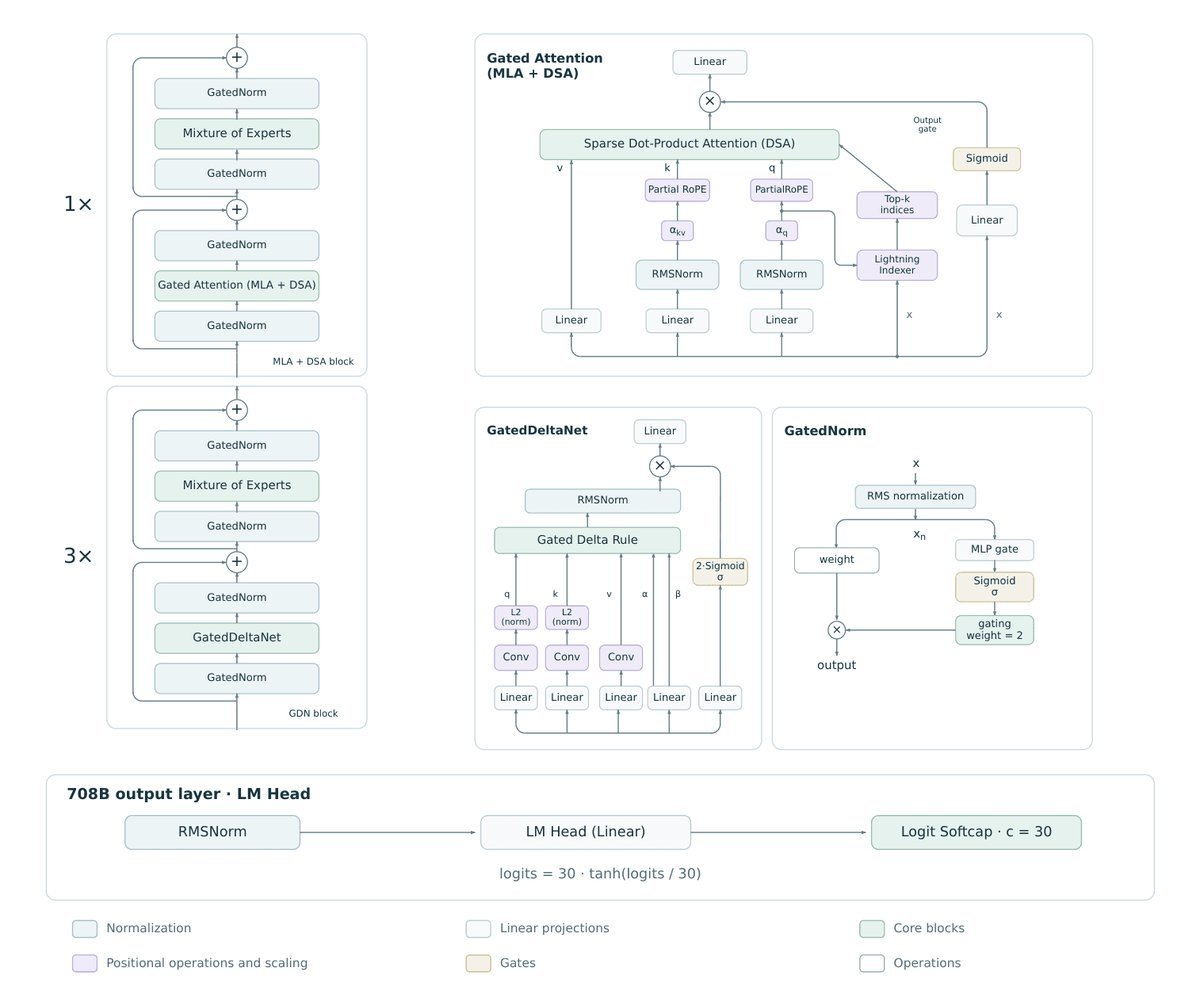
GigaChat 4 succeeds the 432-billion-parameter GigaChat 3.5. The new model keeps the same width but grows from 40 to 64 blocks. It mixes Gated DeltaNet layers with multi-head latent attention at a 3:1 ratio. For long inputs, DeepSeek Sparse Attention replaces dense attention in the latent-attention blocks, while the Gated DeltaNet blocks stay as they were.
One model offers two modes, Reasoning and Instant. The team used smaller proxy models to choose training settings and stability controls before committing to the full run. The stability work includes block-local learning rates and a projection-specific Z-loss.
How it was trained
The pretraining corpus holds about 15.35 trillion tokens, against a target of 20 trillion. Domain weights are 57% web text, 17% code, 13% OCR and PDF documents, 6% mathematics, 2.95% multilingual web and 4.05% reference and domain-specific sources. Higher-quality datasets get more passes through their data. English and Russian anchor the web corpus, with additional streams in Arabic, Chinese, French, German, Japanese, Portuguese and Spanish, plus languages of post-Soviet states and minority languages of Russia.
An LLM-based parser converts HTML pages to Markdown while keeping equations, tables and code, with a rule-based extractor as a fallback. Synthetic tasks for reasoning and tool use enter the mix mostly during midtraining.
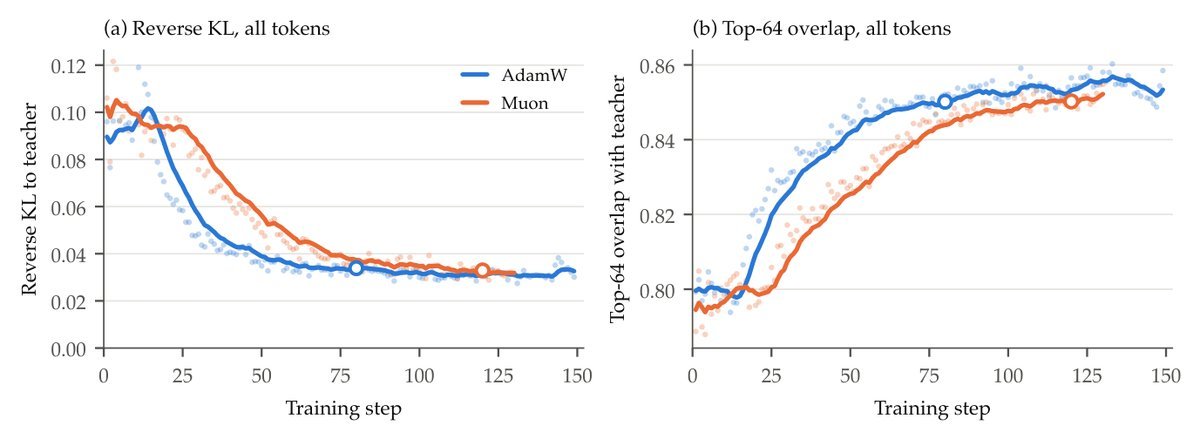
After supervised fine-tuning, the team trained specialist models with reinforcement learning. Multi-teacher on-policy distillation then merged their skills into the single model. Training ran in FP8, using 128×128 blocks for weights and 1×128 blocks for activations, and post-training was asynchronous.
Benchmark results
All figures come from the developers’ own evaluation setup, which combines public benchmark runners with in-house implementations. For some benchmarks the team raised the timeout to seven hours, and attempts to cheat were scored as zero.
In Reasoning mode, GigaChat 4 gained 40.96 percentage points on Terminal-Bench 2.0 over GigaChat 3.5 Ultra, 36.92 on GraphWalks and 18.06 on τ2-Bench. It posted the highest reported scores on several tests:
- IFBench: 80.33%
- FCL v4: 73.28%
- POLLUX: 81.46%
- CoworkBench: 83.00%
On coding and agentic benchmarks, the Reasoning model performs about on par with DeepSeek V4 Flash 0731 and Mistral 4 Large.
Instant mode scores 60.47% on Terminal-Bench 2.0, compared with 12.94% for the previous generation. Against GigaChat 3.5 Ultra Instant it gained 41.12 points on SWE-bench Verified, 31.67 on HMMT (pass@8) and 28.03 on GraphWalks. On Terminal-Bench 2.1 it reached 66.29%, behind DeepSeek V4 Flash at 70.77% but ahead of Qwen 3.5 397B at 56.18%. Mistral 4 Large has no Instant mode, so it isn’t in that comparison.
Serving the model
The inference stack uses low-precision execution for the experts, fused kernels and speculative decoding. Multi-token prediction drafts tokens ahead, and the Gated DeltaNet layers recover their recurrent state by replaying compact per-step updates instead of storing a full state matrix at every draft position. The team compares recurrent multi-token prediction with DFlash2 and measures prefill and decode throughput across context lengths. Quantization and attention kernels were tuned for the million-token window.
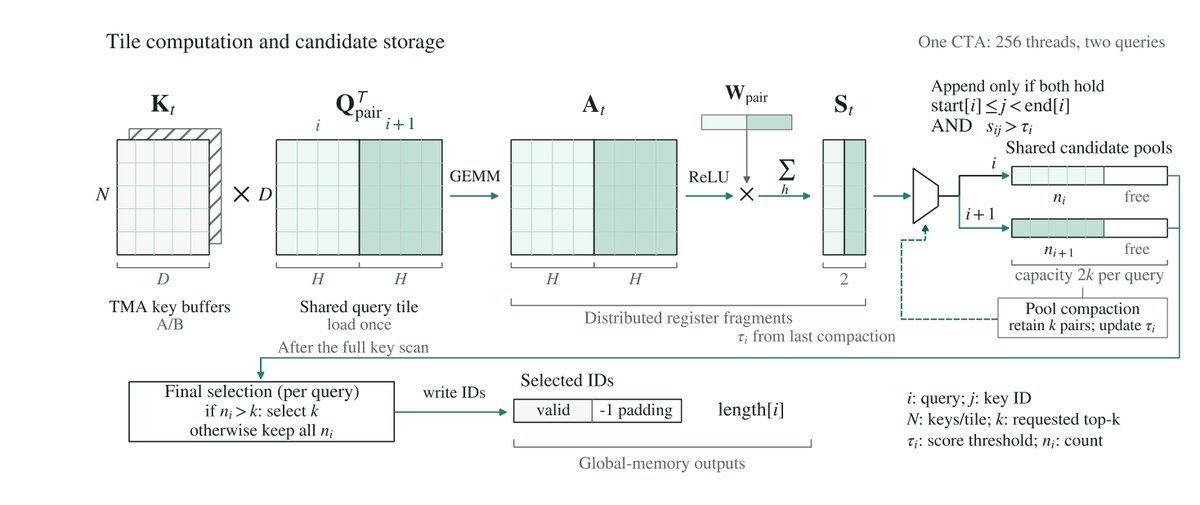
Large expert counts and long contexts make memory the main cost of serving a model like this. That’s why the team puts so much work into the serving side: only 41 billion of 708 billion parameters fire per token, and the long-context attention avoids building the full score matrix.
What to watch next
The open weights let outside teams test the claims. Self-reported benchmarks, especially ones with extended timeouts, are worth reproducing before drawing conclusions. Independent runs on Terminal-Bench and SWE-bench would show whether the jump from GigaChat 3.5 holds up. The pretraining run is also still short of its 20-trillion-token target, so a later checkpoint trained on more data is a reasonable thing to expect.
Source: giga.chat