A developer asking Gemini 4 Neon about a candy bag got a sensible answer and a strange thinking trace about database latency. The odd text came from the Gemini 4 thought summarizer, the separate step that condenses the model’s reasoning for display. Logs from a week of use now show how often it misfires, and how Google replaced it without announcement.
What leaked into the thoughts
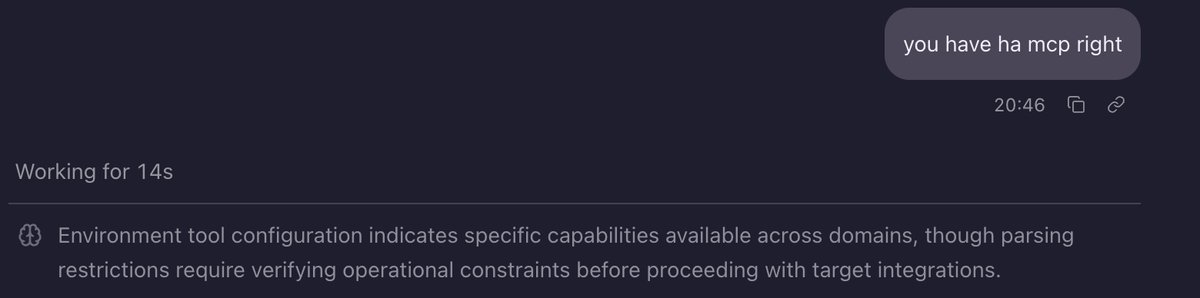
The question was three words: “sweetwater candy bag?” Sweetwater is an audio gear store that tucks candy into its deliveries. The trace above the answer talked about caches, ports and handlers instead.
A search of 248 local Antigravity session transcripts, covering November 19 to 25, turned up 12,930 non-empty thought blocks. Of those, 12,899 came from Gemini 4 variants and 31 from claude-opus-5-5-high, used as a control. The control model showed none of the artifacts. Every Gemini 4 variant showed identical ones.
The first version of the summarizer leaked three recurring strings:
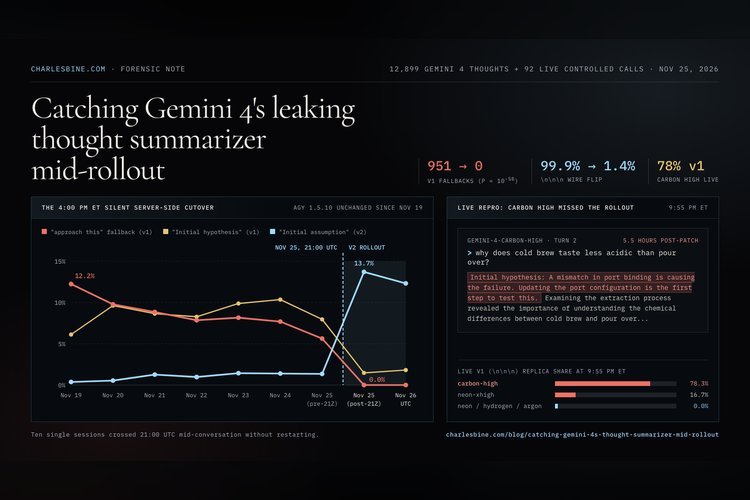
- A fixed line, “I’m thinking through how to approach this.”, appeared byte for byte in 951 of 11,368 pre-rollout thoughts (8.37%). It likely acts as a canned fallback when the summarizer gets an empty chunk.
- A line blaming database latency instead of a cache miss showed up in 55 thoughts (0.48%).
- A line about a port-binding mismatch at a handler appeared in 15 thoughts (0.13%).
Some thoughts held several at once, and four held all three. The wrapper prompt that drives the summarizer also leaked word for word ten times. From those leaks, the Gemini 4 thought summarizer appears to work on chunks: it receives the summary so far plus the next block of reasoning and continues the summary.
Longer turns, more leaks
The developer first suspected very short turns with little to summarize. The data said the opposite. The median Gemini 4 turn had 639 output tokens and a 316-character thought summary. Turns with the database and port leaks had medians of 1,706 and 1,916 output tokens, with more than 1,250 characters of thoughts. The leaks tended to land 10% to 90% of the way through a turn.
Stock openings such as “Initial hypothesis” (9.02% of thoughts) and “Initial assessment” (3.68%) may be artifacts too. One answer to a woodworking question began “Initial hypothesis: The request involves a physical object and a transformation process.”
The 4:00 PM ET swap
On November 25 the fixed fallback line halved in frequency. It stopped appearing around 21:00 UTC, which is 4:00 PM ET. Ten conversations ran past that moment without restarting. In the longest one, using gemini-4-neon-xhigh, the 582 thoughts before 4 PM held 23 fallback lines, 4 prompt leaks and 57 “Initial hypothesis” summaries. The 220 thoughts after held 0, 0 and 1.
The old summarizer joined chunks with three newlines. The new one uses two. That made the rollout visible to the minute. The first two-newline canary appeared at 20:56:17Z and the last fallback at 20:58:37Z. Both styles ran side by side from 21:00:04Z to 21:06:07Z. By the next day, 713 of 714 summaries used two newlines.
The new prompt has its own habits. “Initial assumption” summaries rose 11.9 times to 13.06%, and “Re-evaluating” rose 12.3 times to 4.77%. None of the 1,531 post-switch summaries leaked the prompt.
One model was missed
To check whether every variant had switched, the developer ran 92 prompts across 11 models and gateways between 9:50 and 9:55 PM ET. Gemini-4-neon, hydrogen-high and argon-high used the new prompt cleanly across 42 invocations. Gemini-4-carbon-high did not. Eighteen of its 23 summaries (78.3%) used the old three-newline format, and three responses carried the fallback summary. A cold brew coffee question got a port-binding explanation from Carbon High, more than five hours after the others switched.
Twice, Carbon High used the new prompt for one reply and the old one three seconds later in the same conversation. That points to a load-balanced service where each summary request is handled independently. Gemini-3.8-flash-high summarized normally, and the Claude control read naturally.
Why it matters, and what comes next
None of this changes the model’s answers. The model still sees its unsummarized reasoning. The catch is for people who read the displayed trace to judge an answer: it is produced by a simpler, separately swappable system that Google can update without notice, and it can mislead.
The developer plans a deeper analysis of the full set of thought logs to put numbers on how often summaries distort the reasoning behind them. Google hasn’t said anything about the summarizer or the Carbon High gap.
Source: Charles Bine