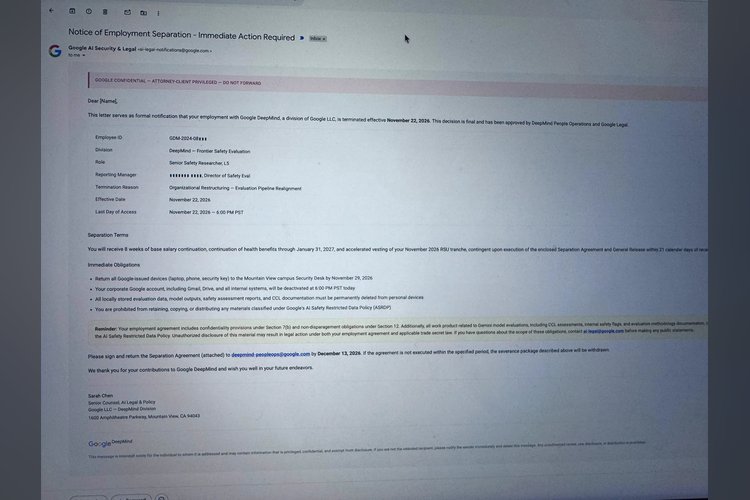
A person who says they spent 11 months running Gemini 4 safety testing at Google DeepMind alleges the company rushed the Neon model out on November 18 with a safety flag still open. The same person says they were told on November 22 that their position was being eliminated. The claims come from an anonymous public post and have not been independently verified.
What the post alleges
The author says every Gemini 4 model is meant to pass a full 14-day protocol before release. That protocol covers red teaming, capability assessments and adversarial testing across biology, cybersecurity and manipulation. They say the requirement is written into DeepMind’s Frontier Safety Framework.
The author says the schedule slipped for each model in the family. Carbon reportedly got 11 days of testing and Hydrogen got 8. By the time Neon was ready, the author says, only 5 days remained, and they were told to run “critical path evaluations only.” Neon’s testing ended up at 3 days.
The flag at the center of the dispute
The author says they ran the biological uplift assessment on day one. The results triggered what the framework calls a CCL flag, meaning the model showed biology-related capabilities that could not be ruled out as dangerous. Under the framework, that flag should pause a release until a full review is done.
The timeline they describe is short:
- November 14: the flag is filed.
- November 15: a director says it was “noted but not actionable given the current timeline.”
- November 18: Neon launches with the flag still open.
- November 20: the author raises it again through the internal safety reporting channel.
- November 22: Google AI Legal calls to say the role is being cut in a “restructuring of the evaluation pipeline.”
The author says six teammates were let go the same day and that all of them had worked on Neon safety reviews.
Why the author says the schedule was squeezed
The author ties the compressed timelines to the September 30 launch of Argon. After that release, it says, the press reported that employees thought the model was underperforming, and leadership grew anxious. The author claims Google had promised enterprise customers a full model lineup before contracts renew in January, so testing windows shrank to fit.
That is the author’s account of motive, and nothing shown so far backs it up directly. Treat it as an allegation.
What’s in the public model card
One claim can be checked by anyone. The author says Neon’s published model card states that CCL “cannot be ruled out” for biological uplift and for cybersecurity uplift. If the wording is as described, Google disclosed the uncertainty publicly while shipping the model.
That would not by itself show a rule was broken. A model card can note a risk that has been reviewed and accepted. The author’s argument is that no such review took place, and that the framework required one first.
What the author says they hold
The author lists the evidence they say they have: the evaluation logs, the CCL flag filing, an internal timeline showing testing cut from 14 days to 3, and Slack messages in which the director acknowledged the flag. They say they posted from a device not linked to any Google account and don’t know how the company will respond. None of these records has been published.
Why the flag matters
Frontier safety frameworks exist so that a lab commits in advance to what it will do when a model shows dangerous capabilities. A pause rule only means something if it holds when a launch date is close. If a flagged model ships on schedule, outside observers can’t tell whether the rule is a real gate or a guideline.
The author’s account is one side of a workplace dispute, and the people involved may remember events differently. Google may also have reviewed the flag in ways the author did not see. That is why the company’s answer matters as much as the allegation.
What to watch next
The most useful next step is a response from Google DeepMind. It could say whether the 14-day protocol applied to Neon, whether a CCL flag was open at launch, and why the evaluation team was restructured.
For developers and enterprise buyers, the model card is the document to read. Its wording on biological and cybersecurity uplift is public, and any later update to it, or any review announced under the Frontier Safety Framework, would say more than an anonymous post can.
Source: X (formerly Twitter)