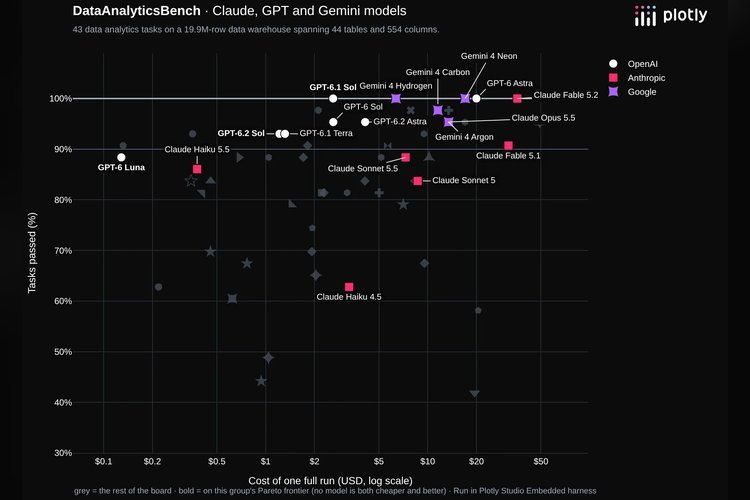
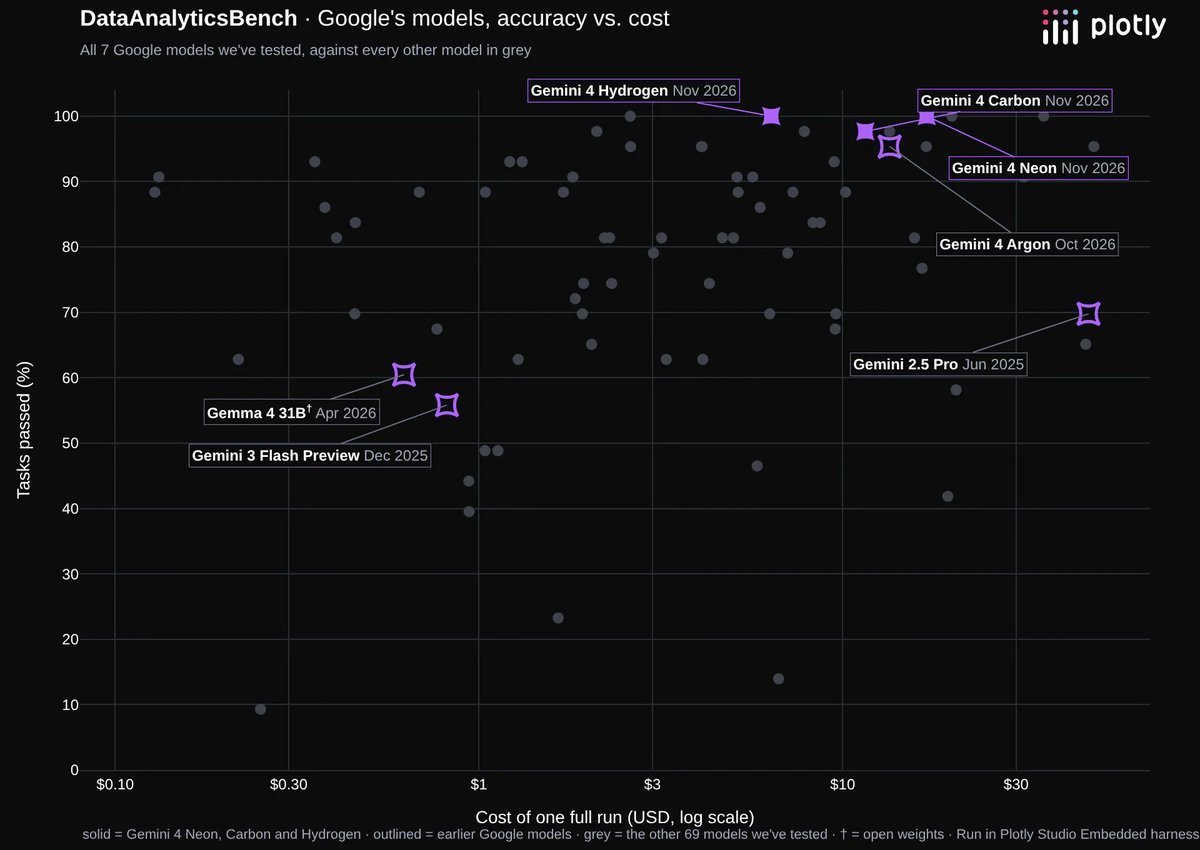
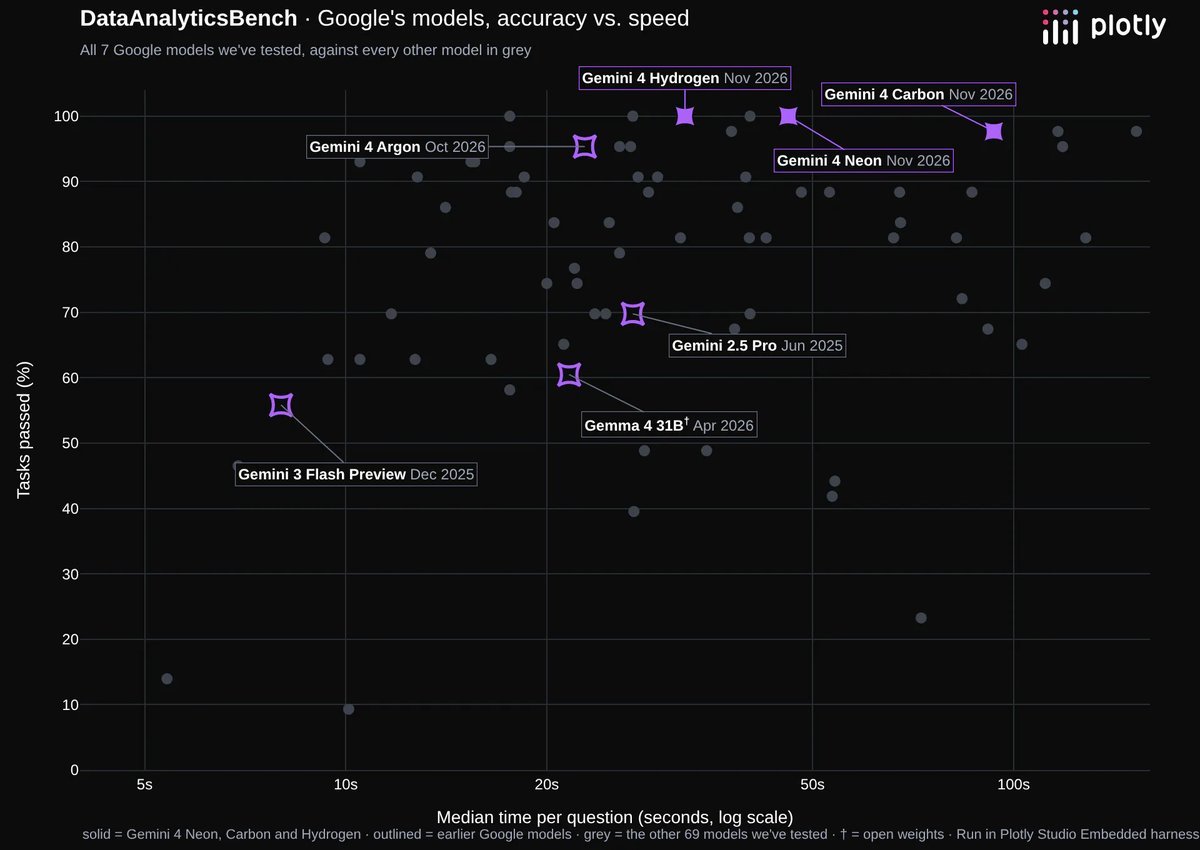
Gemini 4 Hydrogen is the model to pick for data analysis in Google’s new lineup. In a 43-question analytics exam, Hydrogen and Neon both scored a perfect 43, but Hydrogen finished a full run for $6.36 against Neon’s $17.03. Hydrogen came in at roughly 37% of Neon’s bill, and its median answer arrived in 32 seconds instead of 46.
Google shipped three Gemini 4 models in three weeks: Carbon, Hydrogen and Neon. Developers now ask which one to buy, and how each compares with the Claude and GPT model at the same tier.
How the three Gemini 4 models scored
Accuracy barely separated them. Neon and Gemini 4 Hydrogen answered every question correctly. Carbon dropped a single data-quality item. Each model spotted all the planted patterns in the warehouse and avoided every statistics trap. Run-to-run noise on this exam can reach three points, so a one-point gap is close to a tie.
Cost and speed did the separating:
- Hydrogen: $6.36 per run, 32-second median question, 43 minutes for the whole exam.
- Neon: $17.03 per run, 46 seconds, 58 minutes.
- Carbon: $11.55 per run, 93 seconds, 108 minutes. Its slowest single question took 679 seconds.
Neon and Hydrogen used a similar volume of tokens, 20.1 million and 18.0 million. Neon’s bill is higher since it charges twice Hydrogen’s rate: $3 per million input tokens and $15 for output, against $1.50 and $7.50. Carbon burned the most tokens at 29.5 million, yet its introductory price of $2 and $10 kept the bill modest.
Carbon’s price is about to double
That introductory rate ends on November 30. On December 1, every Carbon price tier doubles, with input and output moving to $4 and $20. The same exam would then run about $23.10, above Neon. Google’s Argon model, which scored 41 for $13.47, gets the same increase.
Google says Neon is cheaper per task than Carbon, by 32%, at the default high thinking setting. With Carbon at its current promotional price, this exam showed the opposite.
Carbon is also the slow one. It writes less per call, about 495 output tokens against Neon’s 904, yet each call is slower to begin, and the model splits work into a larger number of small steps. Its effective output rate was 34 tokens per second, against 96 for Neon and 104 for Hydrogen.
What Google says each model is for
Google describes the family as a ladder. Carbon handles the hardest long-horizon work, including complex software engineering, scientific reasoning and cyber defense. Neon sits in the middle for complex coding and production enterprise workflows. Gemini 4 Hydrogen is the “daily driver for agentic workflows” and it alone among the three is free to try through the Gemini API.
All three accept text, image, audio, video and PDF input with a one million token context window. Neon and Hydrogen offer four thinking levels: low, medium, high and xhigh.
For coding agents the order flips back. On the Artificial Analysis Coding Agent Index, Neon tops the family there with 59. Carbon scores 55 and Hydrogen 52. That makes Neon the better pick for agent work, or a fallback if Hydrogen disappoints on your own tests.
How Gemini tiers line up with Claude and GPT
List prices per million input and output tokens put the rough equivalents like this:
- Top tier: Carbon at $2 and $10 (rising to $4 and $20), Claude Fable 5.2 at $8 and $40, GPT-6.2 Astra at $8 and $40.
- Balanced: Neon at $3 and $15, Claude Opus 5.5 at $4 and $20, GPT-6.2 Sol at $2 and $10.
- Fast and everyday: Hydrogen at $1.50 and $7.50, Claude Sonnet 5.5 at $2 and $10, GPT-6.1 Terra at $1 and $5.
- Cheapest: Haiku 5.5 from Anthropic and GPT-6 Luna from OpenAI, both starting at $0.10 and $0.50. Google has no Gemini 4 model at that price. Hydrogen costs 15 times more.
On the same exam, every lab’s best model scored 43 and its cheapest scored 37 or 38. That works out to 86% to 88% of the best result at a sliver of the price: one run on Haiku 5.5 costs around 1% of a Fable 5.2 run. GPT-6.1 Sol remains the cheapest perfect score at $2.61.
Tier order doesn’t always hold. Sonnet 5.5 landed at 38. That’s three points under Opus 5.5 and one over Haiku, while costing 19 times as much as Haiku. The older Fable 5.1 lost to Opus 5.5 by two points, 39 to 41, and cost over twice as much. OpenAI’s newer GPT-6.2 Astra gave up two points against GPT-6 Astra (41 versus 43) but ran in half the time at about a fifth of the price.
Where the cheap tier falls short
Coding agents punish the bottom rung more than analytics does. On the Artificial Analysis index, the two cheapest models, Haiku 5.5 and GPT-6 Luna, reach only about half their flagships’ scores. The data exam showed a much narrower gap. The tiers above them stay within roughly seven points of the top.
What to do before December 1
Teams considering Carbon should run their own numbers before the price change lands. At $4 and $20 it costs more than Neon per token, and it was slower on every measure here. Gemini 4 Hydrogen is the sensible default for analytics work, with Neon as the upgrade for agents. Each model was run once, which is a single sample, so check the choice against your own data.
Source: plotly.com