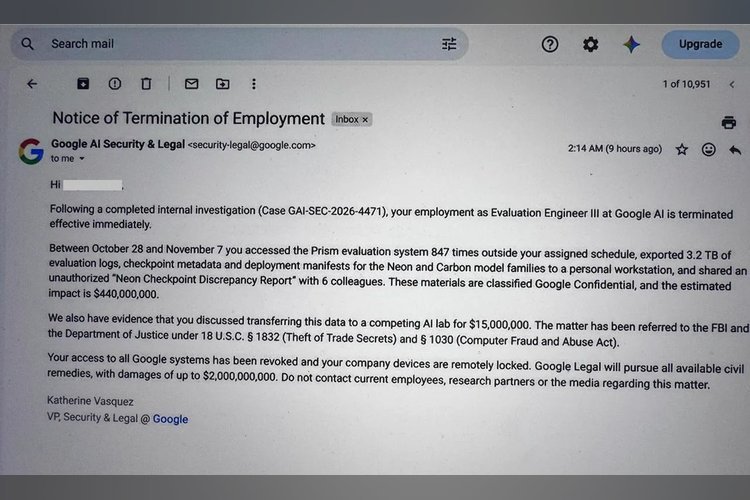
Google’s published Gemini 4 benchmarks may not describe the model developers actually get, according to a former DeepMind London engineer who says they were one of 11 fired in one day. The allegations were made anonymously. Nobody has verified them, and the evidence the author mentions hasn’t been released.
The core claim: the scored model isn’t the shipped model
The author says Neon’s model card reportedly claims a win over Claude Opus 5.5 on 16 of 19 benchmarks. The version tested inside the company, the author says, lost on 11. They claim the weights benchmarked and the weights served through the API are different.
The mechanism they describe is an internal tool called Prism, which they say lets a team hot-swap checkpoints seconds before an evaluation run. They allege that the scores published for Neon, Carbon and Argon all came from cherry-picked checkpoints that were never deployed to production.
How the author says they found out
The author says Cursor and GitHub Copilot both integrated Neon on day one, and users quickly reported it performed worse than Carbon. The author says they then pulled the deployment manifest and found checkpoint hashes that did not match the model card. In their telling, the checkpoint users are hitting today is 9 days older than the one that was scored.
That detail is checkable in principle. Anyone with access to both checkpoints could compare them. Outside researchers don’t have that access, so for now it rests on the author’s word.
The dismissals
The author says they reported the issue on November 7 through DeepMind’s research integrity channel. On November 19, they say, everyone who had touched the report received a termination email from Google Legal. The email reportedly cited “unauthorized access to evaluation infrastructure” and “intent to damage corporate reputation.”
The author disputes the first charge, saying running that infrastructure was their job. All 11 people let go had access to the internal evaluation pipeline, they add.
Why it matters for buyers
Benchmark tables drive purchasing decisions. A team picking between Neon and Claude Opus 5.5 reads those 16-of-19 and 11-of-19 style figures and assumes they describe the endpoint they will call. If the scored weights differ from the served weights, the comparison misleads even when every individual number was measured honestly.
The same applies to the tools built on top. Cursor and GitHub Copilot users are the ones who noticed first, according to the author, because they compare models on real code every day.
The pricing detail
The author also points to pricing. Neon is priced at $3 per million tokens, while Carbon costs $2 until December. The author finds that odd, since the mid-tier model costs more than the flagship, and says the people who could explain it were fired. The author also says Google retired Argon 49 days after its launch.
Pricing alone proves nothing. Companies set prices for many reasons, and a temporary promotion on one model can create exactly this gap.
Who is named
The author says Demis Hassabis personally approved the Neon model card. The author claims to hold the sign-off chain, the checkpoint hashes and the deployment logs showing the swap. They conclude that Google published fabricated benchmarks and fired the people who found out. That conclusion is theirs, and Google has not been shown to accept it.
What would settle it
Three things would help. Google could state which checkpoint Neon’s published scores came from and whether it matches the one served through the API. The author could release the manifest and hashes in a form others can verify. And independent testers could rerun the 19 benchmarks against the live API and compare the results with the model card.
Until one of those happens, treat the Gemini 4 benchmarks as published claims under dispute. Teams choosing between Neon and Claude Opus 5.5 can run their own tests on their own workloads, which tell them more than a leaderboard figure either way.
Source: X (formerly Twitter)