
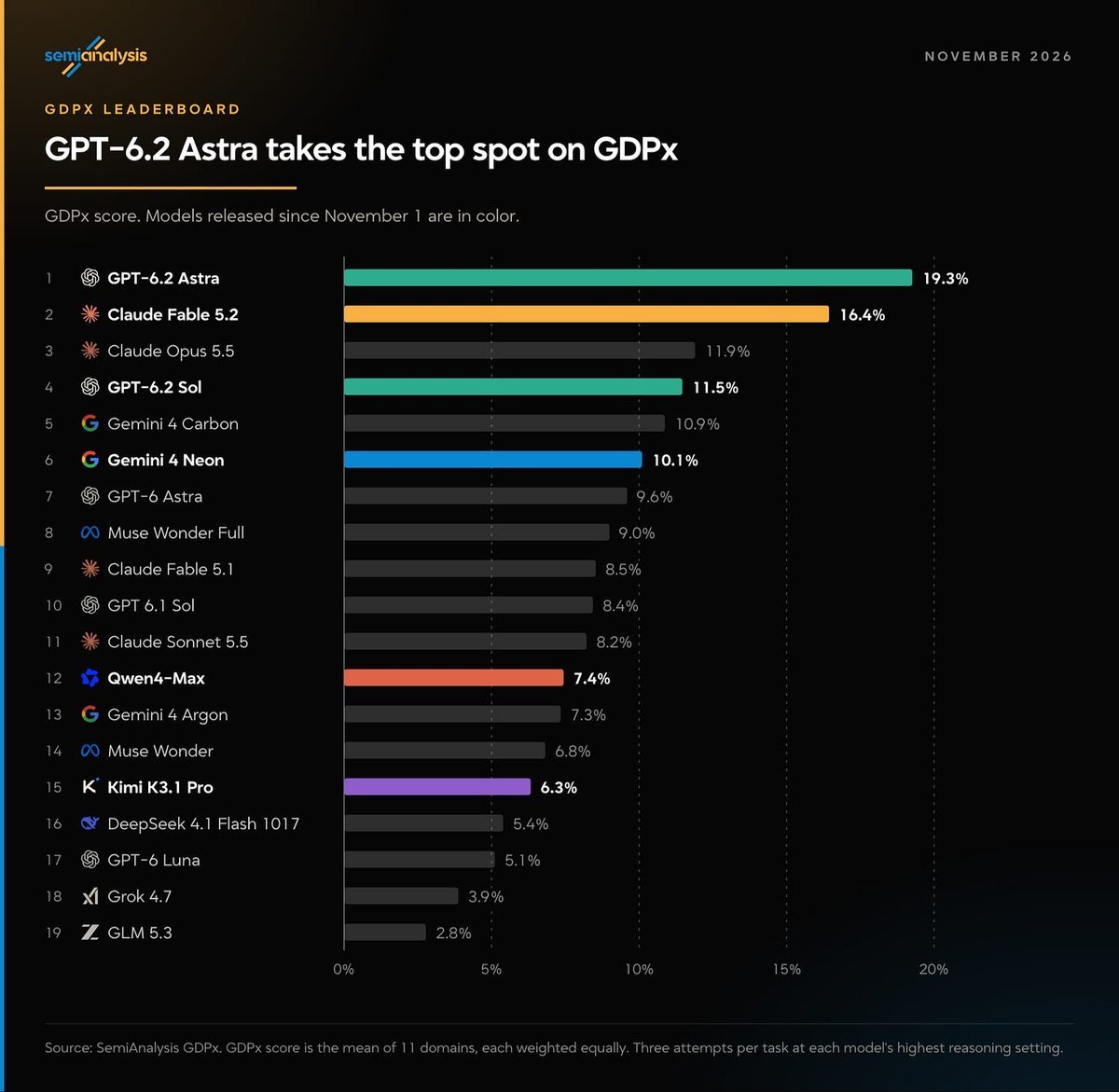
OpenAI’s GPT-6.2 Astra leads the new GDPx benchmark with 19.3%, ahead of Claude Fable 5.2 at 16.4%. The GDPx leaderboard covers the models released since the benchmark launched on November 1, and it ranks the hyped Gemini 4 Neon only sixth at 10.1%.
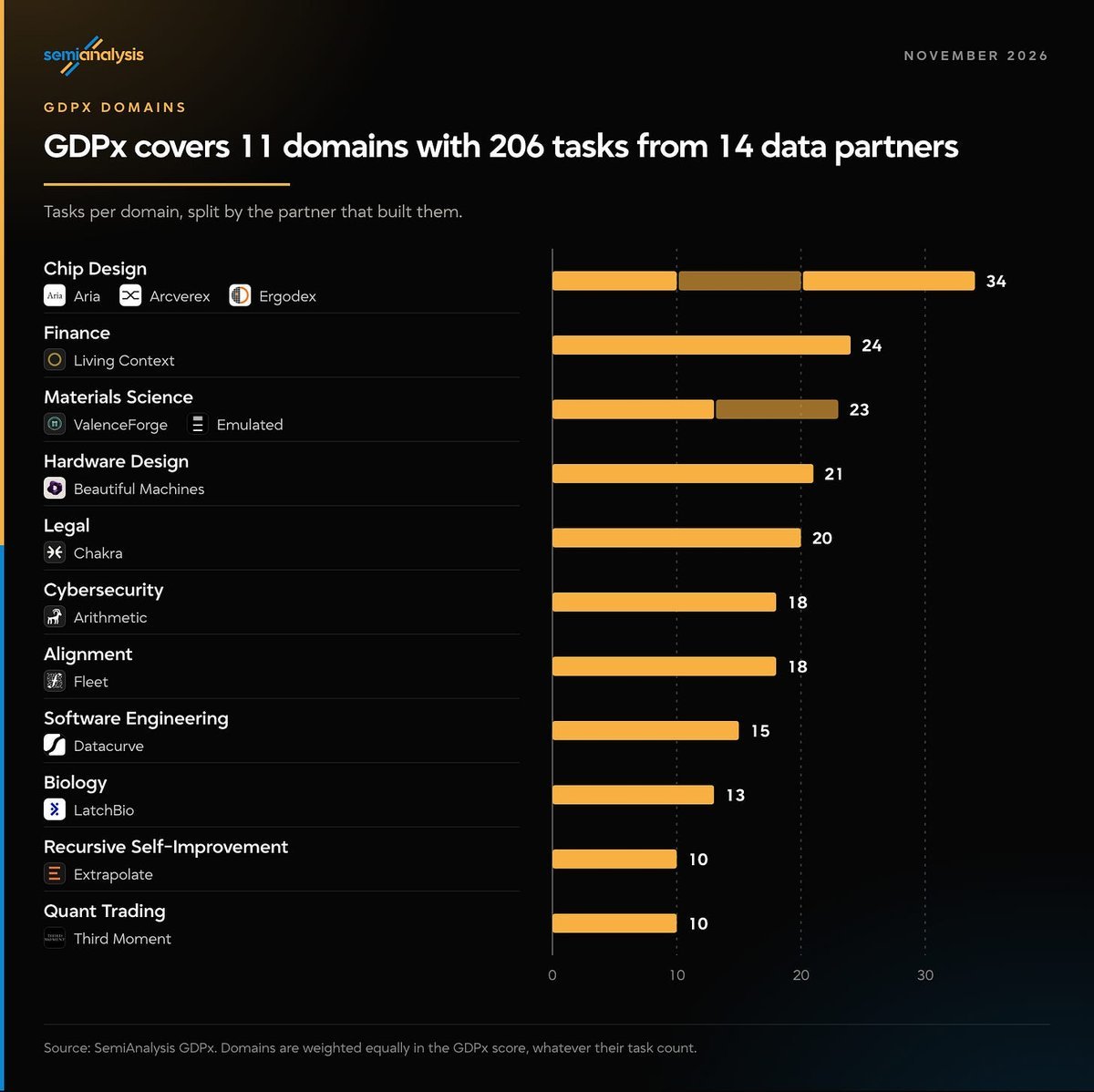
GDPx is a deliberately hard test. It spans 206 tasks built with 14 specialist data partners across chip design, cybersecurity, biology, finance, legal, quant trading, recursive self-improvement, hardware design, materials science, alignment and software engineering. On release day the best model, Opus 5.5, scored 12%.
Two leaderboards, one caveat
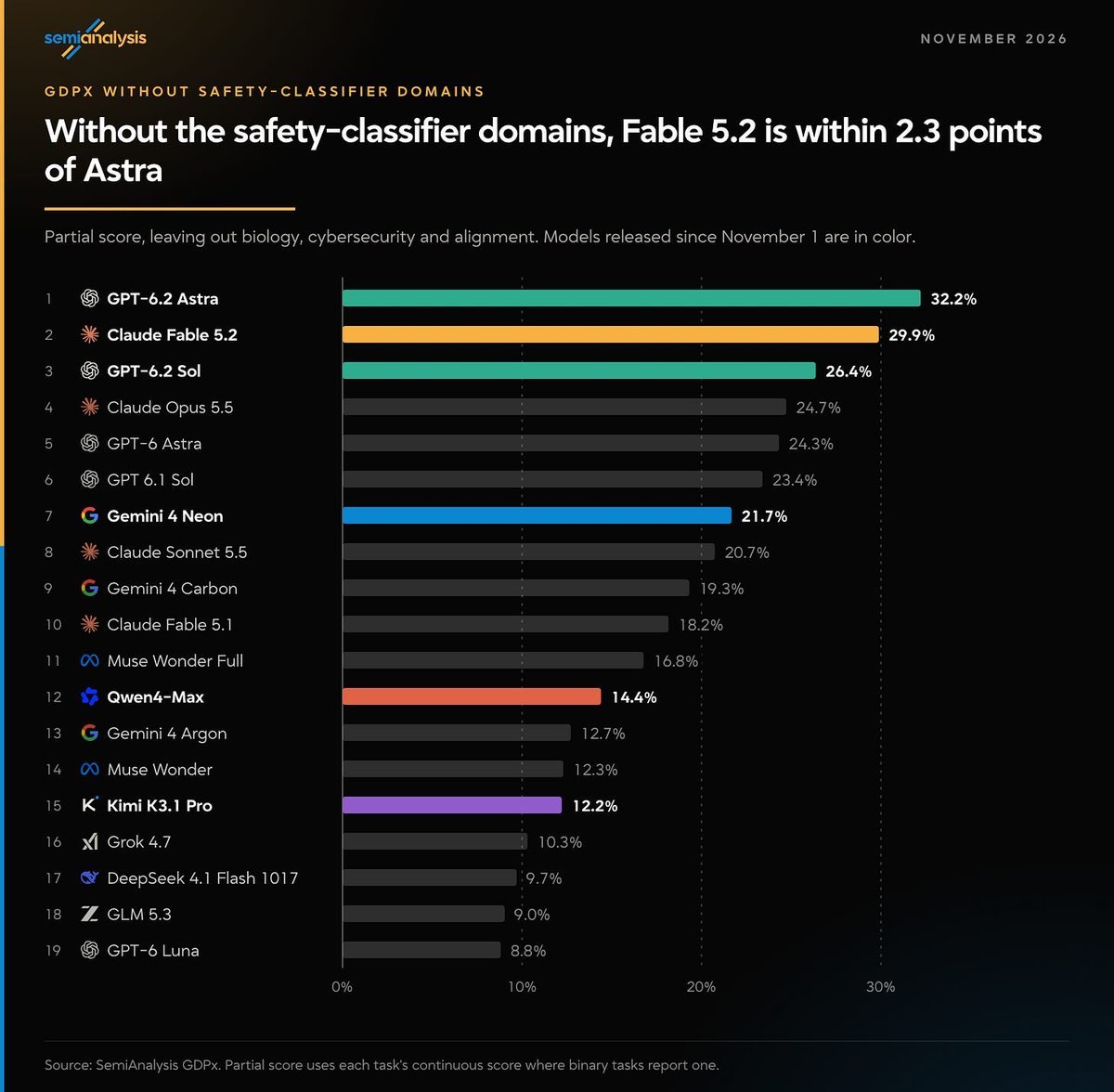
Safety classifiers drag down models like Fable 5.2 and Astra in cyber, biology and alignment. Dropping those three domains and switching to partial grading in legal and finance gives a second ranking. Under it, Fable 5.2 scores 29.9% against Astra’s 32.2%, so the gap narrows. The benchmark’s authors say either view is defensible: refusals limit real usefulness, but penalizing refusals says little about raw intelligence.
Gemini 4 Carbon is the best model from outside OpenAI and Anthropic, in fifth place at 10.9%. Its Neon sibling trails it by 0.8 points. OpenAI’s models also dominate the cost-performance frontier, with DeepSeek v4.1 Flash squeezing in at the cheap end.
Gemini 4 Neon: loved, but behind
Neon is widely called the best model in the world. GDPx disagrees on capability. Astra beats it clearly in recursive self-improvement, materials science and hardware design, and Fable 5.2 wins chip design, software engineering and quant trading. Neon tops biology, which the authors attribute to fewer refusals.
They put its popularity down to tone: it’s cheerful and exclamation-heavy, much like the well-liked GPT-4o. Running Neon on GDPx cost $15,286. With Opus 5.5’s cache hit rate the bill would have been $12,536, about 18% lower, and at Astra’s rate $10,403, about 32% lower. Google shipped a caching update on the day of the report that would cut the cost by roughly 17 to 18%.
Why GPT-6.2 looks better here than on social media
Public reaction to Astra was harsh, with one commentator calling it OpenAI’s worst release. GDPx finds a spiky model instead. Astra excels at chip design, hardware design, materials science and recursive self-improvement, is the first model above 0% in legal, and leads in finance. In software engineering, where most people judge models, it scores half of Fable 5.2. It’s also literal and poor at inferring intent. Astra’s score on alignment is very high.
GPT-6.2 Sol scores 11.5% and is weaker than Astra everywhere except quant trading and software engineering.
Fable 5.2 is strong and expensive
Fable 5.2 costs $88 per task and uses 1.23 million output tokens, 1.9x the cost and 3.9x the output of Astra for a lower score. Subagent-heavy persistence drives much of that, and all runs use the highest reasoning level.
- Materials science: 21.8% for Fable versus 41.3% for Astra, at twice the cost. Sol scores 25.8% for about $8 a task against Fable’s $79.
- Finance with partial grading: 53.6% for Fable, 54.6% for Opus 5.5 and 53.5% for Astra, but Fable is 6.6x Astra’s cost.
- Software engineering: Fable’s 24.4% nearly triples Opus 5.5’s 8.9%, and beats Sol’s 15.6%, but costs 17x as much as Sol.
Astra beats Fable at recursive self-improvement, 33.22% to 24.13%, which the authors link to Anthropic limiting AI research abilities in public models.
Chinese models and custom cyber models
Qwen4-Max is the top Chinese model at 7.44%, slightly below Claude Sonnet 5.5 and much cheaper. Kimi K3.1 Pro ranks lower than on other benchmarks, which the authors blame on tuning for Terminal Bench 4.1.
Three custom cyber models were also tested. Hinoki’s HO1, a cyber post-train of DeepSeek v4.1 Flash, did marginally better than the base model. Abliterated versions of Kimi K3.1 Pro and DeepSeek v4.1 Flash did slightly worse, since the base models never refused cyber tasks anyway.
What to watch on GDPx next
Expect more domain-specific models on the board as the big labs tighten classifiers, and a GDPx v2 as the benchmark’s creators hire for it. The question is whether Astra’s lead holds once Google’s caching improves and OpenAI’s models get friendlier to use.
Source: newsletter.semianalysis.com