The Formlabs Form Studio 1 is a resin printer that sells from $699, roughly a quarter of what a Form 4 costs. A full teardown shows where the savings came from: a cast aluminum frame, fewer parts, a smaller box and a cheaper computer, with print quality left intact.
A cast base plate replaces the sheet-metal box
The Form 4 builds its rigid frame from several sheet metal and polymer parts. Each sub-assembly needs tight tolerances, and the build often calls for jigs.
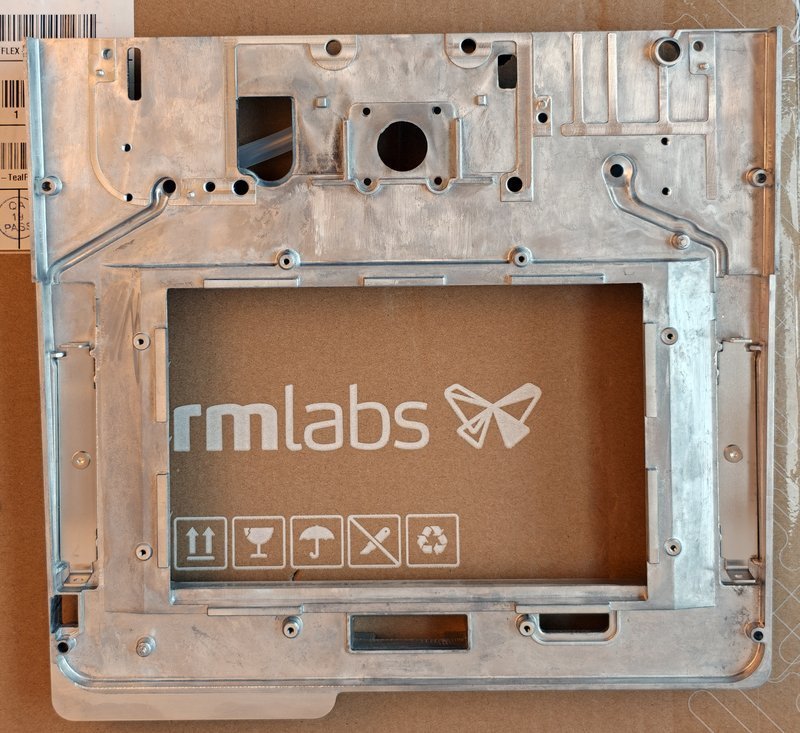
The Form Studio 1 hangs everything off one cast aluminum plate. Casting leaves a little extra material in key areas, and two CNC passes, one per side, level the critical surfaces, drill precision holes and refine the alignment bosses. The LCD, the Z-motor and the light box all reference that single plate, so an error in its thickness cancels out instead of stacking up.
The catch is the molds. Casting molds are expensive, so design changes get costly. Formlabs kept the Form 4 light architecture, which let engineers focus on cutting cost without redesigning the optics at the same time.
Why a simpler build saves money
Labor drives assembly cost. A screw costs a fraction of a cent, but installing it costs far more. Rework adds to the bill: if each step in a 50-step build is 99% reliable, only about 60% of units come out right, and at 100 steps the yield falls under 40%.
Taking the Form 4 apart took almost two weeks of on-and-off work, and a couple of assemblies had to be pried apart because their build order stayed unclear. Most of the Form Studio 1 came apart in about two afternoons. That is a sign the factory should see far less rework.
Shipping air freight at the right density
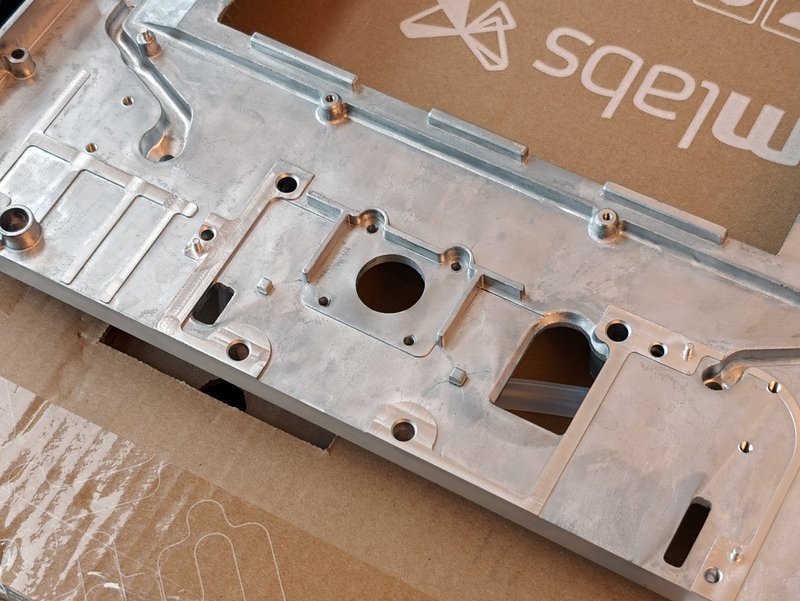
Air freight pricing favors a density of about 0.16 to 0.2 grams per cubic centimeter. The Form Studio 1 box measures 107,525 cubic centimeters and weighs about 18,500 grams, or 0.17 grams per cc. The Form 4 packed in at 0.11, so its 23 kg box was billed like a 34 kg product.
At roughly $10 per kg, that 11 kg gap meant about $100 per unit, a painful number on a $699 printer. This time the build platform and resin tank travel inside the printer’s empty build volume instead of in separate boxes.
What came out of the printer
The light source is simpler. The Form 4 had several individually controlled light zones. The Form Studio 1 uses a single chain of LEDs with a basic controller and an EEPROM that identifies the assembly. The extra diffuser stage is gone too, with the diffusion now built into the lens texture. A light uniformity test still looks excellent.
The resin stirring bar is also gone. It needed a fast, precise motor with an optical encoder. Now the build platform moves up and down in the resin to mix it during filling and heating. Formlabs says the stirrer also helped detect foreign objects in the tank, a job the new design hands to a load cell.
The main board runs on a Rockchip RK3568 module from Forlinx with 1 GiB of LPDDR4X memory and 32 GiB of eMMC storage. Earlier printers used a Raspberry Pi compute module. A standard module makes it easier to switch suppliers later, which helps with negotiating. The back of the board carries no components at all, which trims assembly steps.
A load cell that helps users
The Form 3 and Form 4 used a load cell under the resin cartridge to track resin use. On the Form Studio 1 it moved into the build platform mount. After installation the printer calibrates it, and it can then notice a missing platform or a leftover print still stuck to it by comparing mass.
Formlabs points out the Form 4 had a separate force sensor at the bottom of the Z-axis. Even so, repurposing a part the printer already had adds a feature at no extra hardware cost.
Smaller changes users will notice
- The build platform has integrated supports, so it stands on a counter without a separate holder.
- Its surface has a micromachined texture, probably laser cut, and prints seemed to release more easily.
- The bundled scraper is much thicker steel with a sharp edge, unlike the dull, flexing ones in earlier kits.
- The maintenance kit and a port cover appear to be 3D printed.
- Two tubes run from the frame to the back panel to drain spilled resin if the tank film fails.
The bottom cover has an irregular pattern of air holes. It looks like a hidden message, but Formlabs says it is just the layout it found cools the printer well.
What the Form Studio 1 means for the printer market
The Form Studio 1 shows a company moving from pushing technical limits to competing on price, in a market where 3D printers are increasingly cost sensitive. Formlabs kept the optics and print quality of the Form 4 while cutting parts, labor and shipping costs. Watch for how well the lower price holds up in production volumes and how competitors respond at the same price point.
Source: bunniestudios.com