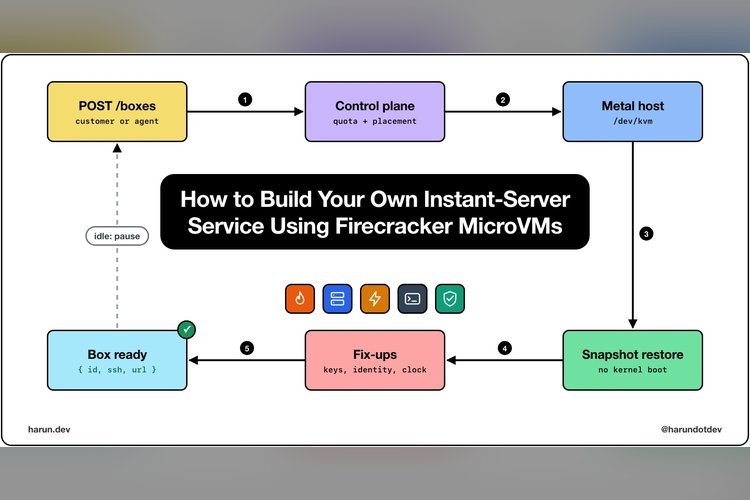
One developer with one Linux machine can now stand up a Firecracker microVM service that hands out isolated servers almost instantly. A detailed walkthrough lays out the design, which mirrors what many AI agent sandboxes already run in production.
Vendors such as InsForge (with InstaBox), E2B, Vercel Sandbox and Superserve all describe their products as Firecracker based. The walkthrough rebuilds that idea in miniature, using Firecracker v1.18.0 with its jailer helper, a warm pool of ready VMs and a TypeScript API in front.
Containers versus microVMs
Containers borrow the host’s kernel. When untrusted code makes a system call, it reaches the same kernel that runs your control plane, so one kernel flaw can become a breakout. For code you wrote yourself that risk is tolerable. For code an AI model generated moments ago, it isn’t.
A microVM runs its own guest kernel, and the boundary to the host is enforced by KVM hardware virtualization. Firecracker also removes most emulated hardware. The guest sees only network and block devices over VirtIO, vsock, a serial port and a tiny keyboard controller whose sole job is requesting reboots.
Extra barriers surround that. Every thread gets a seccomp filter unless you change the default. The jailer wraps each VM process in a private chroot, mount namespace and cgroup, then sheds root privileges before starting Firecracker.
Speed makes per-request isolation practical. Firecracker’s published targets are a memory overhead of no more than 5 MiB for a one-vCPU, 128 MiB guest, and a start time of 125 ms or less from the InstanceStart API call until the guest’s init begins. Those figures assume a minimal kernel and root filesystem.
How the service fits together
- The host needs /dev/kvm, pinned Firecracker and jailer binaries, cgroup v2 and one firewall ruleset that guests cannot get around.
- A golden snapshot comes from a VM that boots once, warms up, pauses, writes its state to disk and is then destroyed. Nobody resumes the original.
- A slot pairs a network namespace and a jail with a copy-on-write disk and a paused VM restored from the golden snapshot. The warm pool is a queue of these.
- When a user claims a slot, it becomes a box: it gets an identity from Firecracker’s metadata service, a private persistent /data disk and a resume signal.
- A small HTTP service on the host, written in TypeScript, manages the pool, tracks usage and enforces quotas. A POST to /boxes hands back a VM that was restored in advance, so nothing boots while the caller waits.
Where to run it on AWS
Firecracker must be able to read and write /dev/kvm. Its quick-start guide recommends a c5.metal instance on Ubuntu 24.04 and says EC2 offered KVM only on bare-metal types.
Amazon relaxed that in February 2026 by adding nested virtualization to ordinary instances. Eligible families include M7i, M8i, C7i, C8i, R7i, R8i, X8i and I7i, and the hypervisors supported inside them are KVM and Hyper-V. Enabling it means setting NestedVirtualization at launch, with no added fee. All eligible families use Intel chips, so Graviton can’t do this yet.
For production the author still prefers metal. Amazon advises evaluating bare metal where latency matters, and every machine in Firecracker’s own list of tested platforms is a .metal type, among them m6i.metal, m7i.metal-24xl and m8g.metal-24xl. No Firecracker documentation addresses nested setups, so virtual instances are pitched only for development and CI.
The case for cgroup v2
Snapshot restoration slows noticeably under cgroups v1, according to the project’s snapshot docs, which recommend v2. A service whose main job is restoring snapshots should follow that advice. Setup turns on the cpu and memory controllers and creates a dedicated group where the jailer applies limits.
The install step downloads the v1.18.0 tarball and verifies its SHA-256 checksum before placing the firecracker and jailer binaries on the path.
Untested on real hardware
The author wrote the guide on a Mac, where KVM doesn’t exist. Commands and JSON payloads were compared with the v1.18.0 documentation and OpenAPI definition, and the TypeScript compiles in strict mode, but nothing ran on actual KVM hardware. The stated advice is to treat it as a reviewed design and try it on a bare-metal host before relying on it.
Suggested build order
Start by launching a single box manually under the jailer. Then script the golden snapshot, and only after that add the warm pool and the API. Keep production on metal and use nested virtualization for development.
Since commercial sandbox vendors already use this pattern, copying it mostly costs engineering time.
Source: Harun R. Rayhan