Baidu put out an early version of its next language model, called ERNIE 5.5 Flash Preview. It’s a Mixture-of-Experts design holding 280B parameters in total, with 14B doing the work on any given token, and it reads up to a million tokens at once. Baidu says ERNIE 5.5 Flash is aimed at coding, 3D design, office-style knowledge tasks and video production, and that it’s cheap to serve.
The company labels it a mid-training-run checkpoint. Post-training continues, so some skills may still be weak, and Baidu plans to fold user feedback into the final release.
How it relates to the Base model
This is the first post-trained model derived from ERNIE 5.5 Flash Base. It reuses that model’s architecture and tokenizer, so existing tooling should work unchanged. The gains come from extra mid-training and post-training, including a stretch of the training context from 128K to 1M tokens.
Four target uses
- Software and games: the model handles jobs from repairing real code to writing whole apps, and knows Unreal Engine, Unity and Godot. Baidu says one 11-hour run produced a complete third-person wuxia game in C++ on Unreal Engine 5.8, and that nearly 100 mobile mini-games came out of design documents.
- 3D work: given a written description, it reasons about form and layout and writes scripts for Blender and CAD tools.
- Office tasks: it gathers loose inputs and returns spreadsheets, documents or slide decks. Baidu trained it in 300,000 simulated workspaces for areas like finance and law, using 10 million reference files of over 40 formats.
- Video: it collects and generates material, decides look and pacing, and delivers a finished clip after one to two hours of work. Training drew on over 150,000 creation environments.
Keeping serving costs down
Most of the 43 layers, 37 of them, use a compressed attention scheme that stores one cache entry for each block of 128 tokens, so the KV cache stays small. The remaining six layers retain per-token history but attend only to chosen positions.
The experts, where most parameters sit, are stored in MXFP4 and run with 4-bit weights and 8-bit activations. Baidu trained with quantization in the loop, using the same scaling and rounding as at inference, so training and serving agree numerically. The shipped weights run in that format without further conversion. Everything else is blockwise FP8, as is the KV cache.
Faster output through speculative decoding
Speculative decoding lets a small drafter guess several tokens that the main model then checks in one pass. This Preview includes DSpark, a drafter that guesses a block in parallel. Baidu reports that continued distillation on production-style data lifted how many drafted tokens get accepted by more than 10%.
Later versions will add ECHO, a one-token-after-another multi-token prediction method trained in pre-training, alongside DSpark. For settings, Baidu suggests drafting up to 7 tokens when few requests run at once and 2 to 3 when traffic is heavy.
Long contexts get their own fix. In the six sparse layers, a light indexer picks 2,048 positions to attend to. Head routing and an early filter trim that cost, which Baidu says speeds up decoding by 40% at the full million-token length. Fused GPU kernels cover the attention, residual and MoE steps.
Getting and running it
The main repository carries FP4 expert weights. People without FP4 kernels on their hardware can choose the FP8 or BF16 versions, and BF16 is the starting point for fine-tuning. SGLang and vLLM both serve it. Baidu’s sample commands use a 131,072-token window, and either server can be raised to the 1,048,576-token ceiling.
What to check before relying on it
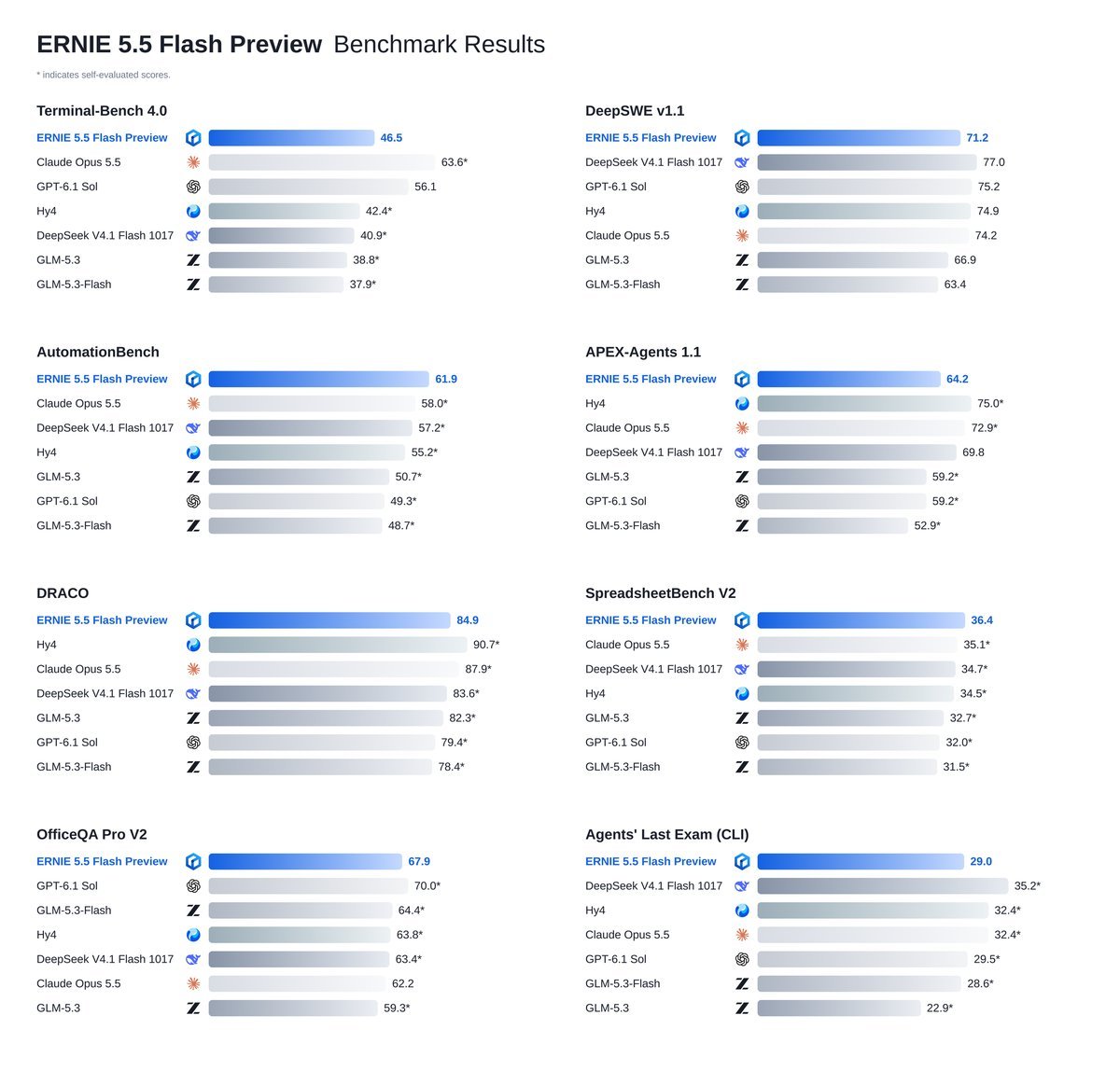
Every Preview score comes from Baidu’s own testing, across 20 benchmarks. For rival models Baidu combines published figures with its own runs, using each model’s top reasoning mode. Third-party tests will show whether the results hold.
The official ERNIE 5.5 Flash launch is the one to watch. Baidu says improvement is quick and that lessons from the Preview will go into it.
Source: huggingface.co