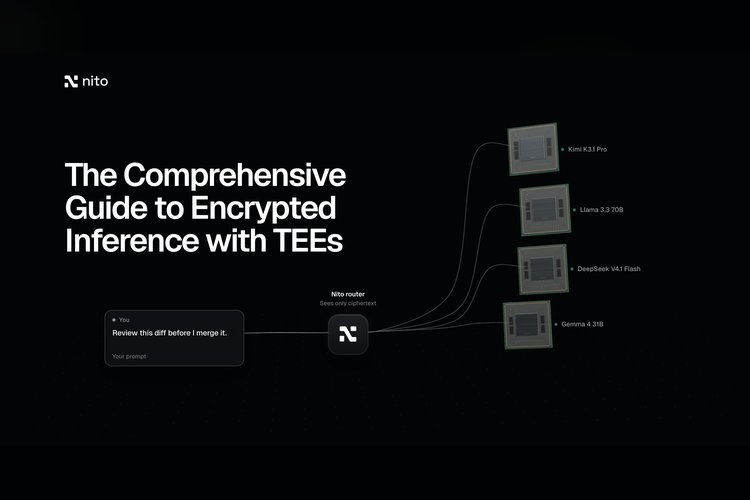
Encrypted inference is becoming a buying criterion for AI teams after a string of prompt exposures at hosting companies. When an app calls a model through a router, the text of the request is typically opened and read at the router, then opened again by whichever company runs the model.
Routers have caught on because one key and one endpoint reach many models. OpenRouter is the name most developers know. The trade-off is exposure. Between your app and the GPU sit gateways, logs, caches and the staff who maintain them, and each one sees plaintext unless something stops it.
A bad week for prompt privacy
Within seven days, four separate disclosures landed:
- GMI Cloud: an intruder viewed prompts the company had stored.
- OpenRouter: customers were told an outside party might have seen prompts aimed at MiniMax models.
- Prime Intellect: for roughly two days, a tampered model answered calls to its DeepSeek V4.1 Flash endpoint.
- Together: an unauthorized party took some of the prompts sent to the service.
Big customers got caught too. Notion says Fireworks had agreed in its contract not to keep Notion AI chat transcripts, yet a Fireworks breach may have exposed them.
Why a no-retention contract isn’t enough
Zero data retention (ZDR) is the usual reassurance. It governs what gets saved afterward, not who can look while the model is running. During that window the prompt sits readable in server memory for the serving code and for administrators. Exceptions for legal holds, abuse review and features that keep state are common, and customers have no way to audit compliance beyond trusting the vendor.
Failure handling matters as well. If a private route goes down and the request quietly shifts to a normal server, nothing was ever protected. Private routers have to refuse the request instead.
What a trusted execution environment does
Models need plaintext to work. On a standard machine, anyone controlling it can pull that plaintext out of memory: cloud employees, an attacker holding admin rights, or the management software itself.
A trusted execution environment (TEE) moves the boundary into the chip. The processor walls off the workload and scrambles its memory under a key the chip never exposes, so the host owner sees only noise. The hardware can also sign a statement describing the exact code it runs. That statement is called an attestation.
Both processors in an inference server need coverage. For CPUs, confidential virtual machines strip the hypervisor of its ability to read guest memory. AMD’s SEV-SNP gives each VM a separate memory key, while Intel’s TDX uses a small module signed by Intel that sits between hypervisor and guest. GPUs need their own protection.
How attestation proves the right machine answered
Encryption delivers a prompt to a key holder. Attestation says who that holder is. The process has five stages:
- Boot-time fingerprints: each loaded stage is hashed, from firmware to the serving application.
- A signed report: the processor returns the hashes plus 64 bytes the workload chooses, signed by a key tracing to the chip maker.
- Verification: a checker confirms the signature, the firmware version and whether the hashes match approved builds.
- Key binding: the workload stores a hash of its public encryption key in those 64 bytes, tying the report to the connection.
- Freshness: a random challenge or an encrypted handshake prevents replay of an old report.
Key binding is where many implementations cut corners. A valid report without it shows that some approved machine exists, but not that your traffic landed there.
Fingerprints only help if they map to published code, so the stronger designs build releases publicly, sign them and log them in a transparency record. Some also pin a hash of the disk holding model weights, so a swapped model changes the fingerprint and routing stops.
How Nito uses it
Nito runs a router on this design, and says every model in its catalog executes inside a TEE. It mimics OpenRouter’s interface with an OpenAI-compatible endpoint, supporting streaming and tool calls. Models listed include Kimi K3.1 Pro, DeepSeek V4.1 Flash and Gemma 4 31B. Customers prepay and can cap spending per key by day, month or lifetime.
To get encrypted inference, a client requests a model name with the suffix :encrypted. The client checks the enclave’s attestation on its own, pulls the key from that verified report and seals the whole request with HPKE (RFC 9180). Everything is covered: system prompt, conversation, tool definitions and tool results. The gateway forwards ciphertext it has no key for, and only the enclave can decrypt and reply.
The gateway still bills by token count and keeps a record of account, model, usage and timing. Nito also bought Switchboard, a team that specializes in running TEE platforms.
Questions to put to any router
Teams weighing encrypted inference vendors can ask three things. Does the client check the attestation itself? Is the encryption key bound to the machine that was verified? Does the service fail closed when the private path is unavailable? Answers that rest on a contract alone offer the same protection that failed in these incidents.
Source: Nito