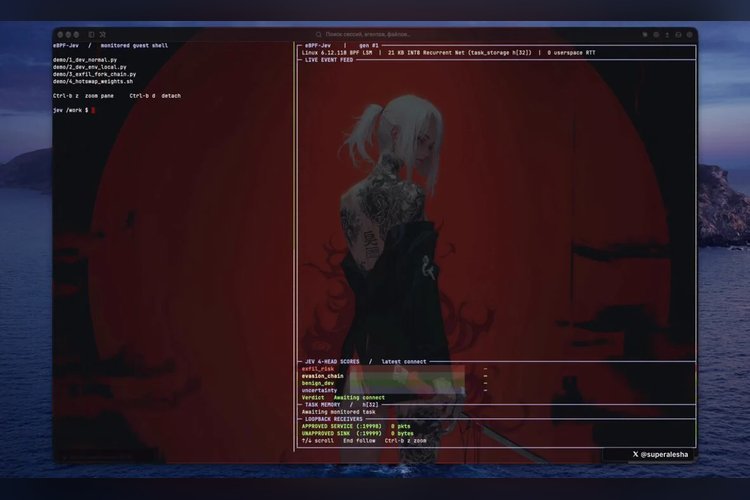
A developer has built an eBPF security model small enough to run inside Linux kernel hooks and block AI coding agents from leaking secrets. The model is 21 KB, runs in a median of 5.65 microseconds per hook, and stops the data before a single packet leaves the machine. The code is published under an MIT license in the developer’s llm.asm repository.
The idea targets a growing worry. Agents that read files, run shell commands and open network connections can be tricked into sending API keys or .env contents to a server they shouldn’t reach. Most teams don’t want any model sitting in the syscall path, so the usual defense is a fixed rule. The benchmarks below suggest fixed rules cost a lot of legitimate work.
How the model works
This isn’t a text generator. It’s a small decision model that runs one fixed-point INT8 forward pass (64 to 64 to 4 units, with FNV-1a 3-gram embeddings). The output is four calibrated probabilities: exfiltration risk, evasion chain, benign workflow and uncertainty.
What sets it apart from a stateless classifier is memory. A 32-byte recurrent hidden state sits in a BPF task-storage map and follows a process across fork() and execve(). That lets the model link a file read in one process to a network call made later by a child process, which is exactly how an evasion chain behaves.
It uses no floating point, no tail calls and no userspace round trips. The program passed the real Linux 6.12 eBPF verifier at 21,457 instructions out of the 1 million allowed.
Benchmark results
The developer tested four approaches on Linux 6.12 across 3,840 unseen multi-step developer workflows. A simple rule that blocks a network connection after a secret file is opened broke 500 of 1,000 normal workflows. A 1.3 KB oblivious decision tree and a stateless 21 KB INT8 model both produced zero false denials, but caught only half of the multi-step chains, a 50% recall.
The recurrent 21 KB model also kept false denials at zero per 1,000 workflows while lifting recall to 75% on the strict gate. It scored 0.947 F1 on evasion chains. Median hook latency was 5.65 microseconds, with a 12.25 microsecond p99. These are the developer’s own results, not an independent test.
What the live demo showed
In a KVM video using inert dummy files and plain shell commands, reading config.yaml left the hidden state marked CLEAN, in 20 microseconds. Reading dummy_secret.env flagged it TAINT in 13.5 microseconds. A python3 process that read .env and connected to an approved local port, 19998, was allowed through in 13.6 microseconds after one packet.
The blocked case was a bash subshell that read .env and then ran a clean python3 toward unapproved port 19999. The kernel returned -EPERM in 18.2 microseconds, and no bytes left the machine.
Updating the model without a reboot
The same design handles retraining. When the model reports high uncertainty or a false denial occurs, the event streams out through a BPF ring buffer for review or labeling. A 10-second CPU pass retrains the 21 KB INT8 pack, and the new weights swap into a double-buffered BPF map. In the demo, the system moved from generation 1 to generation 2 with no reboot and no downtime.
Why the kernel is the place to enforce this
eBPF lets small verified programs run inside the Linux kernel, and LSM hooks let those programs allow or deny actions such as opening a file or making a connection. Enforcing a decision there means an agent can’t dodge it by spawning a new process or switching tools, because every path ends in the same system calls. The cost is a strict budget: the verifier limits program size and complexity, so any model has to be tiny and predictable.
That budget explains the design choices. Integer math avoids floating point, which kernel BPF code can’t use freely. A fixed network of 64 to 64 to 4 units keeps each decision to a single pass. And a 32-byte state is cheap enough to attach to every task without straining memory.
What to check before using it
The results come from one developer’s test set, so teams should run their own workflows through the model before trusting the recall figure. A 75% recall also means a quarter of strict-gate chains still get through. Because the full eBPF C code, loader and training pipeline are open, security engineers can inspect the logic and test it against their own agent setups.
Source: X (formerly Twitter)