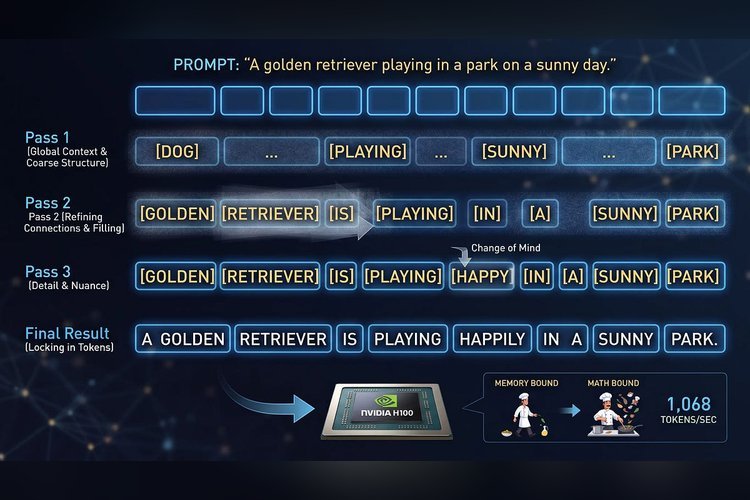
On October 19, startup Inception released Mercury 3, one of the first diffusion language models to compete with mainstream chatbots. On Nvidia hardware it produces over 1,000 tokens a second, around 750 words. Inception claims it keeps pace with or outscores GPT-6 Luna and Claude Haiku 5.5 at four to eight times their speed.
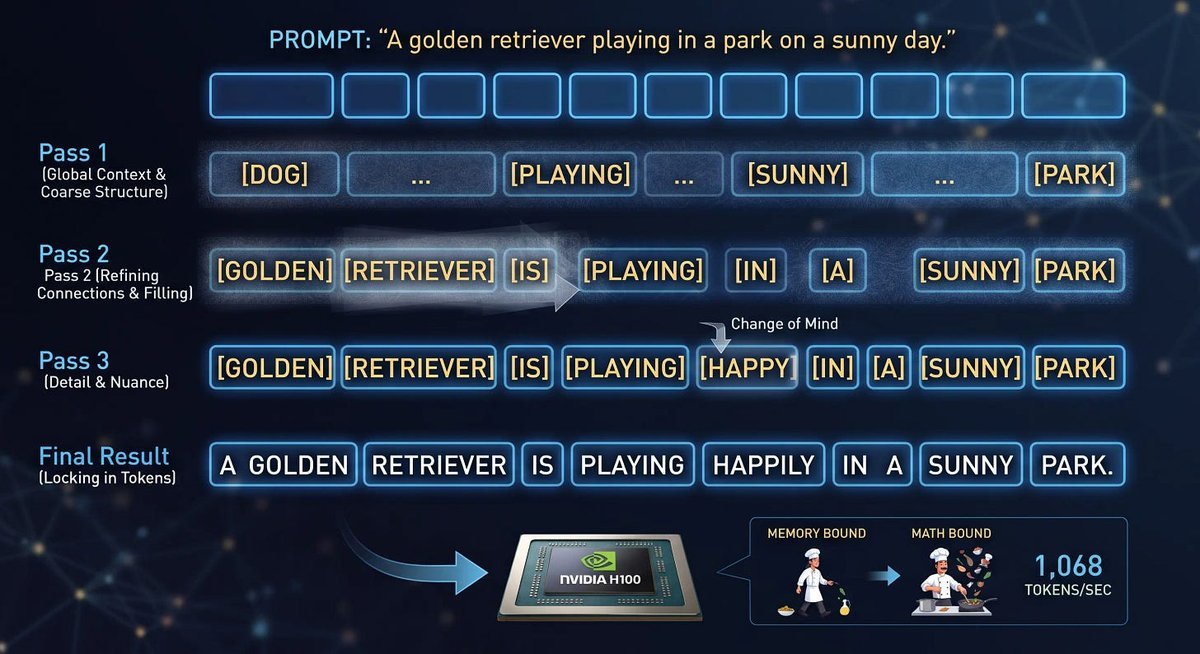
It doesn’t produce words in sequence. It begins with a page of empty slots and fills many together.
From image noise to text blanks
Diffusion models first became known for images. Add random static to a photo a thousand times and it disappears. Train a model to remove one sprinkle of static at a time, hand it pure noise, and it produces a picture that never existed. The same recipe now covers video, with Sora and Veo, and audio.
Text was harder because “cat” with noise on it is a different word, not a blurry cat. The fix was blanks. Models learn by restoring passages where some words, or every word, have been removed. In 2024, Stefano Ermon and two of his students took a Best Paper award at ICML for a version that held its own against regular models of the same size. Inception grew out of that work. Google showed an experimental Gemini Diffusion in May 2025 and released the open DiffusionGemma in June.
Why it’s fast
The speed of diffusion language models comes from how chips work, not from marketing.
When a regular chatbot writes, the chip’s bottleneck is memory, not math. Nvidia’s H100 moves about 3.35 terabytes a second, and an 8-billion-parameter model stored the usual way takes 16 GB. That caps one conversation at around 200 tokens a second while the chip uses well under one percent of its compute.
A diffusion model works on a whole block of blanks per trip to memory. DiffusionGemma handles 256 tokens at a time and locks in about 20 per pass on average, where a regular model locks in one. It has about 26 billion parameters but uses roughly 3.8 billion per token, fits in 18 GB of graphics memory when compressed, and exceeds 1,000 tokens a second on a single H100 and 700 on an RTX 5090.
The catch is in Google’s own notes. In a busy data center, regular models already batch many conversations, so the chip’s math is busy anyway. Google says the gain is biggest on one chip under a light or moderate load. Under heavy cloud traffic the edge narrows, and serving can get more expensive.
What independent tests found
Inception says Mercury 3 writes 1,068 tokens a second. An independent tester measured 850 to 900, roughly double the pace of Gemini 3.5 Flash-Lite, 2.8x Haiku 5.5 and 6x Luna. Short answers came back in 0.30 seconds.
The same tester ran gpt-oss-120b on Cerebras chips as a control. That model produced around 2,400 to 2,500 tokens a second and outran Mercury 3, which suggests Mercury’s speed comes from the model and its serving stack together.
Quality is close to the fast models, not the top ones. On 637 coding problems Mercury 3 passed 86.0%, against 86.1% for Haiku with thinking off and 83.2% for Luna. With thinking on, Luna reached 88.4% and Haiku 87.9%. Google says DiffusionGemma is below the regular Gemma 4 it came from.
Where the savings disappear
Mercury 3 lists at 20 cents per million input tokens and 70 cents per million output tokens, with launch pricing at half that. Per finished task, it can cost more. On the coding test, a thousand correct answers from Mercury cost 59 cents. Haiku’s cost 14 cents and Luna’s 7. On a database test it cost $1.31 per thousand tasks against Luna’s 74 cents, partly because it needed 5.1 rounds per task to Haiku’s 3.2. Inception advertises up to 70% lower cost per task, which these tests didn’t reproduce.
Where diffusion language models fit
They help when someone, or something, is waiting. Agents make several model calls per question, and Mercury completed a typical database task in 2.06 seconds. Haiku needed 3.86, Gemini 4.43 and Luna 5.95. For voice, Inception says its Mercury Voice model, out since September, begins replying within 170 milliseconds. A model that sees the whole page also suits filling gaps in the middle of a file, which is what Mercury Edit 2 does.
They’re not the tool for hard legal questions or long research summaries, where a flagship model still wins.
What to watch next
Mercury 3 replaced Mercury 2, which TIME named one of 2026’s best inventions, and Inception stopped offering Mercury 2 to new customers four days after that announcement. ByteDance, Nvidia and Ant Group are also working on the approach. The test that matters is cost per finished task on your own workload.
Source: blog.galratner.com