
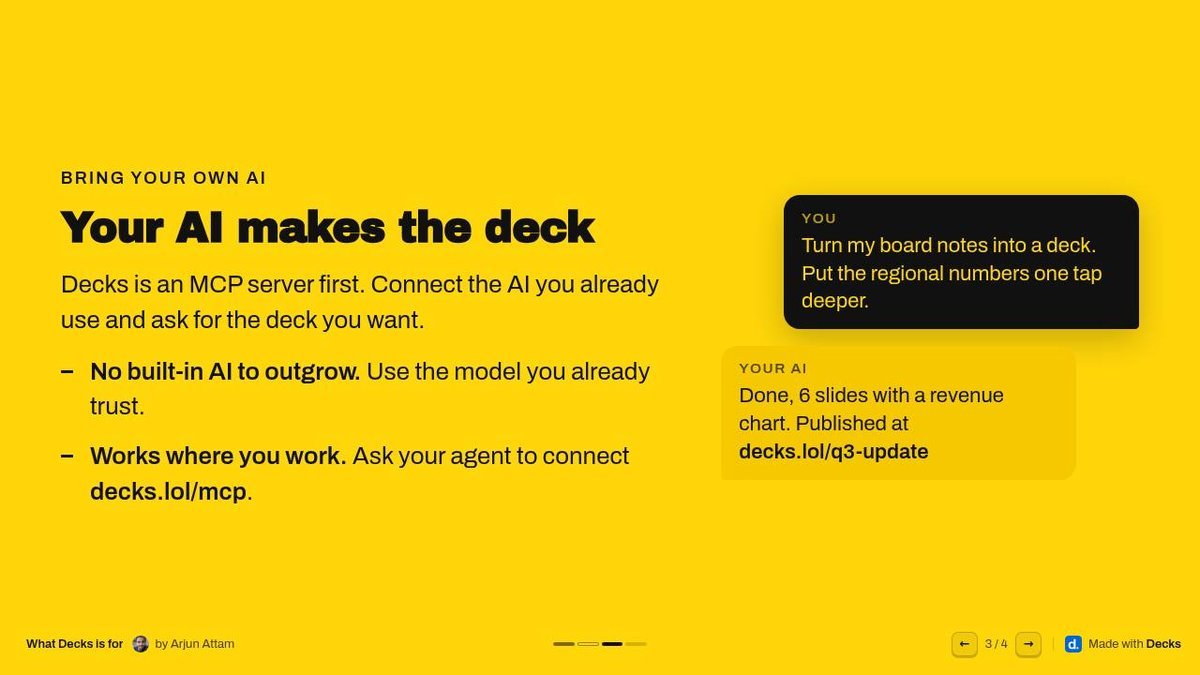
The Decks MCP server drops the usual split between development, build and production. Decks is a tool for building presentations as code, and every deck lives in one place: a Cloudflare Durable Object backed by SQLite. Agents write files, get a build result back in a fraction of a second and preview screenshots on desktop and mobile. Its creator calls the approach “dev is prod.”
Why a three-computer pipeline is overkill here
A normal website involves three machines: the developer’s laptop, a CI server that builds the code, and the host that serves it. That split makes sense when production needs scale and stability while development can be messy. For a blog or a slide deck, the author argues, it is ceremony nobody wants.
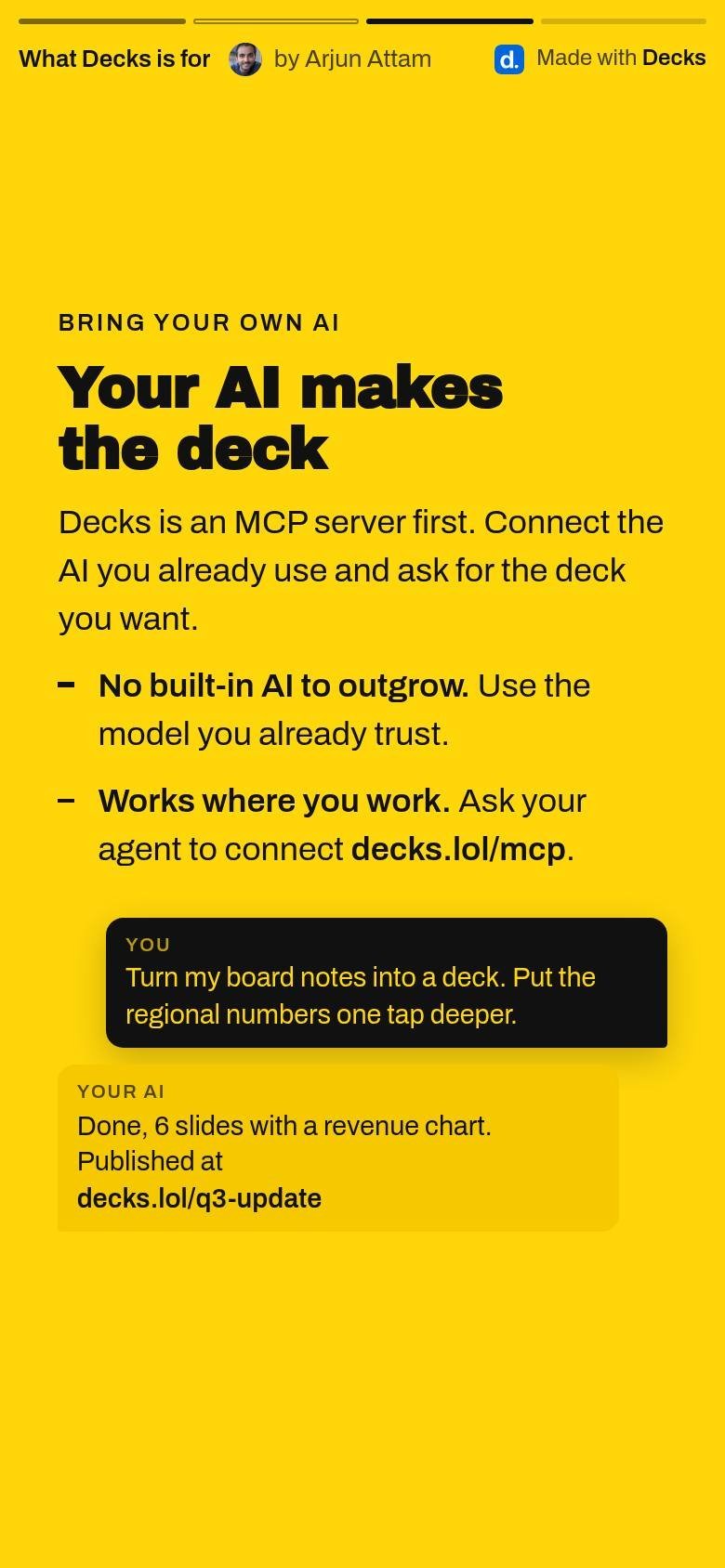
The argument rests on agents. Code is increasingly how they produce things, whether an app, a presentation or generative art. Presentation software offers a fixed set of layouts and animations because users need guardrails and vendors can only ship so many options. With an agent, users can describe what they want in words, and the agent can write any code, so neither limit applies.
What Decks needed
The design started from three requirements:
- Unrestricted, expressive code as input
- Output measured in kilobytes, so decks load on poor mobile data
- A fast edit-and-preview loop for agents
MDX with TSX fit well. It’s old enough to appear in model training data, flexible, and backed by mature build tooling.
Git and CI would have worked, and both do useful jobs. Git lets agents edit freely without breaking what viewers see. CI turns expressive React into a few kilobytes of static HTML. The problem is speed, since CI takes minutes at best.
SQLite replaces git
From the outside, Decks is a single MCP server. Behind it, each deck is a Durable Object whose SQLite database stores every version of the deck’s files, like a simplified git repository. Every edit creates a new version. “Draft” and “published” are just pointers to two versions.
There is no staging environment and no deploy step. The draft an agent edits sits right beside the version readers see.
Builds inside the request
Each deck combines its own text and code with a shared component library, then builds into light static HTML, JavaScript and CSS. Instead of running CI asynchronously after a push, Decks builds synchronously whenever an agent calls write_files. The agent gets back a result with a version number, a build status and any problems, such as a missing closing tag on a Callout component on a given line of a slide file.
The build runs in a Dynamic Worker, a sandboxed V8 isolate. With no caching or other optimization, p90 build time is about 650ms and the median is around 300ms, which fits inside a single request and response.
Previews close the loop
Build errors catch mistakes, but an agent also needs to see the slide. Decks offers a preview_deck tool that pairs the instant build with browser rendering and returns screenshots in desktop and mobile viewports. An agent names a deck slug and the slides it wants to check.
Where the idea goes next
The author sees Val Town as an earlier attempt at the same idea: write code, save, and it’s deployed, with logging, versions, error tracking and a hosted SQLite database included. Val Town is winding down, and the author thinks it simply arrived a bit early. Picturing each “val” as a Durable Object with a shared standard library, he expects more experiments with the code supply chain now that agents handle the writing.
For now, Decks is built entirely on Cloudflare, and the author expects to keep building there.
What it means for people building agent tools
The design shows what changes when a tool is made for agents rather than people. A person tolerates a build that takes a few minutes, because they can read email while it runs. An agent waiting on a build is idle, and a slow loop means fewer attempts per task.
By making the build part of the write call and the screenshot part of the preview call, Decks gives the agent a result inside the same step. A mistake like a missing closing tag comes back with a line number, and the agent can fix it and try again immediately.
The trade-off is dependence on one platform. Durable Objects, Dynamic Workers and browser rendering all come from Cloudflare, so the model doesn’t port easily to other hosts. Teams that need a normal git history or a staging environment would find less to like.
Source: arjun.is