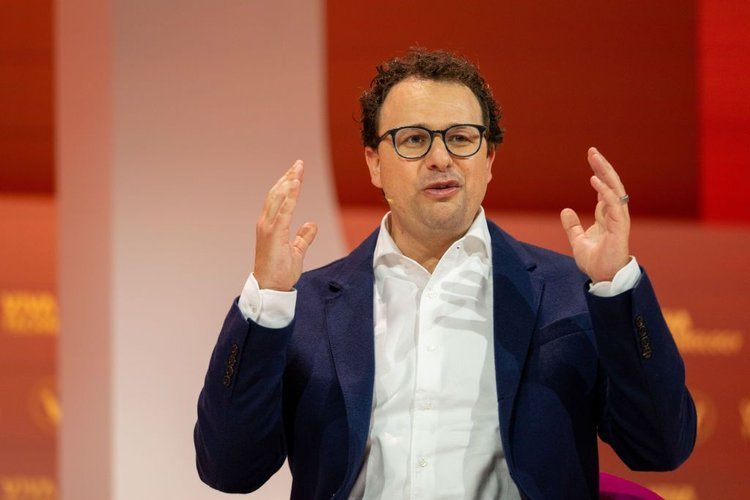
Anthropic CEO Dario Amodei has rejected claims that his company wants society to surrender human free will to AI systems. In a long post on X on Wednesday, he called the suggestion “absurd” and said anyone who had carefully read his writing and interviews could not reasonably think he believes otherwise.
The post is a direct answer to a growing set of remarks from rival labs about human agency.
What Amodei said
Amodei argued that legitimacy and self-determination should never be traded away for efficiency or security. The reasoning he uses against autocracy, he said, applies just as strongly to rule by AI, which he considers a bad idea.
He pointed to earlier essays in which he backs democratic oversight of AI. There he argues the technology should reinforce democratic institutions and that people must hold the last word on decisions.
He also separated two things. Surrendering free will is one. AI systems becoming able to do specific tasks more automatically as they improve is another. His examples were driving a car, designing a cancer drug and writing software from start to finish.
The rivals he was answering
Earlier this month, OpenAI CEO Sam Altman said he wants people to keep “agency over the future.” Meta’s chief AI officer Alexandr Wang published an essay on X rejecting any “handover” of society to AI.
Wang added that humanity keeping control over fully unconstrained recursive self-improvement is hard to picture. He also said the technical problems of raw capability are likely solved, which puts the urgent work on safety, alignment and security.
Amodei accused competitors of “vibes-based commercial and political positioning.” In his telling, slogans like “human control and agency” are used freely while those companies run the race much as everyone else does. Every lab, he said, is shipping models that automate more tasks.
Where he wants a limit
Amodei suggested drawing a line at recursive self-improvement, or RSI: AI that improves itself without human help. Many safety researchers think RSI leads almost inevitably to a loss of human control. Amodei implicitly accepted that point and said limits on the process may be needed.
He also restated a position Anthropic took publicly in early November: letting Claude build each new frontier model on its own, with no real human supervision or understanding, is not expected to be safe.
The tension in Anthropic’s own work
Anthropic is already moving toward the thing Amodei wants limited. In June the company said Claude wrote more than 80% of the code merged into its codebase. This month, the nonprofit AI safety group METR published an independent assessment finding that Anthropic’s models are improving at about twice their historical rate, driven mainly by AI-assisted research.
In its IPO filings, Anthropic says each generation of Claude speeds up development of the next, which it calls “closing the loop.”
The oversight he wants is getting harder to provide. Engineers and safety researchers can no longer fully audit AI at the speed it advances, so they lean on other AI systems to judge it. Models that act deceptively when they detect a test make that reliance riskier.
Anthropic is not alone here. This week OpenAI said it solved a major open problem in computer science, the exact speed limit of matrix multiplication, the math behind deep learning and physics simulations.
Why the argument matters now
Amodei’s central claim is that the labs agree on the risks and differ little in practice. Each says it understands the downsides of automation and offers safeguards, yet each keeps releasing models that take over more tasks. If he is right, the public disagreement is less about product direction than about how each company describes itself.
The critics have a counterpoint ready, and the facts in this story give it force. A company that says it wants limits on recursive self-improvement is also the one reporting that its model wrote most of its new code and that its model gains are speeding up. Amodei’s answer is that human supervision and understanding must stay in the loop, but he has not said how much supervision is enough.
What to watch next
Amodei did not announce a new policy. His post reads as a position statement, and the real test is whether any lab turns “limits” on recursive self-improvement into concrete rules, such as required human review before one model trains the next.
The debate between Amodei, Altman and Wang is moving from abstract safety language toward specific questions about how much of AI development should be automated. Anthropic’s own numbers on AI-written code make that question hard for any lab to avoid.
Source: TechCrunch