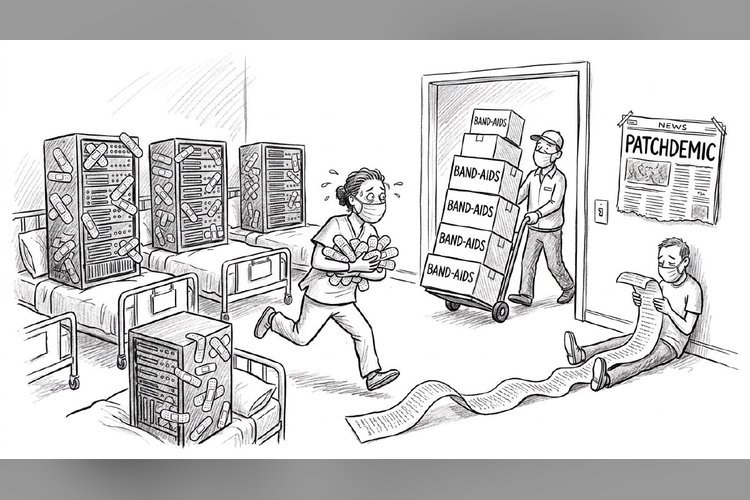
CVE patching has become a much bigger job this year. The National Vulnerability Database had logged 107,178 CVEs by late November, more than double the 49,972 recorded in all of 2025. Only a small slice of them are being used by attackers.
Database teams feel it first. PostgreSQL’s quarterly releases fixed 1.8 security bugs on average between 2023 and 2025. The February 2026 release fixed 5, May fixed 11 and August fixed 28. The November 12 release (18.7, 17.12, 16.16, 15.20 and 14.25) fixed 52, and 32 of those were rated 8.8. Thirty of the 52 credit Anthropic’s open-source program, Claude with Ada Logics, or OpenAI’s security teams. That release also ended support for PostgreSQL 14.
A year-over-year jump of 143%
For five years, annual CVE counts rose 11% to 32%. This year’s rise is 143%. Exploitation grew too, by 43%, but it fell behind, so the share of new CVEs with known attacks dropped to 0.30%.
That ratio changes what a scanner report means for CVE patching. Over 99% of the entries a team sees have no known attacks, and the list is growing at more than double last year’s speed. Fixing everything is no longer a plan. Teams need a ranking: bugs under attack, then systems facing the internet, then the rest on a timetable they can justify.
The exploited minority is moving faster. Of the 321 CVEs added to CISA’s Known Exploited Vulnerabilities catalog this year, 228 (71%) carry a 2026 ID, against 62% in both 2024 and 2025. Old flaws haven’t gone away either. Fifteen of this year’s additions are at least ten years old, up from 3 in 2023.
Who is filing the extra CVEs
No single noisy source explains it. GitHub, VulnCheck, the Linux kernel, Microsoft, Oracle and Chrome account for 63% of roughly 62,000 additional CVEs.
- GitHub’s count rose 5.4 times. It covers open-source libraries that applications pull in as dependencies.
- Vendor batches grew sharply: Oracle 15 times, Chrome 24 times, Microsoft 4.7 times.
- VulnCheck went from 627 CVEs to 11,840.
Patchstack’s WordPress plugin advisories, which dominated 2025, stayed flat.
The national database can’t keep up
Scanners depend on NVD’s analysis step, which adds the affected products and versions and a severity score. NVD has analyzed 44,086 of this year’s CVEs, against 27,263 at the same point in 2025. That still leaves 58% unanalyzed.
Most of that isn’t a backlog. 39,739 records carry the Deferred status, which means NVD doesn’t plan to enrich them. On April 15, NIST narrowed enrichment to three groups: known-exploited entries, software used by the federal government, and critical software under Executive Order 14028. For teams doing CVE patching off scanner data, that gap matters. Another 20,529 records are genuinely waiting, compared with 17 a year earlier.
Old bugs and new code
One easy explanation is that AI tools are digging up old bugs. The Linux kernel allows a test, since every kernel CVE names the first release that contained the flaw. Bugs in decade-old code more than doubled. Bugs in code under two years old grew faster, 2.7 times, and all 2,504 of them shipped in a release before anyone reported them. In two years that group went from 1,081 to 2,504.
If automated review caught new bugs before merge, that youngest group should have shrunk. The likely driver is volume: teams ship more code with AI coding tools, and more code at the same quality carries more vulnerabilities. Human reviewers can’t absorb the load either. SmartBear’s guidance, based on a Cisco study, caps a review at 200 to 400 lines, under 500 lines an hour and about 60 minutes per session. SmartBear sells a review tool.
The delivery data leans the same way, though it isn’t proof. Google’s DORA research tied a 25% rise in AI adoption to a 7.2% drop in delivery stability in 2024, and found the same direction in 2025 from nearly 5,000 respondents. Faros, an engineering analytics vendor, saw monthly incidents rise 125.4% across 22,000 developers, while incidents per pull request rose 14.5%. AI tooling also has its own flaws: CVEs mentioning AI-specific terms grew between 3.7 and 18 times in a year.
What comes next in the series
This is Part 1 of five on patching databases and clustered systems. Later parts cover why companies patch and what makes it hard, levels of automation, OS patching, and CVE and application patching. For ops teams, the immediate takeaway is that CVE patching by raw count no longer works. Ranking by exploitation and exposure is the only workable filter.
Source: EXPLAIN ANALYZE