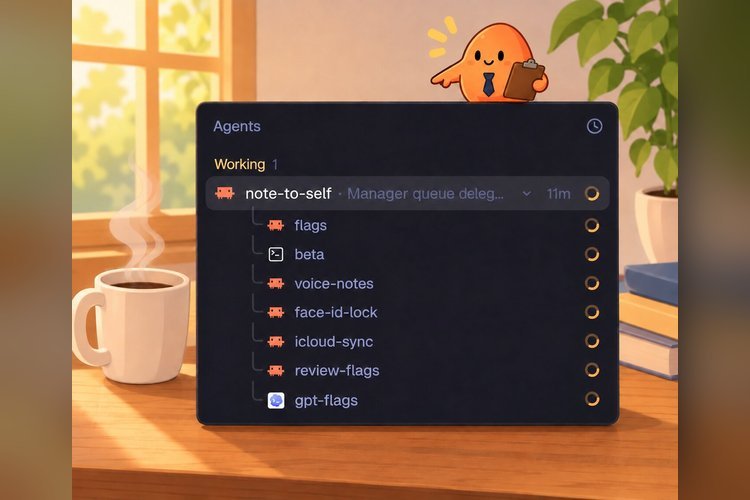
An iOS developer has turned their main Claude Code session into a manager that writes almost no code. In five days the Claude Code manager shipped 37 TestFlight betas of the app Note to Self, covering builds 12 to 48. The five days before, the same developer shipped 9.
The manager started 84 agents and received 303 messages from them. Its whole instruction set is a single Markdown file of 129 lines.
What the manager actually does
The session splits the work into briefs for other Claude Code agents, reviews their output, then merges and releases. An agent reporting “done” isn’t enough for it. It inspects the commits, test results, a recorded proof video and a Release build first.
That leaves the developer with two tasks: approving plans and testing each beta by hand on an iPhone.
The tool-call log shows it. Of 2,057 calls in those five days, just 44 (about 2%) edited files, and mostly briefs and notes. Ordinary sessions for the same developer run at 11%. A few times the manager still repaired a Release build or a test file on its own.
How the setup is wired
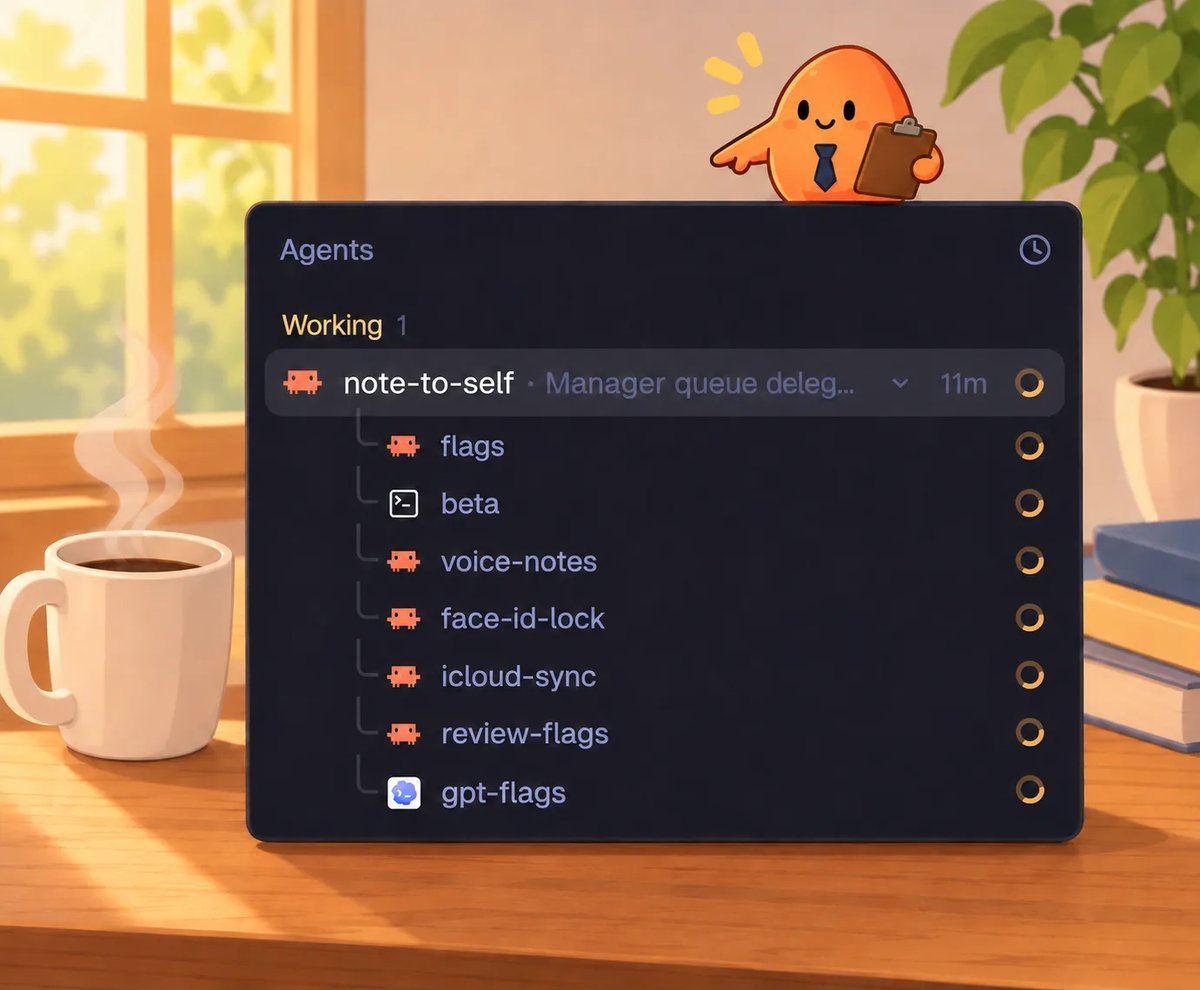
A separate Claude Code agent takes each feature and works in a dedicated git worktree, in parallel when two items won’t clash. Herdr, a terminal app for coding agents, hosts them. Its hc command line launches agents, relays messages and waits for replies, while hc –skill outputs a manual the manager reads to learn all of it.
Each feature moves through the same five stages:
- A plan comes first, and the developer signs off on it.
- The agent builds in logical commits, backed by tests and a simulator recording.
- It runs /code-review on its own diff, and a GPT model gives a second review.
- Each finding gets reproduced, and only the genuine ones are fixed.
- The manager verifies the evidence, merges and sends out a beta.
Separate agents instead of subagents
Subagents fit short, bounded questions. Work that runs an hour through building, testing and review calls for a full session, which can spawn subagents of its own for /code-review.
Context stays small for the manager, which receives only brief status messages like “plan ready” or “committed” and so can work through 20 queued features. The developer can open any agent’s terminal, read along and type in. If the manager restarts or compacts, the agents carry on, and any single one can be halted alone.
The price is infrastructure: a terminal app, messaging between sessions, and tidying up terminals and worktrees.
Every failure became a rule
The manager’s skill file took 9 commits in its first two days, and almost every one answered a specific breakage.
- Unattended permission prompts stalled agents. All agents now use auto mode.
- A one-line edit triggered the full UI suite. Agents now run only the test classes it touches.
- Debug-only builds let a Release beta fail to archive. Agents now build Release before calling work finished.
- Three features got merged with no beta. Every feature now gets one, and a failed beta halts the queue.
- A sync feature consumed a whole day and about 35 review findings, mostly side effects of its earlier fixes. Behavior-heavy work now begins with a spec, and agents pause to ask if a fix calls for new machinery.
Each fix goes into the brief later agents read, so a rule is stated once and applies from then on.
Three Herdr details that cost time
One: hc send posts a chat message, so a slash command sent through it never executes. Use hc keys instead. Two: if auto mode blocks an action, approval passed along by the manager doesn’t count as the developer’s own. Remote Control on that terminal lets the developer approve from a phone. Three: the manager is allowed to clean up only agents it launched, and never the developer’s own terminals.
How to copy the approach
The skill is plain Markdown, so changing it means editing a sentence. This version carries iOS rules for simulators, Release builds and TestFlight. Another team could swap the beta for a deploy, the simulator video for a screenshot, or GPT for a different second reviewer.
A smaller start works too. Open Claude Code in a Herdr session and tell it that it’s the manager and writes no code, to run hc –skill, and to start an auto-mode agent in its own worktree for each item on a list. Each agent plans first and waits for approval, and the manager checks and merges when one finishes.
The developer’s advice is to add one rule the first time something breaks. The full skill, with templates and the review script, is on GitHub for anyone who wants to fork it.
Source: Juraj Blahunka