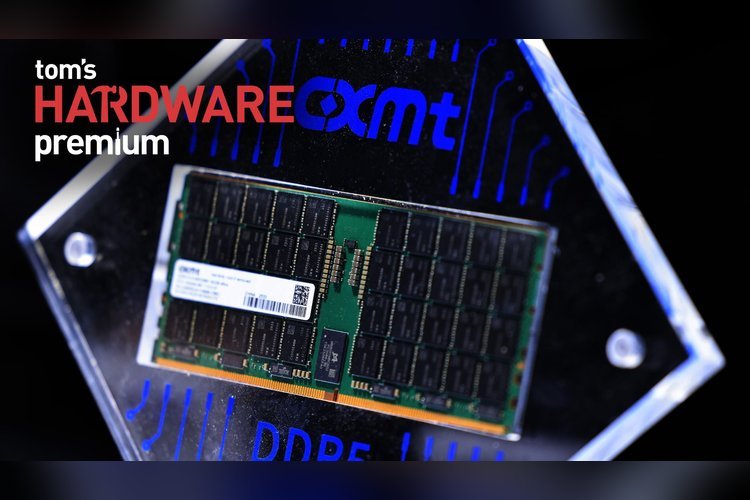
The China memory industry is having a record year, led by two companies: CXMT in DRAM and YMTC in 3D NAND. Both have posted huge profits and are adding fabs. One gap remains. No Chinese maker can yet produce high-bandwidth memory, the layered memory that feeds AI accelerators, in volume.
Record numbers at CXMT and YMTC
CXMT’s Oct. 30 filing reports ¥132.0 billion ($19.6 billion) in net profit for the first nine months. A year before, it lost ¥5.28 billion ($785 million). Revenue climbed more than eightfold to ¥269.0 billion ($40.0 billion). Third-quarter profit alone came to ¥54.4 billion ($8.1 billion). The company listed on Shanghai’s STAR Market on July 27.
YMTC reported first-quarter revenue of ¥47.04 billion ($7.0 billion) and profit attributable to shareholders of ¥33.38 billion ($5.0 billion), more than double 2025.
CXMT: three DRAM fabs running, three more coming
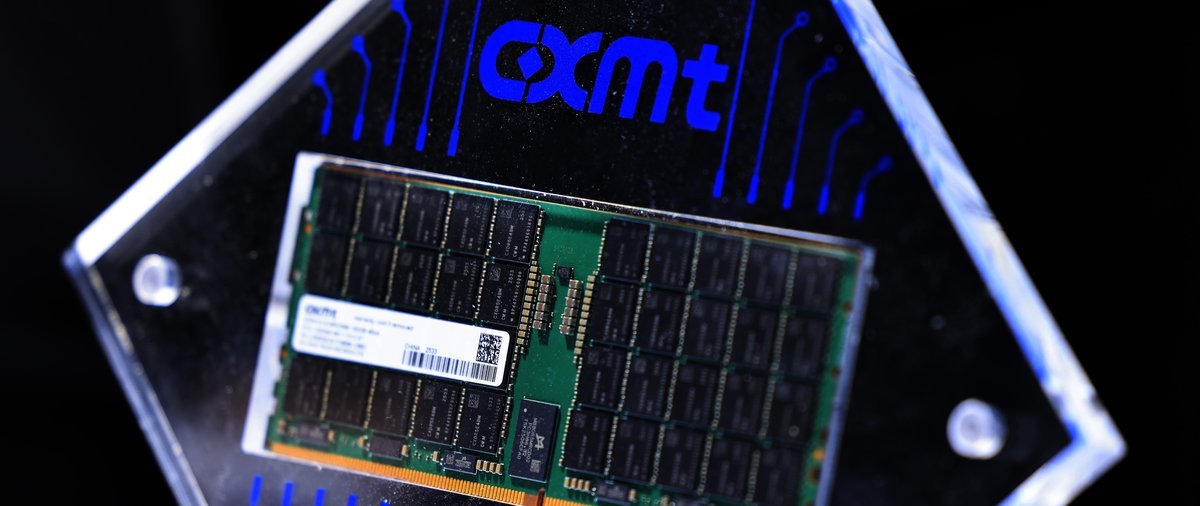
CXMT is China’s biggest homegrown DRAM maker. Two 12-inch fabs in Hefei and a third in Beijing each turn out around 100,000 wafers monthly. Further plants are planned for Shanghai and Hefei, and a second Beijing site is in funding talks. If all of them come online, total output could pass 600,000 wafers per month. Shanghai is the big one, expected to be two to three times the size of the Hefei base, with equipment moving in during the back half of 2026 and volume production following in 2027.
The company is now the world’s fourth-largest DRAM maker, with 9.5% of second-quarter revenue. Its core lineup is DDR5 at up to 8,000 MT/s using 24Gb dies, plus LPDDR5X at up to 10,667 MT/s. The company says it already mass-produces LPDDR6 for Xiaomi, and its president expects the first 4F² chip, a server DDR5 RDIMM, before the year ends.
CXMT lacks extreme ultraviolet lithography tools, so it is limited to nodes made without EUV. It sells no GDDR or 3D NAND. A 3D NAND research line is planned for the second Beijing fab, which could change that.
YMTC: NAND first, DRAM in testing
YMTC has two fabs in Wuhan that together make about 200,000 wafers a month. A third fab in Xinzhou, registered last September, is expected to reach about 50,000 wafers monthly by 2027, then 100,000 at full build-out. Roughly half of that fab’s output is earmarked for DRAM.
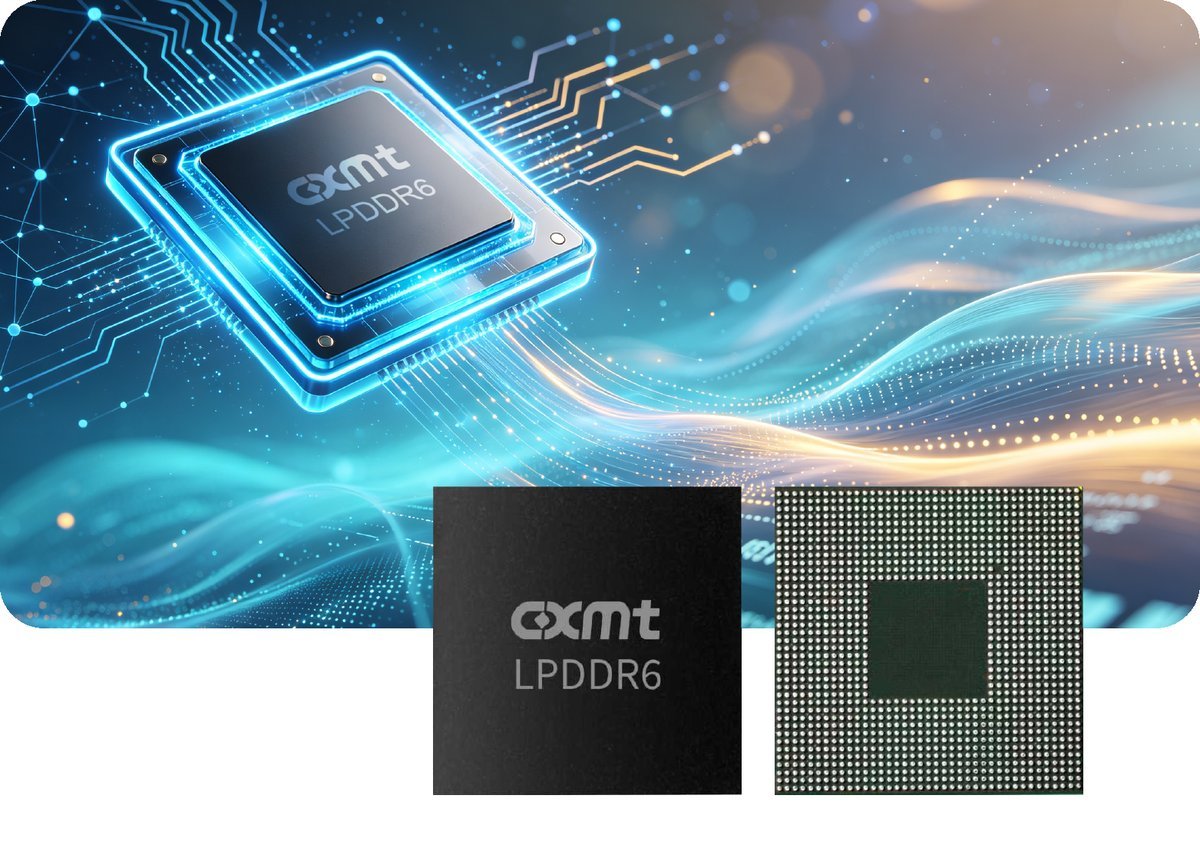
The Xtacking 4.0 die behind its 1Tb TLC and 2Tb QLC chips carries 294 gates, 267 of them active word lines per TechInsights. Yet the bulk of shipments remain older 160- and 232-layer NAND.
In the second quarter, Omdia gives YMTC 38.5% of China’s NAND market and Samsung 33.5%. Counterpoint Research ranks it third globally in NAND shipments, its share of NAND revenue rising from 9% to 14% between the first quarters of 2025 and 2026. The long-term goal is about 20% of global NAND supply and 500,000 wafers a month, DRAM included.
On the DRAM side, Fab 2 makes roughly 5,000 wafers monthly of 16Gb LPDDR5 for research and testing only, with no volume plan. Fab 3 is meant to build a faster 9,600 MT/s chip using a vertical channel transistor 4F² cell, provided it clears qualification.
Smaller fabs
Fujian Jinhua runs a 12-inch fab in Jinjiang making custom 25nm DDR4, 40,000 to 50,000 wafers monthly, nearly all of it for Huawei. SwaySure, a Shenzhen company founded in 2022 with state-owned investment, is installing a 28nm DRAM line on 12-inch wafers, reportedly with Huawei’s support. Objective Analysis analyst Jim Handy doubts it could ever make HBM.
The HBM problem
Training-class accelerators such as Huawei’s Ascend series need HBM. The US banned its export on Dec. 2, 2024, so China can’t buy it from Samsung, SK hynix or Micron.
CXMT has sampled HBM3 to Huawei, built on its 16nm-class G4 node, and has sent HBM3E samples to several domestic AI chip designers. Limited production is due by the end of 2026, with expansion in 2027. Yields sit near 20% to 30%, while SK hynix manages about 70%, and in testing the chips behaved more like SK hynix’s HBM3 than its HBM3E. A Shanghai packaging plant worth upward of ¥17.1 billion ($2.5 billion) is due by year-end, sized for roughly 30,000 units a month.
Huawei designs its own HBM but doesn’t say who makes it. Its Atlas 350 card, launched in March, carries 112GB of HBM. Huawei says the 950PR uses its low-cost HiBL 1.0 memory, which it argues beats HBM3E and HBM4E on cost for the prefill stage of inference. A faster HiZQ 2.0 for the 950DT is due this quarter, at 144GB and 4TB/s.
Samsung and SK hynix in China
Samsung’s Xi’an fab handles about 40% of its NAND and is converting a line to 286-layer V9, aiming for 5,000 wafers in December and 40,000 within a year. SK hynix’s Wuxi plant supplies 30% to 40% of its DRAM. Dalian produces about 100,000 wafers monthly of 192-layer NAND and is stepping up to 240 layers, the ceiling its US authorization allows.
Both companies lost the special status that let them import US equipment freely at the end of 2025. They now need yearly licenses, and Commerce has said it won’t approve expansions or upgrades.
Export rules on both sides
CXMT isn’t on the Commerce Department’s Entity List, but YMTC, Jinhua and SwaySure are. The Pentagon’s 1260H list of Chinese military companies includes CXMT, which is suing over the listing. Beijing, for its part, has proposed putting 40 technologies, reportedly some memory design methods among them, on its own list of restricted exports.
What to watch through 2027
Global memory demand is far ahead of supply. SK hynix says its DRAM and HBM volume through 2029 is effectively sold out. China’s consumer channel shows some cooling, with SSD prices falling this week and spot NAND wafers mostly changing hands over 30% under suppliers’ list prices. The tests ahead are CXMT’s Shanghai fab, its first 4F² RDIMM and whether HBM3E yields climb well above 30%.
Source: Tom's Hardware