China has the AI researchers. Its labs keep shipping: open weights for DeepSeek V4.1 Flash, a Qwen3.8-Max preview from Alibaba, Kimi K3 from Moonshot. China chip manufacturing is another story. Making the processors those models run on takes tools, materials and shop-floor experience that money and talent haven’t yet bought.
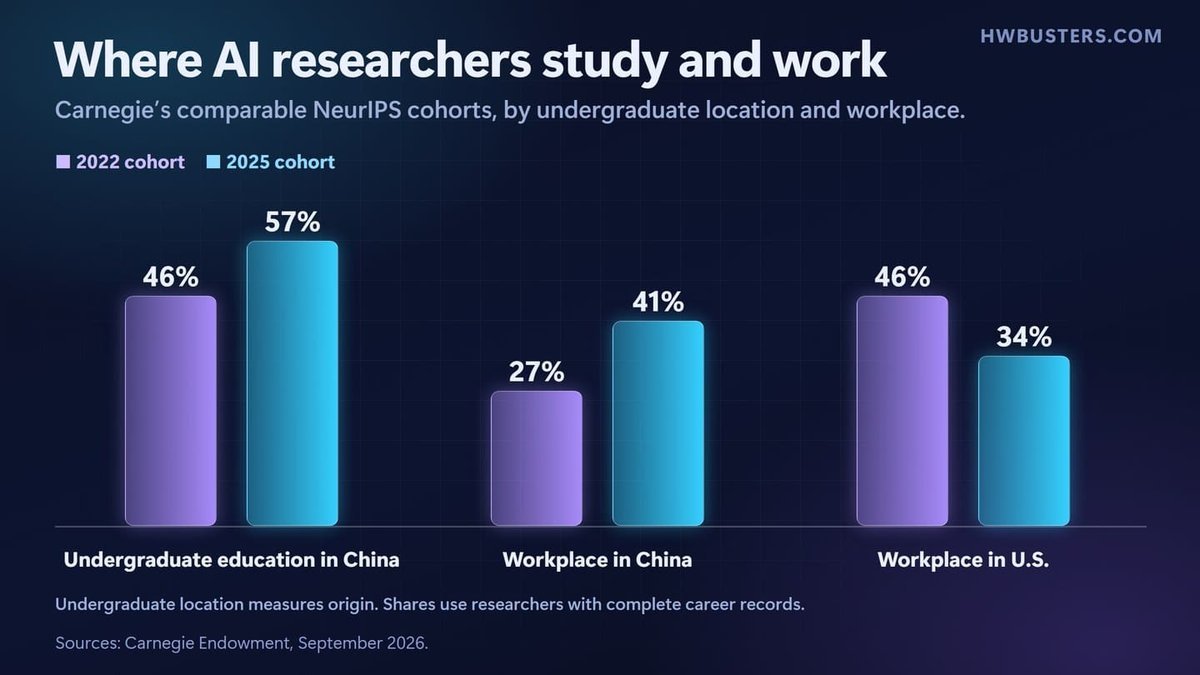
Carnegie’s NeurIPS sample shows 57% of the 2025 cohort with full career records earned their undergraduate degrees in China, against 46% in 2022. But building a model and diagnosing a failed wafer lot are different skills.
Where the process stands
Teardowns by TechInsights placed SMIC’s N+2 process inside Huawei’s Mate 60 Pro in September 2023. The Kirin 9030 followed in December 2025 with N+3, which the firm called a shrink of N+2 that still trailed TSMC and Samsung’s commercial 5 nm on the measures it checked. SemiAnalysis then put N+3 at a 32.5 nm local metal pitch and about 113.4 million transistors per square millimeter in June 2026, ahead of TSMC N6 at 107.7 million. That is one density comparison. Calling the processes equivalent would also need matching power, performance and yield.
Output is the weak spot. SMIC shipped 3.034 million 8-inch-equivalent wafers in Q3 2026 across all processes, but real wafer starts for N+2 and N+3, and accelerator shipments per model, can’t be checked in public data. The numbers on yield are old or secondhand: a 2024 report put SMIC’s yield below one-third of TSMC’s, and one 2025 estimate for its Ascend 910B dies was roughly 20%. In memory, CXMT reportedly sampled HBM3E with usable yield of 20 to 30%, against roughly 70% at SK hynix, according to sources cited by Reuters.
What’s holding it back
Several things slow China chip manufacturing at once.
Export rules hit at several points. An ASML EUV licence for a Chinese customer expired unused in 2019. The Netherlands brought more immersion DUV tools under licensing in 2023 and 2024, and extended controls to certain metrology and inspection equipment in April 2025. Japan added 23 equipment categories in July 2023. The US has tightened limits on advanced computing, tools and HBM since October 2022, and a November 2026 rule restricts remote compute for covered customers.
Even installed tools are at risk. Replacement parts, software updates and related technology may need approval too, which can make it harder to keep a production line running.
The customer side is messy too. Nvidia took a $4.5 billion charge when H20 exports needed licences in April 2025. In November it booked $2.4 billion of licensed Hopper sales into Chinese data centers for the quarter and said the shipments had since stopped, and its outlook assumes zero China data-center compute revenue.
Domestic suppliers are small. CSET put Chinese vendors’ share of 2025 global equipment sales at 12.6% for chemical mechanical planarization, 10.2% for etch and clean and 9.8% for deposition. In lithography it was about 0.2%.
People are the other constraint. An industry association counted over 300,000 unfilled positions across the chip supply chain in 2025 and 2026, with experienced process and device engineers especially scarce. That knowledge comes from running a line. ASML’s first customer EUV prototype shipped in 2010, and TSMC began commercial EUV production in 2019.
How long could the gap last?
Comparing two pairs of milestones gives roughly five years. TSMC began volume production on N7 in April 2018, and SMIC’s N+2 appeared in a phone in September 2023. That is an inference, not a forecast of parity, and TSMC keeps moving: N2 started in Q4 2025 and A14 is targeted for 2028.
China is building its own tools. SMEE showed KrF and i-line scanners at a November expo, and a 28 nm-class immersion tool was said to be with customers for validation. In December 2025, Reuters reported that a prototype in Shenzhen had produced EUV light but no working chip, with 2028 as the government’s target and 2030 seen as more realistic. UBS sees two to five years before domestic immersion DUV reaches high volume, and doubts domestic EUV arrives within ten. Epoch AI expects Huawei’s accelerators to stay three to four years behind Nvidia’s through at least 2030.
Who has the upper hand
By the 27 November market-cap snapshot, Nvidia was worth $3.63 trillion, TSMC $1.83 trillion and ASML $510.99 billion. Nvidia’s lock comes from CUDA, TSMC’s from a leading-edge process paired with usable packaging, and ASML’s from being the only commercial source of production EUV scanners. ASML booked sales of 44 EUV systems in 2024 and 48 in 2025, and it guided to about 65 low-NA units for 2026.
What to watch next
Progress in China chip manufacturing will show up in physical evidence before any announcement.
The evidence to look for is tool deliveries, sustained throughput and yield. First working chips from the Shenzhen project look plausible between the late 2020s and about 2030. Domestic lithography at commercial scale looks like a mid to late 2030s story, with wide error bars. By then the leading foundries will have moved on.
Source: Hardware Busters