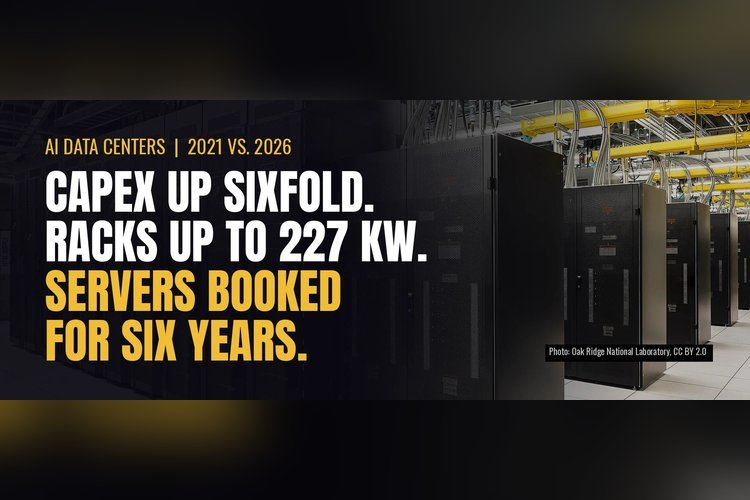
Big Tech capex has grown more than sixfold since 2021, and the accounting behind it has moved in the opposite direction from the hardware. In 2021 the five biggest data center builders put roughly $127 billion into buildings and machines. Their 2026 spending is heading toward about $785 billion.
Over the same stretch, each of them told shareholders its servers would last longer than before. Four settled on six years. Meanwhile, Nvidia’s newest rack pulls between 20 and 45 times the electricity of a typical rack from 2021.
Five years of spending
Capex is money spent on long-lived assets such as buildings, power equipment and servers. For 2021, annual filings showed Amazon at $61.1 billion, Alphabet at $24.6 billion, Microsoft at $20.6 billion for its fiscal year, Meta at $18.7 billion, and Oracle at $2.1 billion.
The 2026 guidance looks very different. Amazon expects about $220 billion and Alphabet $195 billion to $205 billion. Microsoft pointed to about $170 billion for the calendar year. Meta tightened its forecast to a band of $135 billion to $145 billion. Oracle spent $55.7 billion in the year ended May 31, 2026, 26 times its 2021 figure.
For three of the five, spending now outruns the cash their businesses produce. Amazon’s free cash flow after capex was minus $42 billion for the year to September. Alphabet and Meta each reported negative free cash flow for the third quarter of 2026.
What a megawatt costs now
Data centers are priced by the megawatt of computing load they can power and cool. Turner & Townsend put a Silicon Valley build at about $10.3 million per megawatt in 2021 and $13.3 million in its 2025 index, up 29%. That covers the shell, not the computers.
In September 2026, Cushman & Wakefield put a modern greenfield site in the U.S. and Canada at $17.6 million per megawatt before chips, a 21% rise on its late-2024 estimate. Power infrastructure is the biggest piece, near a fifth. Land with power already in place fetched $584,000 a megawatt on average in leading U.S. markets this year, 51% more than a year before.
Adding the machines changes the scale. Nvidia CEO Jensen Huang said in August 2025 that a one-gigawatt AI factory costs $50 billion to $60 billion, about $35 billion of it Nvidia gear. That is roughly $35 million per megawatt in equipment that will be replaced long before the building is.
Racks outgrew the rooms
A 2021 Uptime Institute survey found more than a third of operators ran racks mostly under 5 kilowatts, and nearly half sat between 5 and 10. Nvidia’s DGX A100 peaked at 6.5 kilowatts and the H100 version at 10.2, both cooled by room air.
Nvidia’s own guide puts a GB200 NVL72 rack near 120 kilowatts, cooled by liquid. The newer Vera Rubin NVL72 datasheet allows up to 227. Air can’t remove that heat, so direct-to-chip liquid cooling is now required.
Nvidia is already selling a way out. An August 11, 2026 post pitched an 800-volt DC power rack that fits existing AC buildings, with row-level gear handling up to 2 megawatts per row from 2027. Turner & Townsend found liquid-cooled AI buildings cost 7% to 10% more than air-cooled ones, and 83% of surveyed firms said local supply chains aren’t ready for advanced cooling.
Longer lives on paper
Depreciation spreads a machine’s cost over its expected life. A $6 billion server fleet costs $1 billion a year on a six-year schedule and $1.5 billion on a four-year one. Stretching the life lifts profit without a single extra sale.
- Microsoft moved servers from four years to six in July 2022, a $3.7 billion boost to fiscal 2023 operating income.
- Alphabet did the same in January 2023, cutting 2023 depreciation by $3.9 billion.
- Amazon went from five years to six in January 2024, saving $3.2 billion.
- Oracle moved from five to six in fiscal 2025, trimming expenses by $733 million.
- Meta lifted most servers to 5.5 years in January 2025, reducing depreciation by $2.9 billion.
Together, the first-year gains total roughly $14.5 billion in profit that came from a calendar change instead of customers.
Amazon later reversed course for a subset of servers, returning to five years from January 1, 2025 and citing faster technology development in AI. Amazon expected that to reduce 2025 operating income by about $0.7 billion, on top of roughly $920 million of accelerated depreciation in late 2024.
Rents follow the newest chip
GPUs don’t wear out like bearings; they lose value when a faster chip cuts rental prices. Amazon Web Services cut H100 on-demand prices 44% in June 2025. A daily H100 index fell below $2 per GPU-hour in February 2025, then climbed past $3 by November 26, 2026. Even the 2020 A100 still rented near $1.50 an hour in the third quarter.
Debt that comes due first
CoreWeave still depreciates technology equipment over six years. Its first delayed draw loan, up to $2.3 billion at a 15% effective rate, is due in March 2028. A second, up to $7.6 billion, requires each draw to be repaid within five years. Its debt principal more than doubled, from $21.6 billion at the close of 2025 to $47.5 billion on September 30, 2026, and $11.0 billion falls due in 2027. Contracts on over 130,000 GPUs end in 2027, with another 170,000 or so in 2028.
Meta’s Hyperion campus in Louisiana is held in a venture, 80% owned by Blue Owl funds, with about $27 billion in development costs. Meta leases it on a four-year initial term and gave a residual value guarantee covering the first 16 years.
What to watch in 2027
The gap between lenders who want repayment in five years and books that assume six is the thing to track. If rental prices fall when the next Nvidia generation ships, companies may have to shorten useful lives again.
Source: X (formerly Twitter)