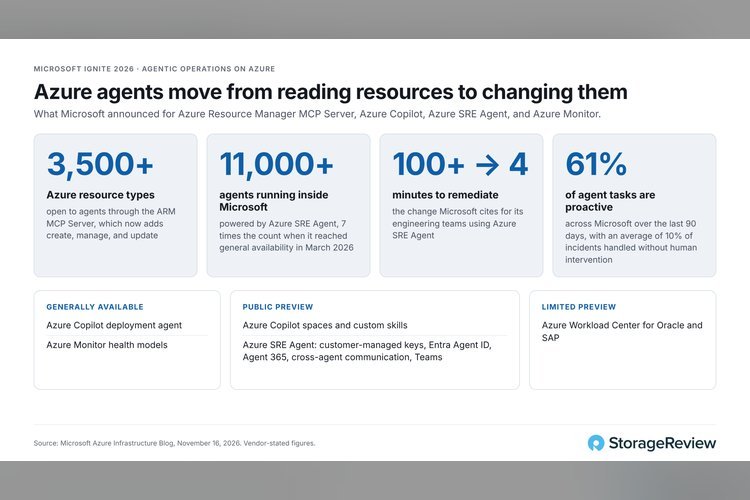
At Ignite 2026, Microsoft let Azure’s AI agents do more than look at infrastructure: they can now alter it. Under the new Azure agentic operations push, the Azure Resource Manager (ARM) MCP Server lets agents create, manage and update resources, and Azure Policy evaluates every request. Microsoft says fixes that used to eat over 100 minutes now take four.
Until now the server only let agents read some 3,500-plus resource types. Write access is the part that matters.
Why Microsoft is moving agents into operations
Enterprise AI spending has mostly gone to email, meeting notes and coding help. Staff who keep servers, storage and data centers alive still dig through scattered logs in the middle of the night.
Microsoft names three pressures behind the change: fragmented tooling, agents that behave less predictably than classic automation, and expertise locked inside separate teams. Alongside the ARM change, Microsoft updated Azure Monitor, Azure Copilot and Azure SRE Agent.
Context is the hard part
Handing an agent a command line doesn’t make it a good administrator. Outages usually come from odd interactions between dependencies, configuration and recent changes, so a failing-service alert rarely points at the cause.
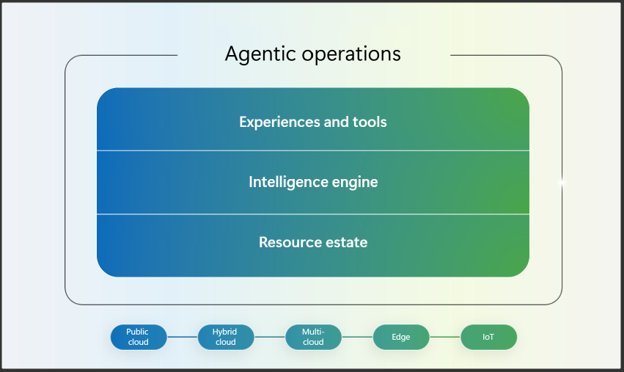
ARM and Azure Resource Graph already hold a customer’s resources, how they connect, and how they’ve changed over time. Microsoft is building an intelligence engine on that data, so both people and agents get usable operational context. Brendan Burns, a corporate vice president and technical fellow at Microsoft, wrote that this frees people to focus on their goals.
If an agent already understands how the network, compute and storage fit together, the prompt can be short. The administrator states the outcome, and the agent works out the steps.
What changes in the ARM MCP Server
Any agent that supports the Model Context Protocol (MCP) can make changes via the same control plane that administrators rely on. Azure Policy rules, such as blocking noncompliant deployments, demanding tags, or limiting regions and SKUs, treat an agent’s request the same way they treat a portal edit.
New and updated Azure tools
- Azure SRE Agent investigates incidents, finds root causes and automates operational tasks. In public preview it gains Entra Agent ID, customer-managed keys, Agent 365 integration, agent-to-agent communication, and a Teams connection for multicloud investigations.
- The Azure Copilot deployment agent, which converts plain-language requirements into infrastructure and deployment code, has reached general availability.
- Azure Monitor health models have also left preview. They build a live picture of application health that ties architecture and dependencies to business impact.
- Copilot spaces and custom skills, in public preview, let teams store lasting notes about their environments.
- Azure Workload Center, a limited preview, applies the idea to Oracle and SAP workloads, checking their health and configuration.
Microsoft says the first three SRE Agent additions give organizations tighter governance over an agent’s whole lifecycle. Azure’s agents come with built-in skills for various operations areas, and customers can write their own to capture local architectures and procedures.
The numbers Microsoft is citing
Azure SRE Agent now powers over 11,000 agents inside Microsoft, seven times as many as when it reached general availability in March 2026. Across the last 90 days, proactive work made up 61 percent of what those agents did. On average, 10 percent of incidents were resolved start to finish with no human involved.
Ecolab, the customer Microsoft named, says it finds root causes 60 percent faster and saves three to four hours per incident. All of these come from Microsoft and its customer and haven’t been independently checked.
Where Azure agentic operations still has gaps
Microsoft’s model runs through the Azure control plane. Systems outside Azure normally connect through Azure Arc, an extra step for mixed on-premises and edge setups. Others are heading the same way. Cisco now exposes Cisco IQ telemetry and automation via an MCP server, but agentic IT is still early for most of the market.
The catch: a write-capable agent is only as safe as the policies around it. A tag rule won’t stop a badly chosen but compliant change.
What IT teams should decide before turning agents loose
For IT staff, the work moves away from remembering syntax and chasing logs and toward setting guardrails, stating objectives and verifying results. Several Ignite additions are still previews, so the first job is choosing the policies, approvals and identities an agent will run under before it can change anything.
Teams that already run strict Azure Policy have a head start. Teams that don’t should tighten it first, then let Azure agentic operations touch production resources a small piece at a time.
Source: StorageReview.com