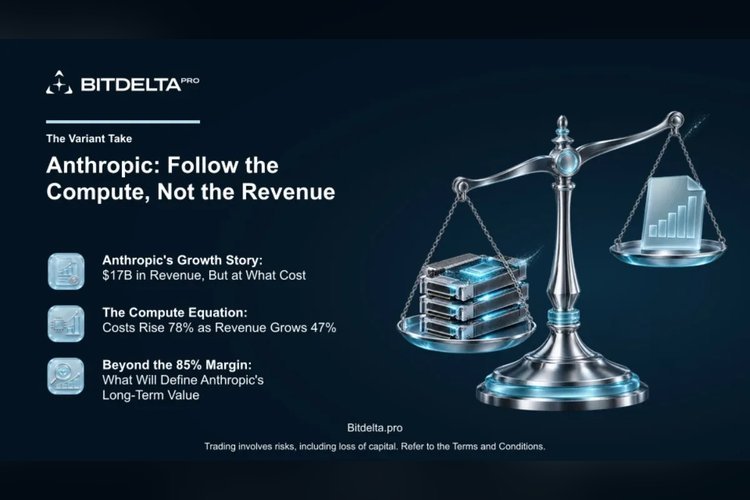
Anthropic’s record Nasdaq debut has put its revenue growth in the spotlight. One analysis argues the Anthropic IPO filing points somewhere else: to what each dollar spent on computing brings in, which got worse in the third quarter. It is an analyst’s argument about how to read the numbers, not a call to buy or sell.
Where the stock stands
Shares began trading last Thursday after the biggest public offering ever recorded. The company sold at $83, ended day one at $97.17, and has since eased to $87.64, which values it near $1.16 trillion. On Monday the Nasdaq had its strongest session since April 2025, and Anthropic still dropped 1.4%.
Headlines have mostly quoted sales. Third-quarter revenue was $17.0 billion, roughly twelvefold on a year earlier, and the nine-month total reached $33.2 billion. Those figures are not contested.
The margin that isn’t the whole story
The filing puts cost of revenue at 14.5% of sales for nine months, which is where the often-cited 85% gross margin comes from. But the company spent $18.8 billion on computing and infrastructure in that period, 57% of revenue, and the bulk of it is recorded under research and development.
The filing doesn’t split that spending between serving paying customers and training new models. An outside estimate from Mostly Metrics puts a margin that counts more of the computing in the low 60s.
Costs grew faster than sales
From the second quarter to the third, sales climbed 47%. Computing costs climbed about 78%. The analysis worked out the second-quarter figure from the 48% share of revenue that computing represented then.
The commitments ahead are large. Anthropic has agreed to roughly $900 billion of computing and infrastructure spending, and about $71 billion falls due within twelve months, close to its third-quarter revenue multiplied by four. Spending locked in at that scale behaves like a fixed cost. It rewards continued growth and hurts quickly if growth stalls.
Suppliers who are also shareholders
Amazon and Google own shares, supply computing, resell the models through their clouds and build competing models. Sales through their marketplaces made up 44% of nine-month revenue, and cloud providers accounted for 52% of receivables at the end of September. Seven chip and cloud suppliers bought $26 billion of stock in the offering.
With suppliers also acting as investors, the analysis says, sales growth alone can’t show how much of it stands on its own. Pricing adds another risk: 79% of revenue is charged by usage, and as downloadable open-weight models improve, buyers can compare providers on price per unit.
For investors the practical question is what the business earns once computing is counted in full. A software company with an 85% margin and one with a margin in the low 60s would normally be valued very differently, and the filing leaves room for either reading. That gap is the reason the analysis treats efficiency of spending as the figure to follow.
What Anthropic says in response
The analysis admits the other side is persuasive. Anthropic attributes much of the third-quarter jump to $5.0 billion of short-term capacity purchased at a premium during a demand surge, and expects cheaper long-term capacity, including data centers it will own, to lower costs.
It buys from many vendors, among them Google’s TPUs, Amazon’s Trainium, Broadcom, AMD and Nvidia, which strengthens its hand in price talks. Existing business customers spend about nine times what they did a year ago, and nine months of operations produced $6.6 billion in cash. Training outlays can also be trimmed if growth cools, which would lift margins fast.
The test arrives with the first quarterly report
The analysis lists three developments that would change its view: compute spending dropping under 50% of revenue, a disclosure showing a strong margin on serving customers once training is stripped out, or a smaller share of revenue passing through cloud marketplaces.
All three should become visible when the newly listed company files its first quarterly results, which are due early next year. They will indicate whether the third-quarter squeeze was a one-off or the start of a pattern.
Source: LiquidityFinder