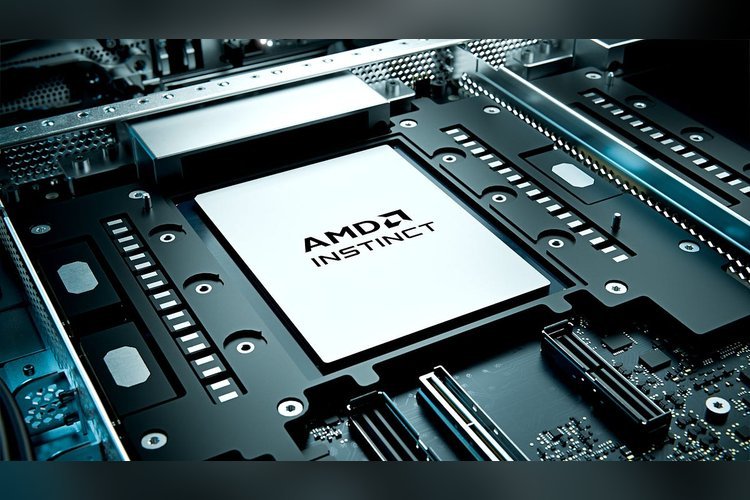
The AMD Instinct MI455X is AMD’s next flagship datacenter GPU, and it carries 432 GB of HBM4 memory. That is 50% more capacity than the previous generation and nearly three times the memory bandwidth. AMD is pairing it with a full rack design called Helios, aimed squarely at NVIDIA’s DGX systems.
The chip heads the MI400X series. AMD first sketched that series in 2025, when it launched the MI355X and said the MI400 family would follow a year later. The company confirmed the MI455X at its Advancing AI event in July and went through the details again at Hot Chips in August.
What’s inside the MI455X
Memory is the headline. The jump to 432 GB of HBM4 lets each GPU hold larger models and bigger working sets without spilling to other devices. Higher bandwidth matters just as much, since AI workloads often wait on memory rather than on compute.
AMD says it reworked how data moves in and around the GPU to make use of that bandwidth. Adding faster memory without changing the internal plumbing would leave much of the gain on the table.
The manufacturing mix is also notable:
- The accelerator complex die (XCD) uses TSMC’s N2 process node.
- The I/O die and the Fabric and Cache Die (FCD) use TSMC’s N3P node.
That makes the AMD Instinct MI455X one of the first datacenter GPUs to put its compute silicon on a 2nm-class process.
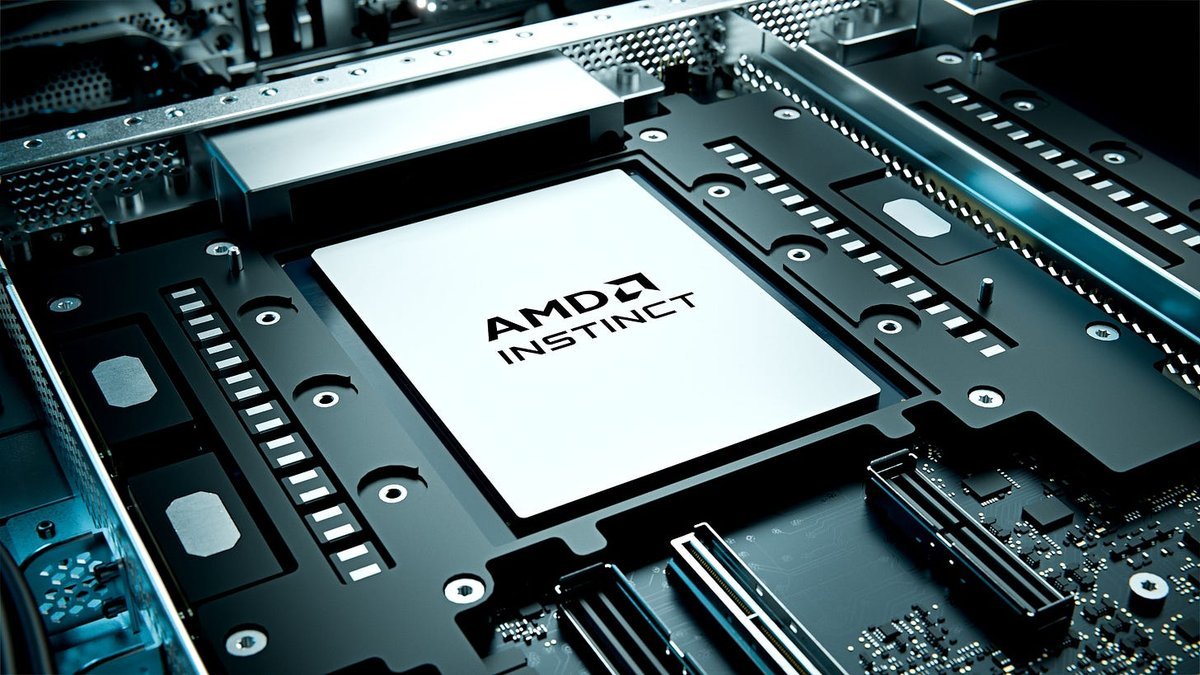
Helios turns the GPU into a rack
AMD calls the MI455X its first GPU designed for rack-scale AI deployments. The Helios reference design is the proof of that claim. It combines the MI455X with AMD’s EPYC Venice CPUs, Pensando networking and the ROCm software platform, and AMD sells it as a ready-to-deploy system.
That puts Helios in direct competition with NVIDIA’s DGX line. Buyers who want a working cluster, not a pile of parts, have so far had one obvious place to look. AMD wants to be a second.
The CPU matters more than it might seem. GPUs get the attention, but CPUs manage and orchestrate the workloads and the data feeding them. Networking ties it together at three levels: chip to chip, blade to blade and rack to rack. A weak link at any level slows the whole system.
How AMD got here
The previous generation set the pattern. In June 2025 AMD announced the air-cooled Instinct MI350X and the liquid-cooled MI355X. Both use the CDNA 4 microarchitecture, TSMC’s N3 node and HBM3E memory.
Those chips ran AI workloads noticeably better than the older MI300X even though they had 16% fewer compute units and 16% fewer matrix cores. Architecture and process gains made up the difference. The MI455X follows the same logic: bigger memory, a newer node and a redesigned data path.
The power problem
Energy is the hardest constraint in datacenter AI right now. Each new GPU generation draws more power per device, while the labs training frontier models keep asking for bigger and faster clusters. Memory design sits at the center of that tension, because HBM4 raises both density and bandwidth within a fixed power budget.
AMD has not changed the basic bargain here. More performance per chip still means more watts per rack, and customers will judge Helios on how much work it delivers for each unit of power as much as on peak speed.
What comes after the MI455X
The MI455X is the first piece of a longer rollout. Likely in 2027, AMD is expected to widen the MI400X series with two more parts: a smaller version for enterprises and a version tuned for HPC workloads that depend on FP64 data types.
The enterprise model would give AMD a way into companies that cannot justify a full rack-scale purchase. The FP64 version matters to scientific computing, where double-precision math still rules and AI-first designs have often traded it away.
For now, the test is delivery. AMD has hit its roadmap so far, with the MI400 series arriving the year after it was promised. Buyers will watch whether Helios racks ship in volume, how the ROCm software stack holds up against NVIDIA’s, and whether the AMD Instinct MI455X delivers the efficiency its memory numbers imply.
Source: microprocessorreport.com