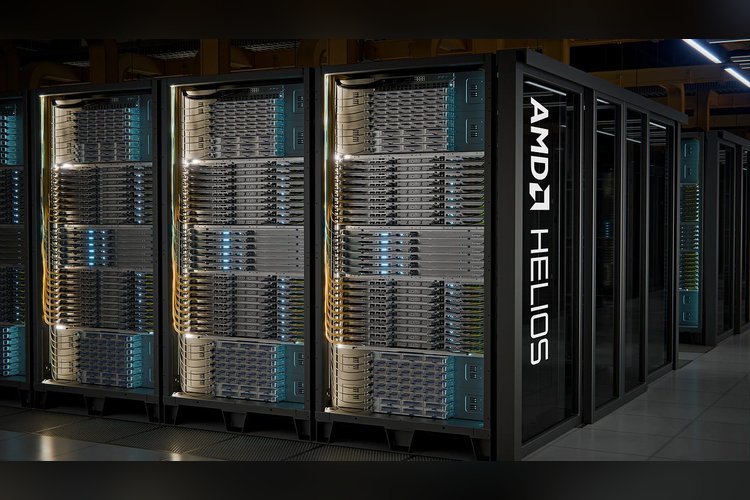
AMD Helios is the company’s attempt to sell AI compute the way NVIDIA does: as a finished rack instead of a pile of parts. The appliance combines AMD’s CPUs, GPUs and Ethernet hardware with the ROCm software framework into a turn-key system holding 72 GPUs.
It’s a considerably more integrated product than AMD has offered before, and analysts now put it alongside NVIDIA’s rack-scale machines.
Inside the rack
Helios uses the Open Compute Project’s Open Rack Wide form factor. The cabinet is 1.2 m wide and 1.3 m deep and offers 44 OU of space. An OU is 48 mm tall, a bit more than the 44.45 mm of a traditional 19-inch rack unit.
Power reaches each tray through the back over a 50 V DC bus. Liquid cooling connects through blind-mate quick-disconnect plugs, so trays slide in and out without hand-fitted plumbing.
The layout is two groups of nine compute trays with six switch trays between them. Management and power sit at the top and power at the bottom. Each tray is 1 OU.
What a compute tray holds
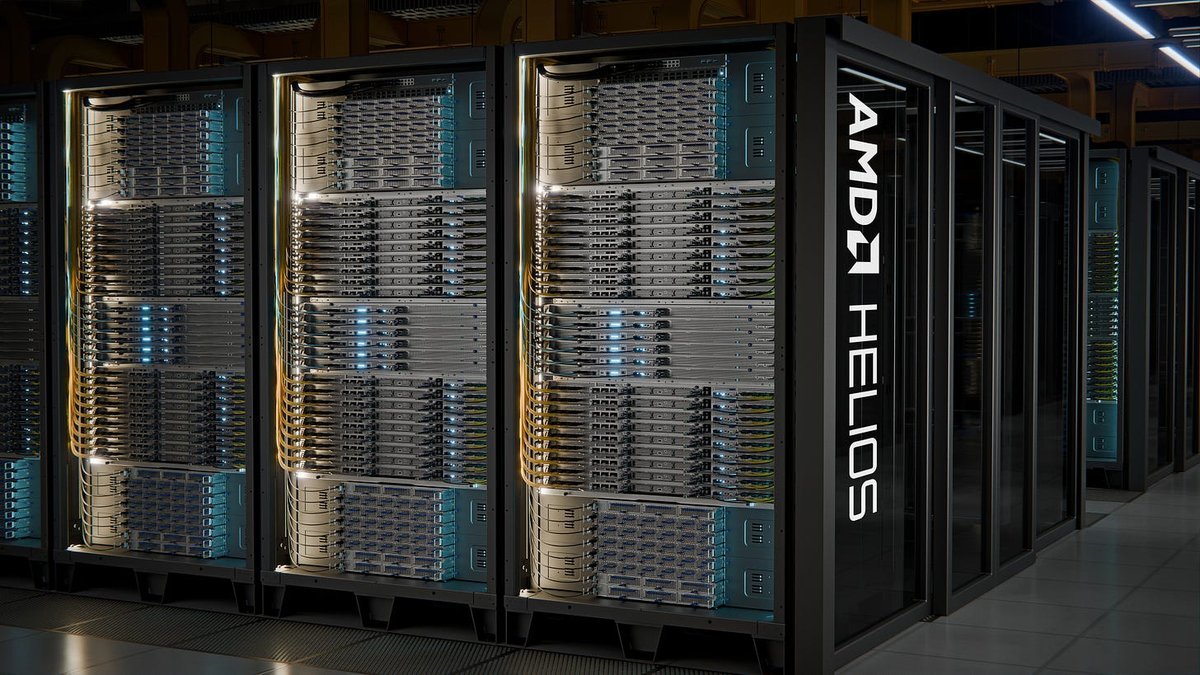
- Four AMD Instinct MI455X GPUs and one AMD EPYC 9006-series SP7 CPU, a 96-core EPYC 9G76 in the standard configuration.
- 16 DIMM sockets, each filled with a 64 GB DDR5 ECC RDIMM, and five E1.S SSD slots wired to the CPU.
- Two networking boards, each with four or six AMD Pensando “Vulcano” NICs for the back-end scale-out network.
- A PCIe slot for a Pensando “Salina” DPU on the front-end network, plus a separate management module with an Ethernet interface.
Across the rack that adds up to 72 GPUs. Each switch tray holds two Ethernet switches, and each of the 12 switches connects directly to all 72 GPUs over copper cable cartridges at the back.
The power question
AMD hasn’t disclosed the MI455X’s thermal design power. If it matches or exceeds the previous generation, 72 GPUs would draw more than 100,000 watts in one rack.
NVIDIA doesn’t meaningfully disclose next-generation GPU power figures either. That makes comparing the two on power a guess, particularly without software benchmarks from anyone other than the vendors.
How it stacks up against NVIDIA
NVIDIA keeps its reputation as the market leader, but it charges a significant premium for it. Its CUDA software isn’t necessarily the moat it once was. Porting from CUDA to ROCm is substantially easier than a year ago, helped in part by AI-assisted porting tools.
Helios also keeps the familiar x86-64 architecture, while NVIDIA is pushing its Arm-based Vera CPU. AI workloads aren’t especially dependent on the instruction set, but familiarity can still ease adoption. ROCm continues to get significant development and investment.
Who might buy it
The big hyperscalers are a hard sell. They mostly rely on NVIDIA GPUs and are investing in semi-custom AI chips such as AWS Trainium and Google’s TPU. Those chips are captive silicon, used inside each company’s own cloud.
Google Cloud and Amazon Web Services offer no AMD Instinct instances today. Microsoft Azure does, even though Microsoft is developing its Maia AI chips. OpenAI and Anthropic are pursuing task-optimized silicon with Broadcom, which the analysis describes as being as much financial engineering as semiconductor engineering. Custom silicon could also turn stifling if models, architectures and leading-edge fab capacity change.
The clearer route to market is smaller cloud providers such as Oracle and neoclouds such as CoreWeave, which benefit from ready-to-serve integration. Most enterprises that adopt AI do it through cloud-delivered software or infrastructure services, given the power and space needed to host leading-edge hardware themselves.
What to watch next
AMD’s pitch rests on integration and price, not on beating NVIDIA outright. Helios gives buyers a single supplier for the CPU, GPU, networking and software layers, which is the same appeal NVIDIA’s racks have.
Three things will decide how far Helios gets: whether AMD publishes the MI455X power figures, whether independent benchmarks appear, and whether any large cloud provider beyond Azure signs up. Oracle, CoreWeave and AMD’s OEM partners look like the first customers to watch.
Source: microprocessorreport.com